

I have noticed something about infrastructure projects over the years.
The most important part of them is usually the least visible.
People pay attention to the technology. The architecture diagrams. The performance metrics. Those things are easy to understand and easy to talk about.
What they miss is the economic layer underneath.
Infrastructure only survives if the incentives around it make sense.
That is the thought I keep returning to when I look at Fabric Protocol.
Most discussions about Fabric focus on the idea of robots having identities, task histories, and coordination mechanisms anchored to a shared network. The technical side of that idea is interesting, but it is not the hardest problem.
The harder problem is economic.
Robotics today operates inside very clear incentive structures. Companies buy machines because they reduce labor costs or improve productivity. The data generated by those machines stays inside the company because it creates competitive advantage.
Introducing a shared coordination layer changes that structure.
If machines operate in an environment where their identities and actions are recorded through a protocol rather than through private systems, the participants in that environment need reasons to support that structure.
Someone has to maintain the system.
Someone has to validate records.
Someone has to participate in decisions about how the network evolves.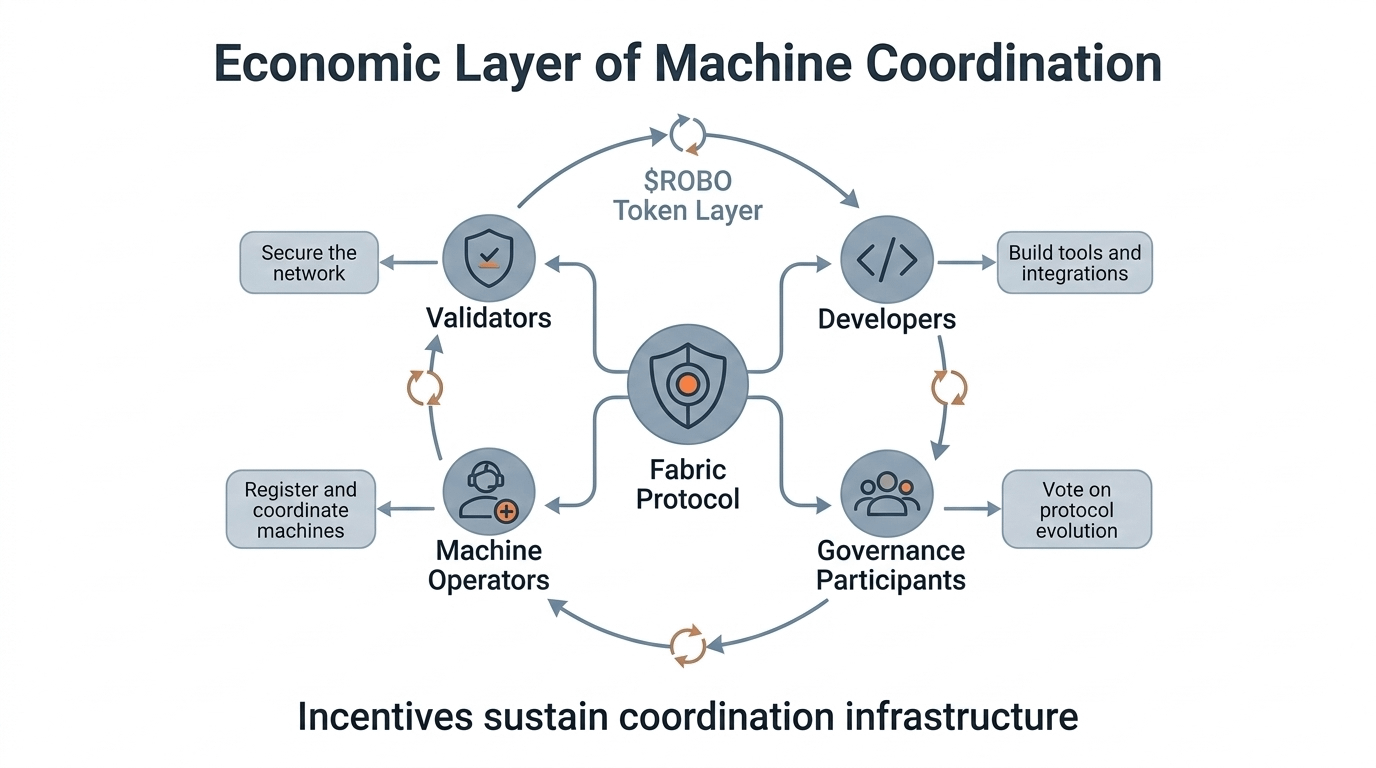
Fabric’s answer to this problem is the $ROBO token.
The token is not just an asset connected to the protocol. It is the mechanism through which participants interact with the coordination layer. Validators secure the network. Contributors build tools and infrastructure. Governance decisions shape how the system evolves over time.
In theory this creates a shared economic structure around machine coordination.
But theory and adoption are different things.
The robotics industry already has functioning systems for managing machines and their data. Companies deploy robots, collect operational information, and use internal tools to manage those systems. Those tools may not be decentralized, but they are familiar and integrated into existing workflows.
For Fabric’s model to become meaningful, the shared coordination layer must provide value that those existing systems cannot easily replicate.
That value could appear in several ways.
A shared system could make it easier for multiple organizations to cooperate around the same machines. It could create standardized records that regulators and insurers trust. It could reduce disputes by providing verifiable histories of machine activity.
All of those outcomes are plausible.
What is uncertain is whether the benefits are large enough to motivate adoption.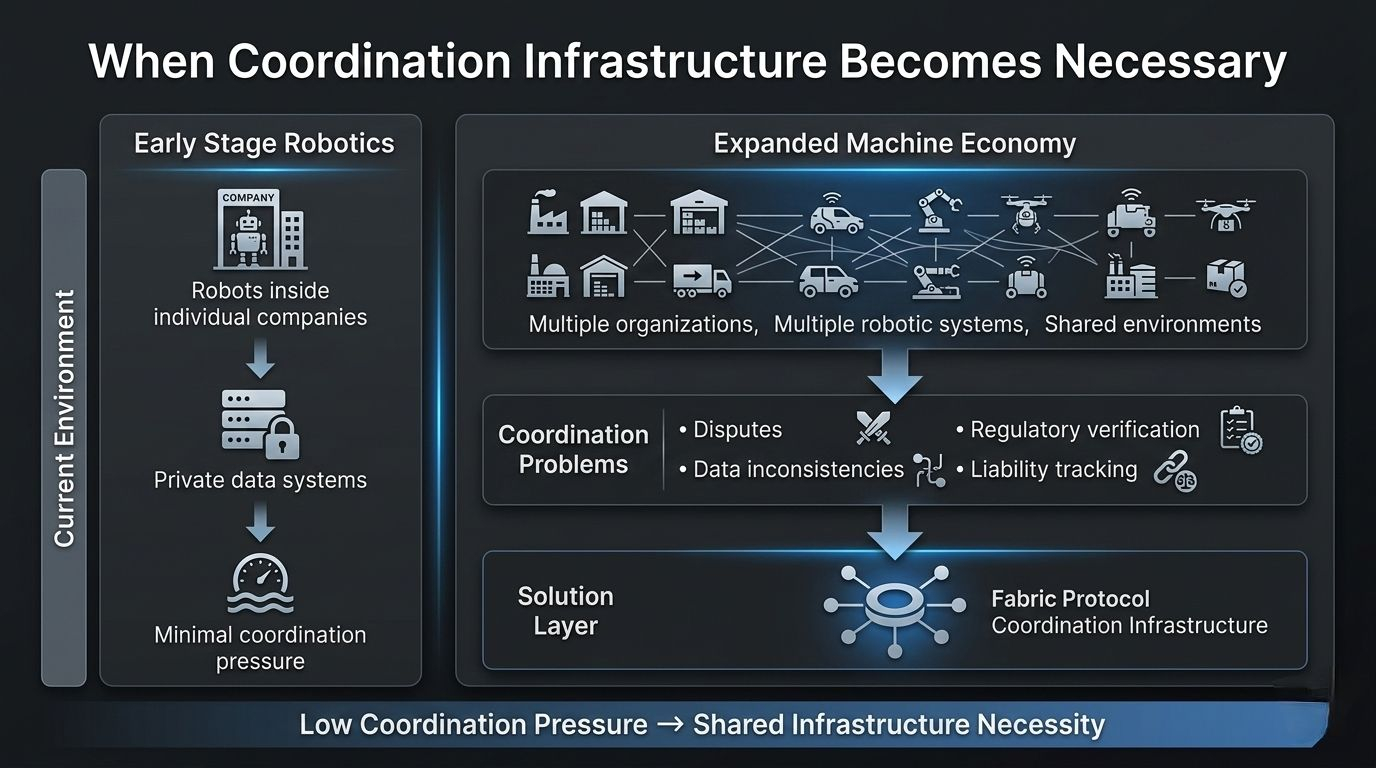
Infrastructure changes usually happen when the existing model becomes inefficient. When coordination across organizations becomes complicated, expensive, or unreliable, the incentive to adopt shared systems grows stronger.
That moment may eventually arrive for robotics.
Automation is expanding across industries, and machines are beginning to operate in environments where multiple stakeholders interact. As those networks grow, coordination problems become harder to ignore.
Fabric Protocol is positioning itself as a solution to that future problem.
The challenge is that infrastructure projects often exist for a long time before the world decides it needs them.
Some succeed because they arrive early and remain patient while the environment evolves around them. Others struggle because the ecosystem never reaches the point where their solution becomes necessary.
For Fabric, the question is not whether the idea of machine coordination infrastructure is logical.
It is.
The question is whether enough participants in the robotics ecosystem will eventually see the same coordination challenges that the protocol is designed to solve.
If they do, Fabric could become part of the infrastructure that supports the machine economy people often talk about.
If they do not, the protocol may remain an interesting experiment built ahead of its time.
Infrastructure projects always live with that uncertainty.
They build for the world they believe is coming.
The rest of us eventually decide whether that world arrives.