

Fabric Foundation $Robo -Creating a Future in which People and Machines Coexist.
@Fabric Foundation $ROBO #ROBO
Something comes to mind each time I consider the future of crypto infrastructure because, as it is, it is not a headline, or the release of a whitepaper, but something more subtle. It is the difference between the claims made by most blockchain projects as to what they are creating and what can be used by ordinary people. It is somewhere on that divide that a trend has been taking shape: these are the projects that keep on surviving market cycles are not the loudest ones. They are the ones who are silently establishing foundations whilst other people are in pursuit of narrative. The hype did not bring Fabric Foundation and its native token $Robo into my field of view; rather, it was that very silent reasoning that did. There was some sort of something under the surface that was worth pulling apart.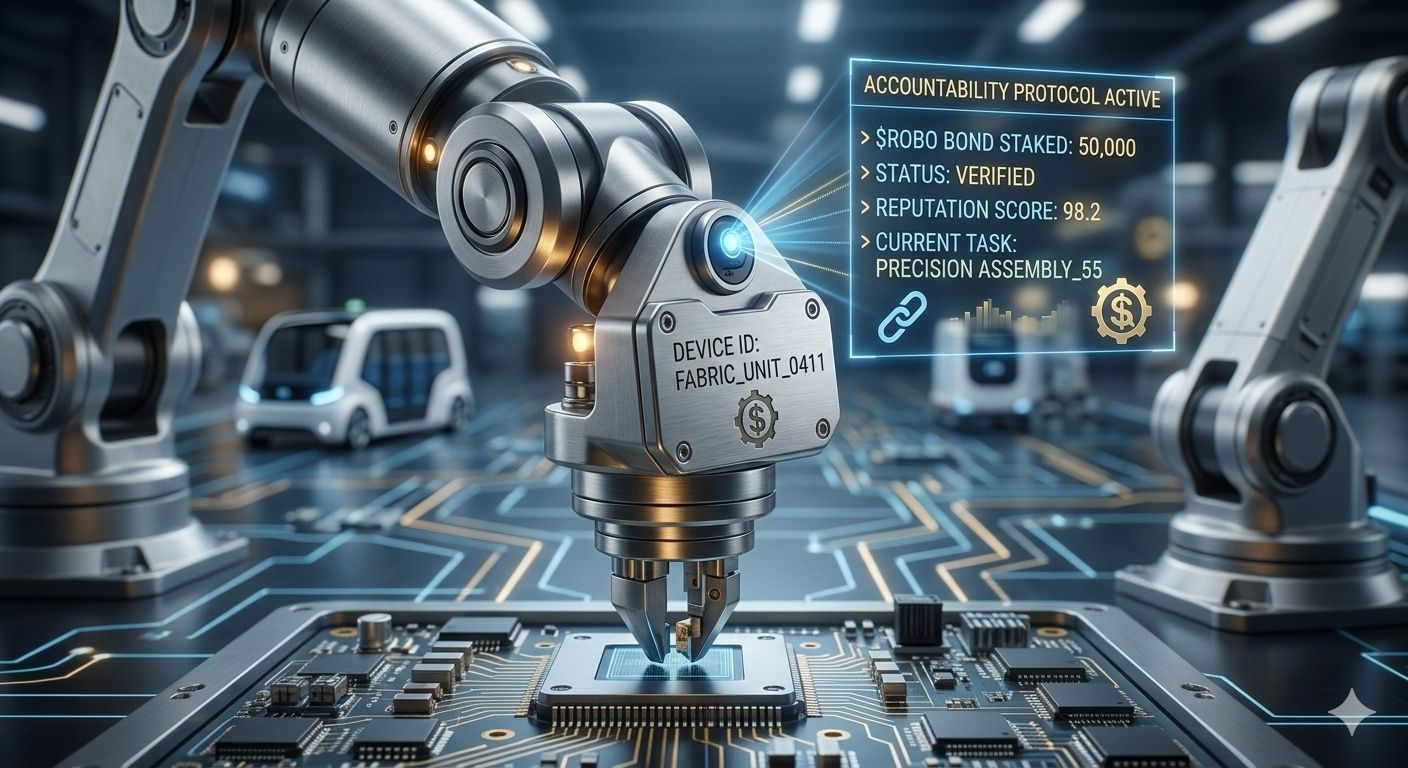
The Tension That really Counts.
The expression of humans and machines collaborating is used so casually that it has become somewhat of a truism lately. We listen to it as being paired with AI startups, logistics platforms, robotics companies, and currently blockchain protocols. However, the piece of information that I remained seated on was this: what does such collaboration need in the infrastructure level? But not at the product layer, not at the marketing layer, but in the bones. Since you can not create any meaningful human-machine cooperation on a basis that lacks trust on either side, is unable to check machine activities, and the interactions of the type that real automation requires are both high-frequency and low-latency, this will not happen.
It is at this point that Fabric Foundation begins to pull itself out of the greater noise. The project does not involve putting a token around a robotics concept and calling it RoboFi. It is targeting something structural: the lack of a common economic level between human decision-making and autonomous machine implementation. There are initial indications that this will be an authentic architectural gamble and not a rebranding.
Superficial To Shallow--What You See.
Most evidently, the native utility and governance token in the Fabric ecosystem is called $Robo. It is the tool by which participants (human operators or developers or one day an autonomous agent) make claims, assign resources, and engage in protocol decisions. That much is legible. However, as with most things here, the superficial explanation does not buttress the substantive idea.
What is being offered by Fabric Foundation is more of an economic substrate as opposed to a governance token. The distinction matters. A governance token provides the holders with the right to vote. A substrate is the object on which all the other objects are running. In the event that the Fabric vision comes to pass, $Robo exists in a world where machines have the ability to trade with each other and with human beings, not via centralized APIs, not via corporate brokerage, but via verifiable on-chain logic in which both parties do not have to trust blindly.
I see this as an equivalent of early internet infrastructure discussions where it was not really about websites, but the question of whether TCP/IP would be universal. The product was the web site, TCP/IP was the base. Fabric is arguing along these same lines, only in the case of a world where machines are economic actors.
The Mechanics Underneath
What is more interesting here is the thoughts that Fabric Foundation makes regarding machine identity and accountability. The fact that machines do not have reputational risk as human beings do is one of the incessant issues in any human-machine system. The cost of bad decision of an automated system is externalized. The architecture of fabric tries to bridge this divide by staking machine action to economic commitments, in other words, machines (or their operators) place values under the risk of being executed in the network.
It is a significant departure of the way the majority of automation systems operate today. With the classical enterprise software, responsibility runs up to the developer or firm. In the model of Fabric accountability is inherent in the transaction, and it can be verified at a protocol level. The scale of that will be determined, but the point is valid: in order to be trusted the participants of a shared economy, machines must have a stake in the game.
It is the $Robo token that gets that skin to be expressed. Staking, slash requirements and such reward distribution is not merely a feature of a tokenomics system but the language of machine responsibility in this system.
What This Enables-- And the Tradeoffs in the Reality.
Assuming that the foundation is worked, what Fabric opens up is truly intriguing: an impartial coordination layer of human-machinery economic action. Imagine logistics webs in which autonomous vehicles offer travel bids, or manufacturing overheads in which robotic hands negotiate extinction time slots, or creative processes in which AI applications submit compute preference bids founded on the urgency of the task. The scope isn't small.
Nonetheless, there are the tradeoffs to tell the truth about. The first risk is the complexity risk: the more advanced the accountability layer the higher the attack surface you provide. There is stress that normal DeFi protocols do not experience because of smart contract systems that deal with machine-level volume of transactions. Second, adoption friction - enterprises that are headed towards automation do not inherently support decentralized infrastructure. To get them to make investments on Fabric instead of proprietary systems, a value proposition that is not purely ideological is needed.
I will be direct about this, I have seen similar ambitious projects undervalue the inertia of an enterprise. The technology may be good and the go-to-market fades away. Fabric Foundation will have to balance such tension with more than a whitepaper.
The Larger Framework-- The Reason, Why This Moment.
A convergence of this nature is taking place that makes the timing of this type of project not as arbitrary as it may seem. The robotics sector is in the realm of actual ability. Multi-step tasks are starting to be done by AI agents. And blockchain infrastructure - following years of over-promising consumer applications - is insidiously finding a niche in B2B and machine-to-machine applications where verifiability is more important than glittering interfaces.The 2024-2025 rotation of the crypto market toward non-meme-driven speculation based on infrastructure include potentially: data availability layers, ZK coprocessor, intent-based architecture; $Robo and Fabric Foundation fall within that generalized one. It is not whether the category is real or not, it is very much so. Whether Fabric is deep enough in its execution that it can become the standard or it ends up as an interesting footnote in the story of the eventual winner.
My actual reading, and sitting down to it: the architectural thought is so serious as to be taken. The economy model possesses internal consistency. What I can never quite judge as an external factor is the ability of the team to stand the ground in the face of the development friction that is bound to occur with the construction at this level of abstraction.
Closing Observation
This is what I have been returning to: the future in which humans and machines truly work together is not going to be constructed out of one big breakthrough. It will be put together, silently, of a hundred decisions on the foundation level, decisions which most people never draw their attention to until they are already established inside the output of those decisions. Fabric Foundation and $Robo wager that one of such choices - how machines acquire economic accountability in a common world - have to be constructed with the ground-up, decentralized, and transparent.
It remains unclear whether that bet will be part of the future structure of machine-human economies. However, it is the type of question that one needs to pay close attention to, as the projects that respond to it the most correctly will not prove to be noisy. They will simply be the foundations upon which everybody will be developed.