I remember the first time I walked into a hackathon hall in Zurich back in spring 2021. The place buzzed with energy engineers, artists, cryptographers, all convinced that robotics didn’t have to stay locked up in proprietary silos. That idea really took shape in the Fabric Foundation’s whitepaper a year later, in September 2022. The thing had real weight behind it people from MIT’s CSAIL, Boston Dynamics, OpenAI, and a bunch of independent researchers. They pulled ideas from Bitcoin’s distributed ledger and Gennaro’s 2016 work on verifiable computing, laying the groundwork for something bigger: the Fabric Protocol. The goal? Connect general purpose robots to a system anyone could audit, wrapped in a shared economic and regulatory framework.
The whitepaper spells it out, and a 2023 feature in IEEE Robotics and Automation Magazine drives the point home. The Fabric Protocol is all about a permissionless ledger. It keeps track of where data comes from, verifies it, enforces rules basically, it lets humans interact with robots whose decisions you can actually check in real time. Updates run through decentralized governance, so open source creativity stays protected. There’s even a token system that rewards transparency and punishes bad actors. The whole design borrows from blockchain economics but tweaks it for the high-stakes world of autonomous machines. Technically, it’s a three-layer stack: a data layer using proof-of-stake Tendermint for lightning-fast, unchangeable records; a compute layer that generates zk-SNARKs to prove robots are following the rules; and a governance layer with token-based voting, inspired by Buterin’s DAO model, all tied together by an API that hides the cryptography so developers can focus on building.
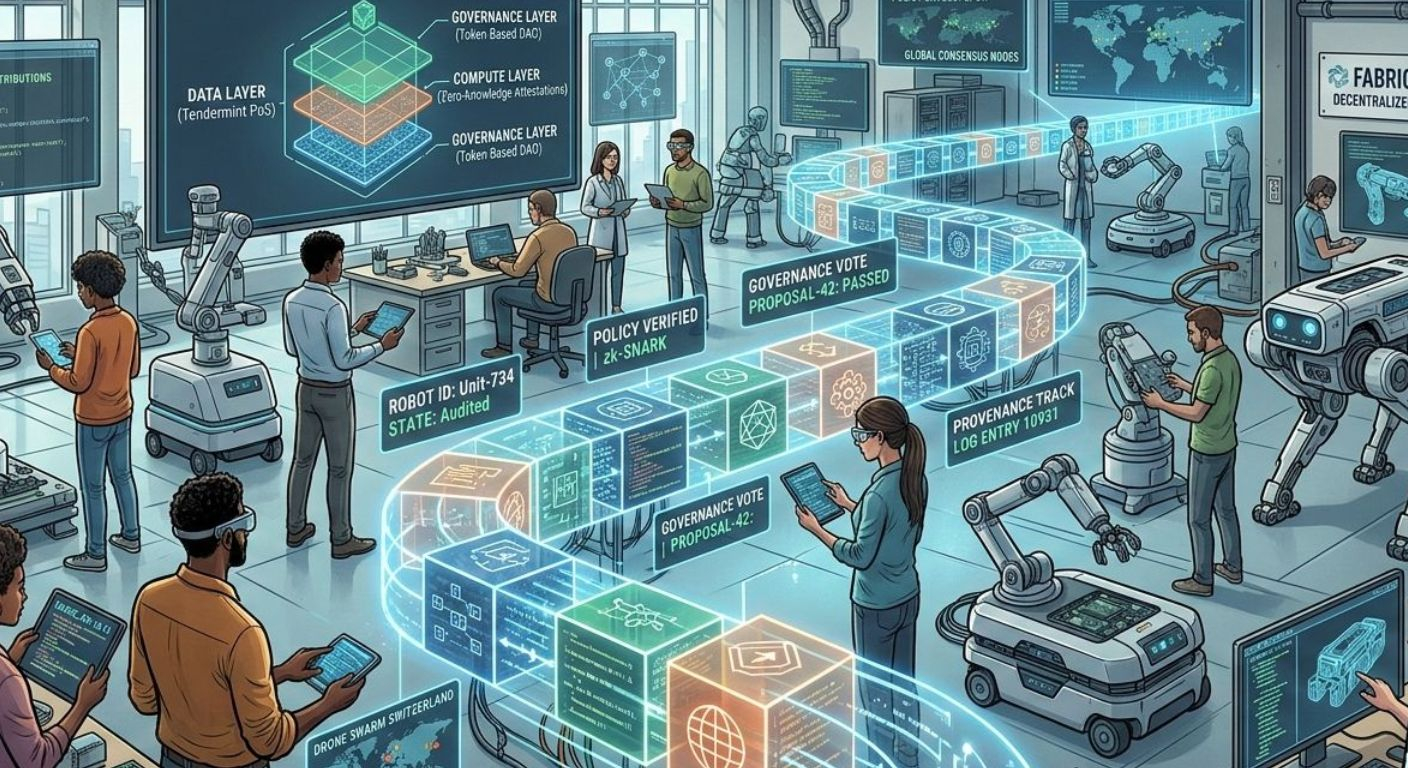
Looking ahead, the 2024 roadmap from the Fabric Foundation recently featured in Nature Communications aims to handle massive data from drone swarms, fold in new modules that keep reinforcement learning inside safe boundaries, and create regulatory bridges so national standards bodies can add their own compliance checks without sacrificing the ledger’s global integrity. But it’s not all smooth sailing. Researchers like Bryans and others have flagged some real concerns. As the system grows, it faces new threats: sneaky policy drift attacks, ballooning costs from ever more complicated zero-knowledge proofs, and the risk that token driven governance locks out developers from poorer regions unless we build in fair access from the start.
If the community can solve these technical, governance, and social problems, Fabric could spark a new era. Imagine robots as open, community-driven platforms they’d keep soaking up open-source upgrades, adapt to new challenges on the fly, and offer provenance-backed services to everyone. That’s the founders’ vision: turning robotics from a closed door monopoly into a public good. This idea echoes through the open-source movement and the digital commons crowd. And with a transparent ledger, anyone with a big idea can contribute code that’s instantly part of an unchangeable, auditable record. That openness encourages people from all backgrounds to work together on policies that actually make sense both technically and socially boosting what humans can do while keeping the guardrails strong enough to protect what matters.
@Fabric Foundation #ROBO $ROBO