

Not a crash.
Not a hardware fault.
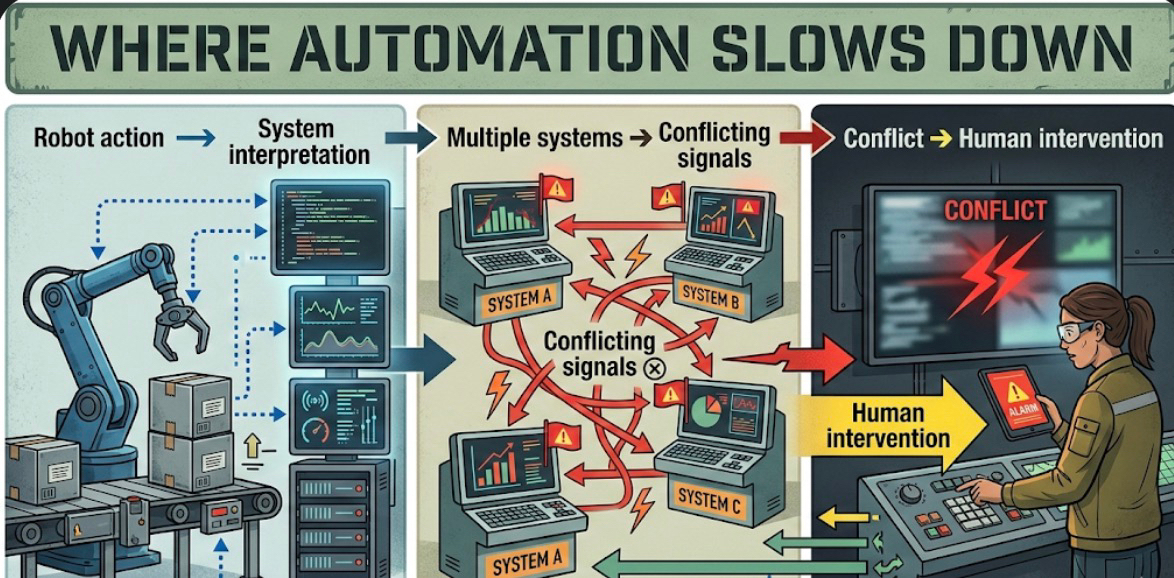
Two pieces of logic simply disagreed.
One system believed the path was clear.
Another flagged the same corridor as restricted.
The robot paused.
Humans stepped in.
That moment explains something important about where robotics actually struggles today.
Capability isn’t the main constraint anymore.
Interpretation is.
Machines can act quickly.
They can calculate faster than any operator.
But when multiple systems interact, the question becomes simple:
Which interpretation of reality wins?
That’s the quiet space where Fabric Protocol is building its structure.
Not just around robot performance.
Around robot accountability.
In most robotics stacks today, responsibility dissolves the moment something goes wrong.
Hardware providers blame integration.
Integrators point to software behavior.
Software teams call it an edge case.
Everyone explains.
Nobody owns the final outcome.
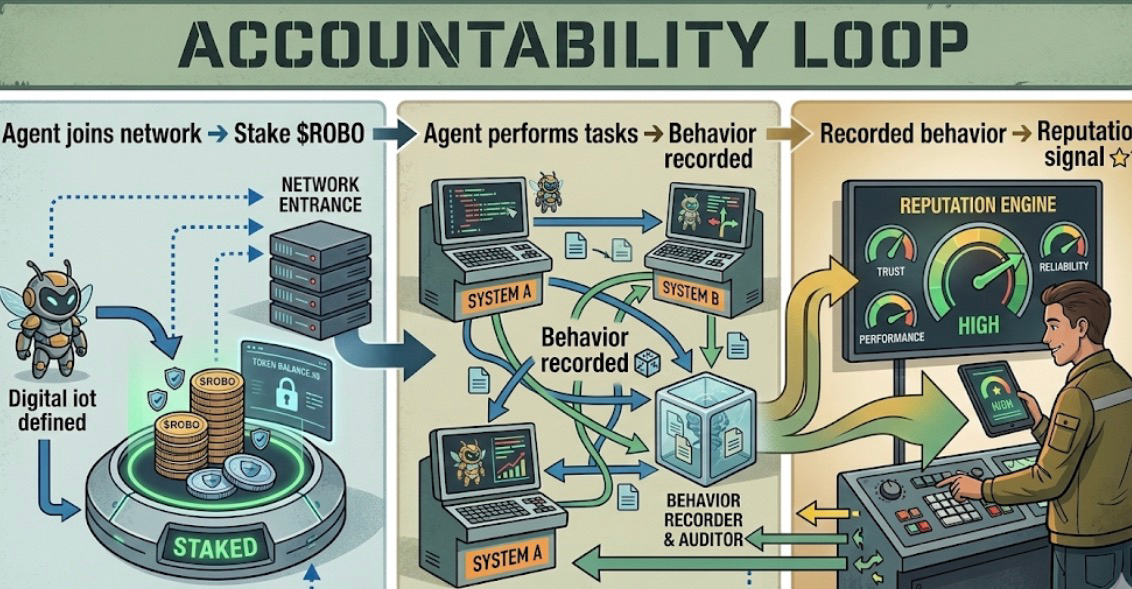
Fabric is trying to change that by making behavior verifiable and persistent across the network.
Not just logs.
Not just diagnostics.
But a record of how agents behave over time.
That’s where $ROBO becomes more than a token.
It becomes a coordination signal.
Participation requires stake.
Performance creates reputation.
Poor behavior becomes visible instead of disappearing inside system logs.
The network doesn’t rely on memory.
It relies on records.
Backed by the Fabric Foundation, the long-term value of this system won’t come from hype cycles or token activity.
It will come from something much simpler.
Whether machines operating together can leave behind clear, verifiable history instead of fragmented explanations.
Because when robots begin coordinating across networks, the most valuable resource won’t be speed.
It will be trust in what actually happened.
@Fabric Foundation #ROBO $ROBO