
While studying underwater robotics recently, one thing became immediately clear: the ocean is one of the hardest places for machines to operate, and that challenge shapes every design choice.
Human divers can only stay underwater for a short time, deep-sea conditions are risky, and the areas that need exploration are massive. That's why scientists are increasingly using Autonomous Underwater Vehicles (AUVs) and Remotely Operated Vehicles (ROVs). These robots go where humans cannot – conducting research, inspecting underwater infrastructure, and monitoring the environment.
During my research, it became obvious that these machines generate a huge amount of valuable data. Handling it efficiently requires something more than traditional systems (a decentralized coordination layer like the ROBO ecosystem)
1) Navigation Challenges Underwater/-
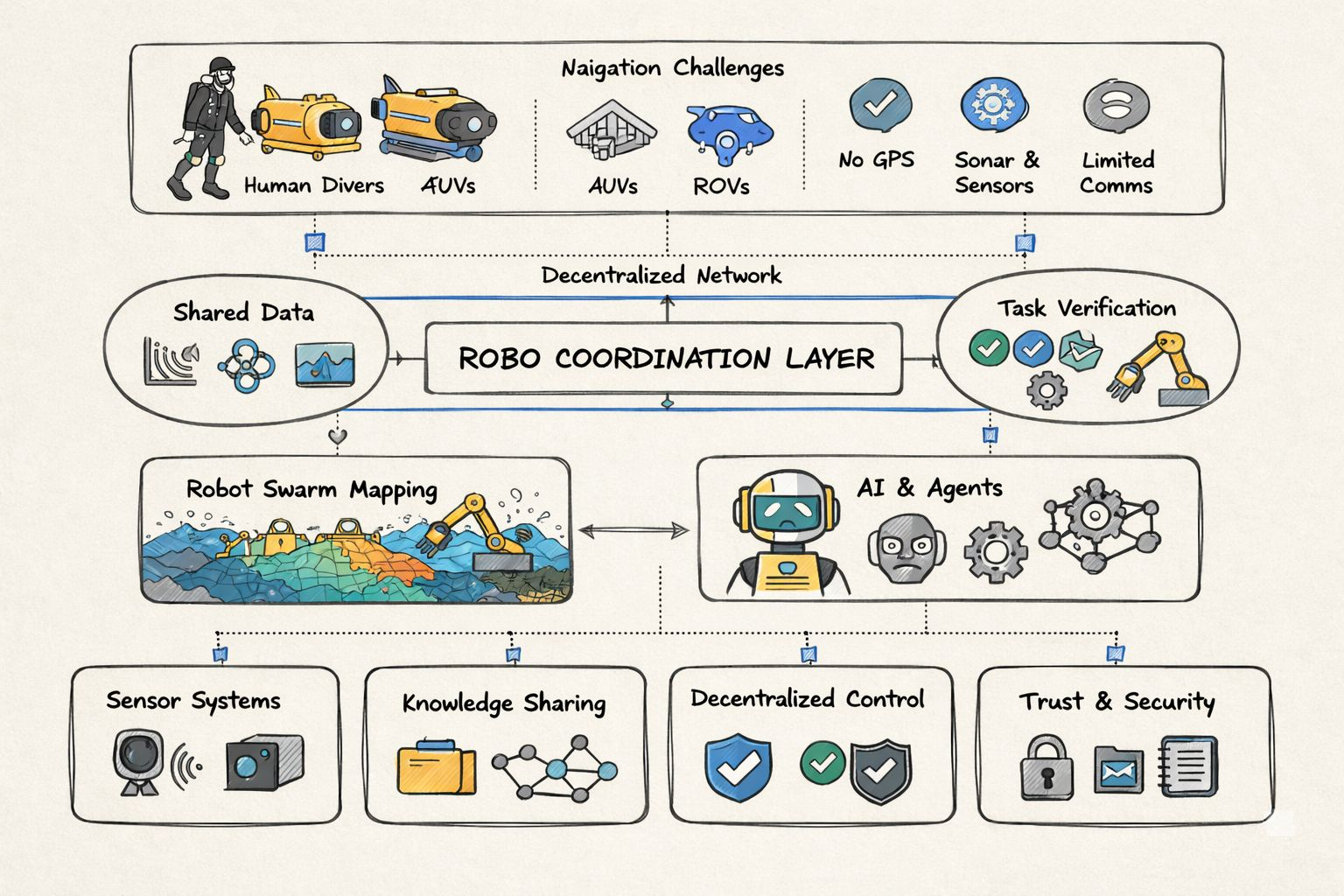
Working underwater introduces another challenge: navigation. GPS doesn’t work below the surface, visibility is often poor, and communication bandwidth is limited. Robots rely on sonar, sensors, and navigation algorithms to know their position and move safely. From what I observed, navigation isn’t just about technical precision; it's about combining different imperfect signals and sharing them across machines.
This is where a decentralized network within the ROBO ecosystem becomes crucial, allowing robots to share sensor data securely and understand their surroundings collectively, even without GPS.
In the ROBO ecosystem, robots, agents, and AI systems can coordinate through decentralized verification, ensuring that tasks, data, and actions are trustworthy even when machines operate autonomously.
2) Collaboration Between Humans and Robots/-
Working with robots isn't just about sending machines underwater and letting them move on their own.
What fascinated me the most during my research was seeing how humans and robots can actually work together as a team. Divers bring intuition, experience, and split-second decision-making, while robots can reach deeper, sense more, and collect data humans cannot.
Many systems already combine human guidance with robotic sensing, producing results far beyond what either could do alone.
But then I started imagining what happens when dozens of robots operate together in the same area: mapping ocean regions, inspecting pipelines, or collecting environmental data at the same time. That’s when it became clear: the challenge is no longer only about navigation or human-robot collaboration.
At that moment, I realized the real test is how all these machines coordinate with each other.
3) ROBO Ecosystem in Action/-
Imagine a group of underwater robots mapping a coral reef. One robot detects an unusual structure through sonar and shares that signal with the network. Other robots nearby automatically verify the observation from different angles, while another unit updates the shared map in real time. Through decentralized verification in the ROBO ecosystem, the system can confirm discoveries without relying on a single controller.
And this is exactly why I find the ROBO ecosystem so amazing. Instead of depending on a single controller, its decentralized network lets robots share information, verify each other's actions, and divide tasks naturally.
In a way, the network itself becomes part of the team. Each robot knows what the others are doing, decisions get checked automatically, and the whole group can accomplish far more than any individual machine could. This is not just robotics anymore; it's a self-organizing, collaborative machine economy, where coordination and reliability are built into the system.
4) Research Insights and the Future/-
From a research perspective, this is where the biggest insight lies. My own study of autonomous systems and underwater robotics highlighted one thing: building capable robots is only half the work. the real innovation comes from building networks that allow robots to share knowledge, verify tasks, and operate together reliably.
And the ROBO ecosystem is actively exploring this space, showing a clear path toward scalable, decentralized, and trustworthy robotic operations.
After looking deeper into underwater robotics, one thing became clear to me: building smarter robots is important, but building systems that allow them to trust, verify, and coordinate with each other may matter even more.
That's exactly the kind of future the ROBO ecosystem is beginning to explore.
If machines are going to explore environments where humans cannot go, then the systems that allow those machines to coordinate and trust each other may become one of the most important infrastructures of the future.
@Fabric Foundation #ROBO $ROBO
