I’ve noticed that people are usually comfortable with rewards in theory, but much less comfortable with the question hiding underneath them: what exactly is being rewarded, and how do you know it really happened. In ordinary work, that question is often answered by a manager, a client, or a time sheet. In open networks, that layer of trust is thinner, and the gap between participation and actual contribution matters more than it first appears.
The core friction is that incentive systems need to attract contributors without drifting into passive entitlement. If a network pays simply for holding a token, it may create early attention, but it also creates an economy where capital can remain idle and still collect value whether or not useful work is being done. If rewards are tied too narrowly to output, the system can become brittle, hard to enter, or easy to game through low-quality actions that look productive in aggregate. The bottleneck is designing a reward model that is active enough to discourage passivity, measurable enough to verify, and selective enough to distinguish contribution from noise.
It’s like paying a repair crew only for completed and inspected work rather than for standing near the building with tools.
In fabric foundation, token-based rewards are framed as proof-of-contribution rather than passive yield. The main idea is simple: tokens may be distributed, but only to participants who can demonstrate verifiable activity tied to network operations. That shifts the center of gravity away from “who holds the asset” and toward “who did measurable work.” In that structure, rewards are not treated as a financial return on ownership. They function more like protocol-native compensation for tasks, validation, data, compute, or other contributions that the chain can observe well enough to score.
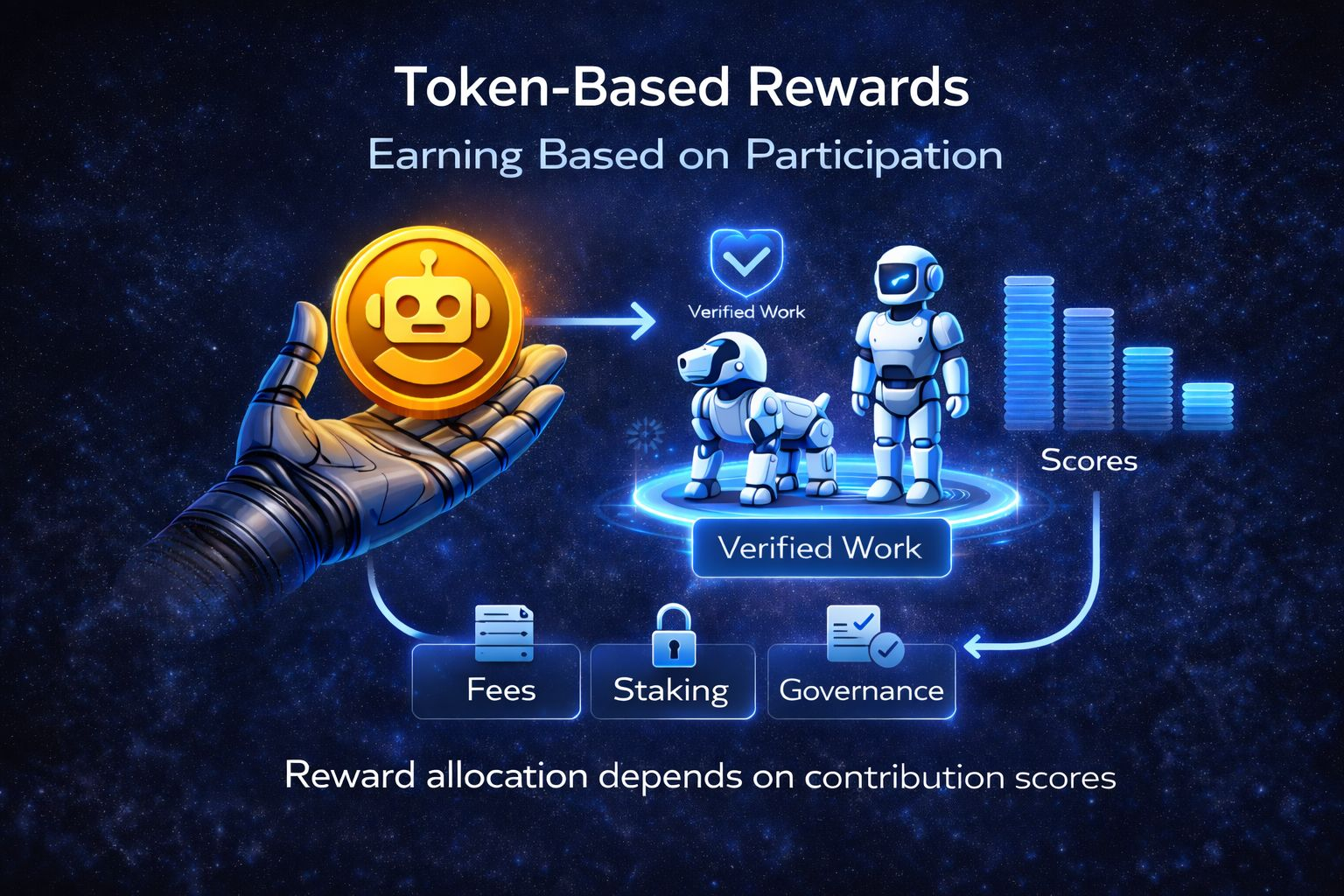
Mechanically, that means the network needs a contribution accounting system rather than a blanket emission stream. The material describes contribution scores that aggregate different categories of work, with governance-set weights determining how much value the protocol assigns to task completion, validation, compute provision, data contribution, and skill development. Each participant accumulates a score over an epoch, and reward allocation depends on that score relative to the total score of all active participants. The logic is straightforward even if the exact weights are not: verified work is measured, weighted, adjusted for quality, and then mapped into a share of the reward pool. That is meaningfully different from systems where delegation or simple token balance is enough to keep rewards flowing.
The quality adjustment is where the design becomes more serious. A contribution count on its own is too easy to inflate, so the system introduces multipliers based on feedback and validation outcomes, along with persistent penalties when fraudulent or poor-quality work is detected. The point is not just to pay for activity, but to pay more for activity that survives scrutiny. The whitepaper framing also adds decay and minimum activity requirements, which matters because it prevents someone from doing a burst of work once and then drifting forward on stale reputation. In practice, that means the score should fade when participation stops, and eligibility should depend on recent engagement rather than historical presence alone.
I can’t responsibly specify the underlying consensus approach from the excerpt alone, because the chain’s finality model is not fully described. But whatever the consensus is, it has to satisfy a narrow requirement: the inputs to rewards must be recorded in a way validators can agree on. The state model and execution environment are also not detailed enough to say whether the chain is account-based or UTXO-based, or which VM executes the rules. What seems clear is that the execution layer must represent contribution scores, quality multipliers, slashing or fraud penalties, and epoch-based distributions as deterministic state transitions. A participant would sign transactions that register work, data, or other protocol-recognized activity; validators would verify the transaction, order it, and once finalized, the relevant contribution state would update. Reward distribution would then occur at the epoch boundary according to the on-chain score totals and the rule set in force.
Data availability is a practical constraint here because “contribution” often involves bulky or partially off-chain work. For a robotics and AI-oriented system, the chain probably should not store raw datasets, large model artifacts, or full execution traces. The safer design is that the ledger stores commitments, receipts, attestations, or cryptographic references to work completed elsewhere, with validators or challenge mechanisms providing the bridge between off-chain activity and on-chain recognition. That keeps the reward system auditable without pretending all useful labor can be compressed into a single ledger entry. Interoperability only matters if outside environments need to feed contribution proofs into the chain, and while that may eventually be relevant, the source material does not specify a bridging model clearly enough to rely on it.
Utility and incentives become more coherent when rewards sit beside fees, staking, and governance rather than replacing them. Fees tie the token to actual usage: users pay for services, and those flows help reveal whether the network is generating real demand. Staking or bonding ties the token to security: operators and validators lock value that can be reduced under misconduct, which makes dishonesty costly. Governance shapes the reward system itself by setting category weights, quality thresholds, decay rates, and other parameters that determine what the chain treats as valuable work. Issuance is therefore not a blind inflation mechanism; it is filtered through operational criteria. Burns or slashing tighten discipline by reducing balances when work fails standards or fraud is detected. “Price negotiation,” in the neutral sense, shows up where users compete for service execution and where contributors decide whether expected protocol compensation is worth the cost of participating. That negotiation is not about speculation here; it is about whether the chain can clear a market for useful work at acceptable quality.
One explicit limitation is that no scoring system can perfectly capture the full value of contribution, and reward formulas can still be distorted by measurement error, adversarial behavior, or incentives that look sensible in design but produce unexpected behavior in practice.
What I keep returning to is the same basic intuition I started with: reward systems are only as honest as their definition of work. A network that pays for active, inspectable contribution is at least trying to answer that question directly instead of hiding it behind passive ownership. That does not solve every coordination problem, but it does shift attention toward what the system can actually verify and sustain, which feels like a more durable place to begin.
@Fabric Foundation $ROBO #ROBO