

Is your AI lying to you?
We’ve all seen AI hallucinations—incorrect facts, made-up data, and "confident" mistakes. In the world of high-stakes Finance and Healthcare, these errors aren't just annoying; they are dangerous.
Enter Mira Network: The decentralized "Trust Layer" that doesn't just generate answers—it verifies them. By using a network of independent nodes to reach a consensus, Mira is turning the "Black Box" of AI into a transparent, verified reality.
Check out the 5 real-world use cases proving that $MIRA is the future of AI-native infrastructure! 👇
The promise of Artificial Intelligence has always been high, but its greatest flaw—hallucinations—has kept it from taking over critical sectors like finance, law, and healthcare. Imagine an AI agent managing your DeFi portfolio or diagnosing a patient; if it "guesses" a wrong number or a symptom, the consequences are catastrophic.
This is exactly where Mira Network steps in. By acting as a decentralized "Trust Layer," Mira doesn't just generate data; it verifies it through a consensus of multiple independent AI models.
Here is a deep dive into the real-world use cases showing Mira Network in action today.
1. Verification-as-a-Service: The Klok Integration
The most prominent real-world application of Mira is Klok, an AI chat application that has transitioned from a simple multi-model interface to a fully verified platform.
The Problem: Most AI chats give you a single answer. If the model is wrong, you have no way of knowing unless you fact-check it yourself.
The Mira Solution: When a user asks a complex query on Klok, Mira deconstructs the answer into individual "claims." These claims are sent to a network of independent verifiers who run different models to confirm accuracy. 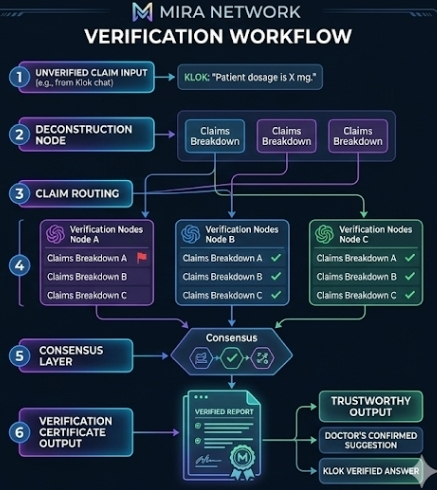
Result: Users receive a response with a "verification certificate," significantly reducing the risk of being misled by AI hallucinations.
2. High-Stakes Finance and DeFi Oracles
In the world of Decentralized Finance (DeFi), accuracy isn't just a preference—it's a requirement. Mira is currently being deployed to solve the "AI Reliability Gap" in automated trading.
Algorithmic Trading: AI agents use Mira to verify market signals before executing trades. If an AI "hallucinates" a price spike that isn't reflected in real-time data, Mira’s consensus layer flags the inconsistency, preventing the agent from triggering a bad trade.
DeFi Risk Assessment: Protocols use Mira to perform automated, on-chain risk assessments. By aggregating validations from various nodes, the network ensures that the data used for liquidations or collateral adjustments is tamper-proof and accurate.
3. Healthcare: Eliminating Medical Hallucinations
The medical field is perhaps the most sensitive to AI errors. Studies show that standard LLMs can hallucinate medical facts up to 50% of the time when dealing with niche protocols.
Clinical Support: Doctors use Mira-backed tools to cross-reference patient symptoms with evolving global clinical guidelines. Instead of relying on a model’s "memory," Mira retrieves and verifies real-time documents from sources like the WHO or local health authorities.
Data Integrity: By reaching a 95.6% accuracy rate through its consensus mechanism, Mira provides a safety net for clinicians, ensuring that the AI suggestions they receive are grounded in verified medical literature.
4. The Creator Economy: Binance Square & Beyond
Mira is actively used by content creators (like those on Binance Square) to ensure the integrity of AI-generated research and technical analysis.
Anti-Detection & Humanization: Creators use Mira Flows to build multi-stage pipelines. These pipelines handle complex tasks like data extraction and text summarization, ensuring that the final output is not only high-quality but factually verified.
Authenticity: For analysts, providing a "Mira-Verified" technical chart or market breakdown adds a layer of professional credibility that standard, unverified AI outputs lack.
5. Legal Compliance and Enterprise Auditing
Enterprises are integrating Mira to handle the "black box" problem of AI in legal environments.
Document Analysis: When AI analyzes thousands of pages of legal contracts, Mira verifies the specific clauses and regulatory requirements identified. This reduces the legal risk of "costly errors" that occur when an AI misinterprets a single word in a contract.
Audit Trails: Every verification performed on the Mira Network is recorded on-chain. This creates an immutable audit trail, allowing companies to prove that their AI-driven decisions were based on verified, consensus-backed information.
TRUST AS INFRASTRUCTURE
As we move toward an era of AI-native infrastructure, Mira Network is positioning itself as the "Verification Backbone." Whether it's through the $MIRA token powering the staking economy or the Verified Generate API being plugged into new dApps, the use cases are clear: Mira turns "Trust me" into "Verify me."
In a world where AI will increasingly move capital and manage lives, having a decentralized layer that ensures machines are telling the truth is no longer a luxury—it is a necessity.