
The world is slowly entering an era where robots are no longer just machines performing repetitive tasks. They are becoming intelligent systems capable of learning, adapting, and making decisions in real environments. From factories and warehouses to hospitals and public services, robots are beginning to play a bigger role in everyday life. But as this transformation accelerates, a deeper question appears. How can we make sure these machines work safely, transparently, and in harmony with people?
Fabric Protocol is built around answering that question.
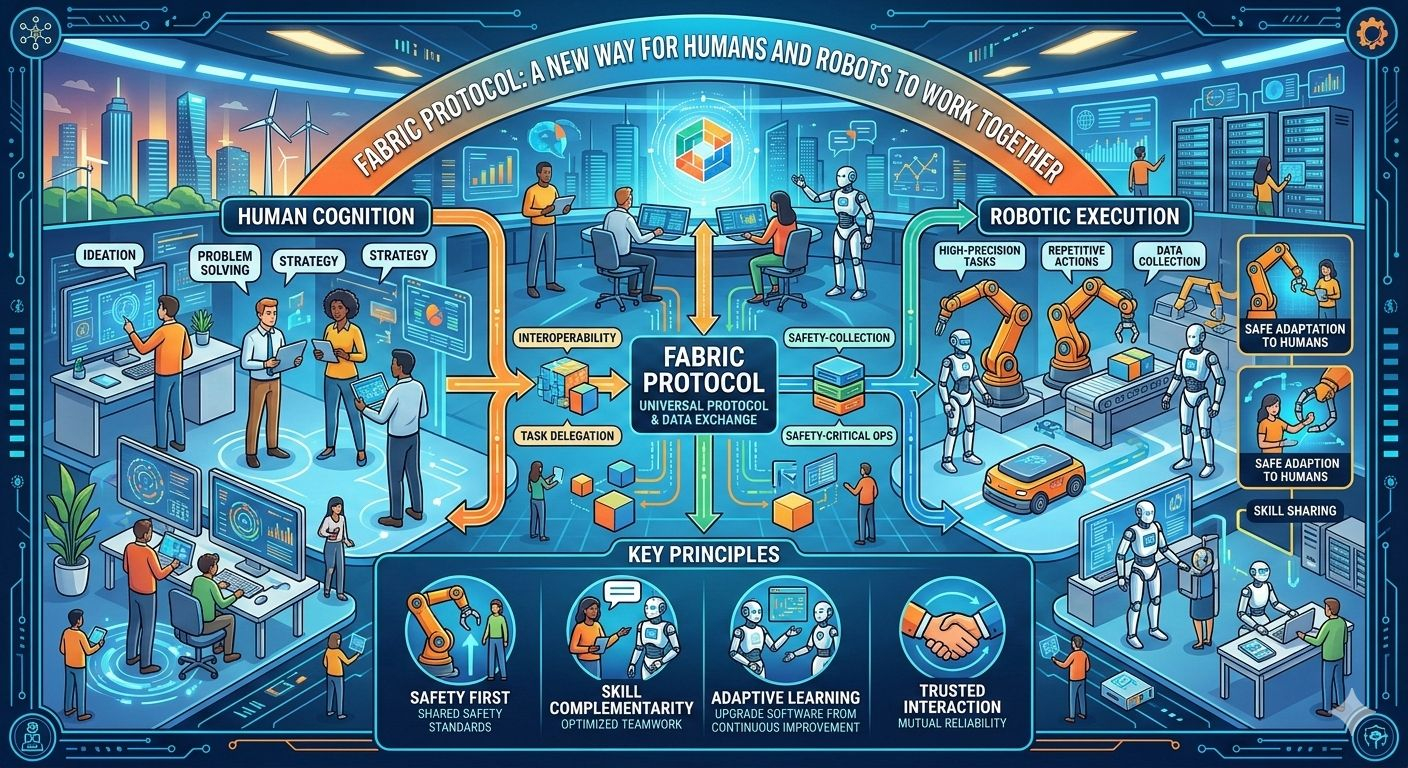
Fabric Protocol is a global open network designed to support the creation, coordination, and long term development of general purpose robots. Instead of building robotic systems that operate in isolation or under the control of a single company, Fabric Protocol creates an open infrastructure where developers, organizations, and intelligent machines can interact through a shared system.
The project is supported by the Fabric Foundation, a non profit organization focused on building open technological ecosystems. Its purpose is not to control robotics innovation, but to guide it toward a future where technology grows through collaboration rather than closed systems.
Today, many robotic technologies are built inside private ecosystems. Large companies develop their own hardware, software, and data systems. While this approach allows rapid innovation, it also creates silos where systems cannot easily interact with one another. It becomes difficult to verify how these machines operate or ensure that they follow common safety standards.
Fabric Protocol takes a different approach.
Instead of isolated robotic systems, it introduces a shared network that coordinates how robots interact with data, computation, and governance. This network uses a public ledger that records important activities across the ecosystem. The ledger acts like a transparent record that allows participants to understand how robotic systems operate and how decisions are made within the network.
This transparency plays a major role in building trust. When robots begin working alongside humans in sensitive environments, people need confidence that these systems behave responsibly. A public record helps ensure that robotic actions are visible, accountable, and aligned with established rules.
Another powerful element of Fabric Protocol is its use of verifiable computing. In most digital systems today, users simply trust that computations are executed correctly. However, when machines begin making real world decisions, trust alone is not always enough.
Verifiable computing allows systems to produce proof that their computations were executed correctly. In simple terms, a robot or AI system can show evidence that it followed the proper process before making a decision. This creates an additional layer of reliability that becomes especially important when robots operate in areas such as healthcare, logistics, or infrastructure.
Fabric Protocol also introduces a concept known as agent native infrastructure. This idea recognizes that the digital world is changing rapidly. Networks are no longer built only for human users. Intelligent agents, AI systems, and robots are increasingly participating in digital ecosystems.
Agent native infrastructure means that these machines are treated as active participants within the network. Robots and intelligent agents can interact with the system, request computational resources, share information, and follow governance rules just like human participants. This allows machines to operate within a structured environment rather than acting independently without oversight.
To support such a complex ecosystem, Fabric Protocol relies on modular infrastructure. Robotics development involves many moving parts including hardware systems, artificial intelligence models, data pipelines, and control frameworks. Managing all these components inside a single rigid system would be extremely difficult.
The modular approach allows different parts of the network to evolve independently. Developers can create new robotic modules, AI tools, or coordination mechanisms that plug into the Fabric ecosystem. This flexibility encourages experimentation and allows innovation to grow naturally as new ideas emerge.
Another key aspect of Fabric Protocol is governance.
When powerful technologies begin to influence real world environments, decisions about safety, ethics, and upgrades cannot be left to a single authority. Fabric Protocol introduces decentralized governance, allowing participants in the network to contribute to important decisions.
Members of the ecosystem can help guide protocol improvements, define operational standards, and shape how the network evolves over time. Because these decisions are recorded on the public ledger, the entire process remains transparent and accountable.
Safety remains one of the most important motivations behind the protocol. As robotics continues to advance, machines will operate closer to humans in everyday environments. Without clear safeguards, autonomous systems could create unexpected risks.
Fabric Protocol attempts to address this challenge by embedding regulatory mechanisms directly into the network. The system can enforce rules about how robotic agents behave, how data is used, and how decisions are validated. By integrating these safeguards into the infrastructure itself, the network helps ensure that robotics development moves forward responsibly.
Another important goal of Fabric Protocol is global collaboration.
Robotics development has traditionally been expensive and resource intensive. Many researchers and developers lack the infrastructure needed to experiment with advanced robotic systems. Fabric Protocol aims to lower these barriers by providing open infrastructure that anyone can build upon.
Developers from different parts of the world can contribute to the ecosystem, share innovations, and build new capabilities without starting from zero. Over time, this collaborative environment can accelerate the evolution of robotics and expand the number of people participating in its development.
The possible applications of such a network are vast. In logistics, coordinated robotic systems could help manage complex supply chains. In healthcare, robotic assistants could support medical professionals while ensuring that their actions remain transparent and verifiable. In manufacturing, intelligent machines could adapt to changing conditions while maintaining safety standards enforced by the network.
Beyond individual industries, Fabric Protocol represents a broader shift in how technology is built and governed. It encourages a future where innovation grows through shared infrastructure, transparency, and collective responsibility.
The rise of artificial intelligence and robotics will shape the coming decades in profound ways. As machines become more capable, society will need systems that ensure these technologies remain trustworthy and aligned with human values.
Fabric Protocol offers a vision of how that future might look.
Instead of isolated robots controlled by a handful of organizations, it imagines a global ecosystem where humans and machines collaborate through open infrastructure. A system where transparency replaces blind trust, collaboration replaces isolation, and safety is built directly into the foundations of technological progress.
In many ways, Fabric Protocol is not just about robotics. It is about building the digital framework that allows humans and intelligent machines to evolve together responsibly in the years ahead.
#ROBO @Fabric Foundation $ROBO