We usually think of markets as places where humans buy and sell things. But what happens when machines start negotiating with other machines?
This isn’t science fiction anymore. It’s happening right now — and most people have no idea.
The Rise of the Machine-to-Machine Economy
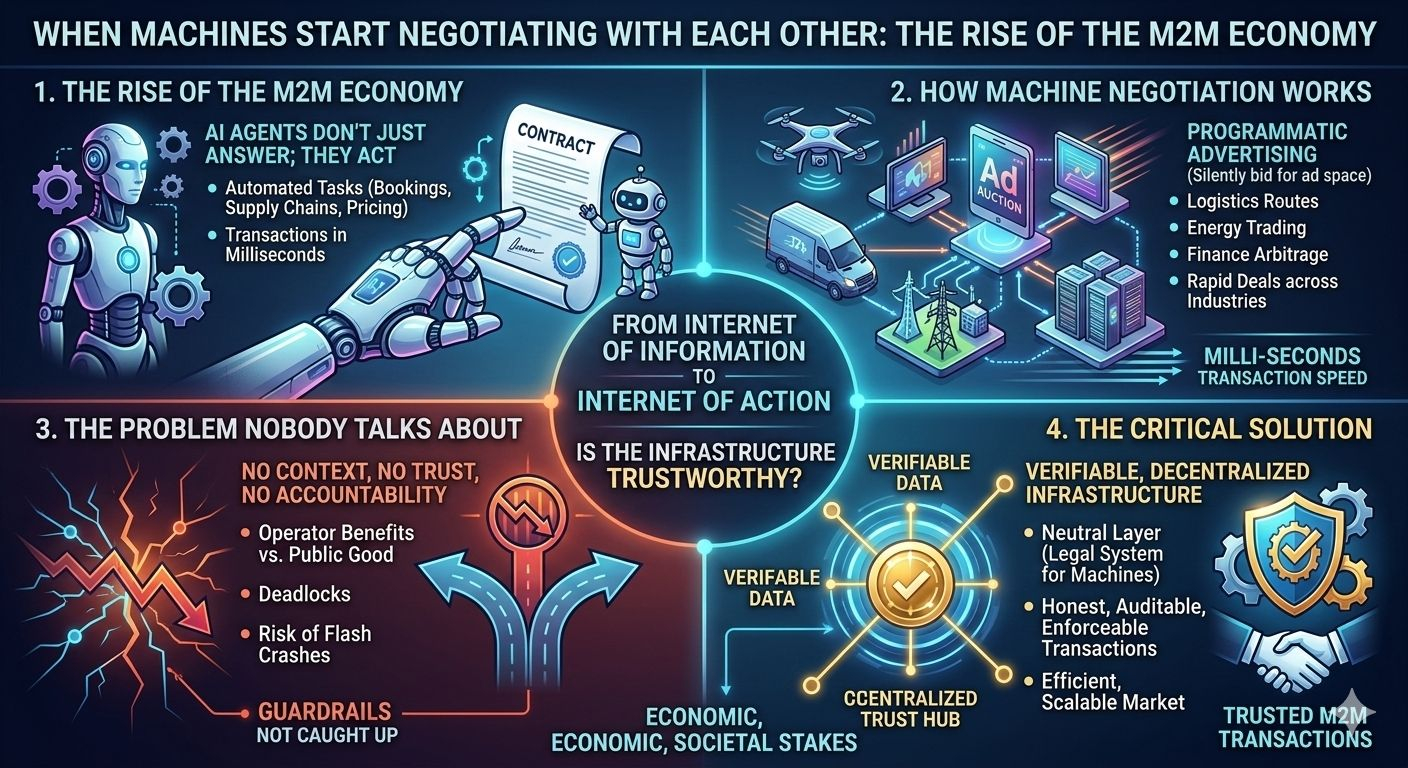
Today, AI agents don’t just answer questions. They take actions. They book appointments, execute trades, manage supply chains, and optimize pricing — all without a human clicking a single button.
When one AI system needs something from another, it doesn’t send an email. It negotiates. Automatically. In milliseconds.
This is the machine-to-machine (M2M) economy — and it’s growing faster than most people realize.
How Machine Negotiation Works
Think about programmatic advertising. Every time you load a webpage, hundreds of AI systems silently bid against each other for the right to show you an ad. The entire auction — from start to finish — happens in under 100 milliseconds.
No human involvement. No handshake. Just machines making deals.
Now scale that logic across every industry. AI agents in logistics negotiating delivery routes. AI systems in energy grids trading electricity in real time. AI models in finance executing arbitrage strategies against each other.
The deals are happening. The question is — who’s setting the rules?
The Problem Nobody Talks About
When humans negotiate, there’s context. There’s trust. There’s accountability.
When machines negotiate, there’s none of that — unless it’s deliberately built in.
What stops an AI agent from making a deal that benefits its operator at the expense of everyone else? What happens when two AI systems hit a deadlock? Who’s responsible when an automated negotiation triggers a market crash?
These aren’t hypothetical questions. Flash crashes in financial markets have already been linked to algorithmic systems reacting to each other in unpredictable ways.
The machines are negotiating. But the guardrails haven’t caught up yet.
Why This Changes Everything
The traditional economy runs on human trust — contracts, courts, reputation. The M2M economy needs a different foundation.
That’s why projects building verifiable, decentralized infrastructure for AI agents are critical. Not optional — critical. If AI agents are going to transact at scale, there needs to be a neutral layer that ensures transactions are honest, auditable, and enforceable.
Think of it as the legal system for machines. Without it, the M2M economy becomes a black box. With it, it could become the most efficient market the world has ever seen.
The Bottom Line
We are moving from an internet of information to an internet of action — where AI agents don’t just retrieve data, they make decisions and strike deals on your behalf.
The machines have already started negotiating. The real question is whether the infrastructure they operate on is trustworthy enough to handle what comes next.
Because when machines negotiate at scale, the stakes aren’t just computational. They’re economic. They’re societal. They’re real.