
I learned a long time ago that some of the prettiest metrics in crypto can be the most misleading. A token can have volume, social buzz, fresh listings, and a clean story, yet still fail the basic test of whether the network can punish bad behavior when money is actually on the line. That is the lens I keep coming back to with MIRA. The interesting part is not just that it wants to verify AI output. It is that the network tries to make wrong verification economically expensive through slashing, which is a much more serious design choice than most people first realize. 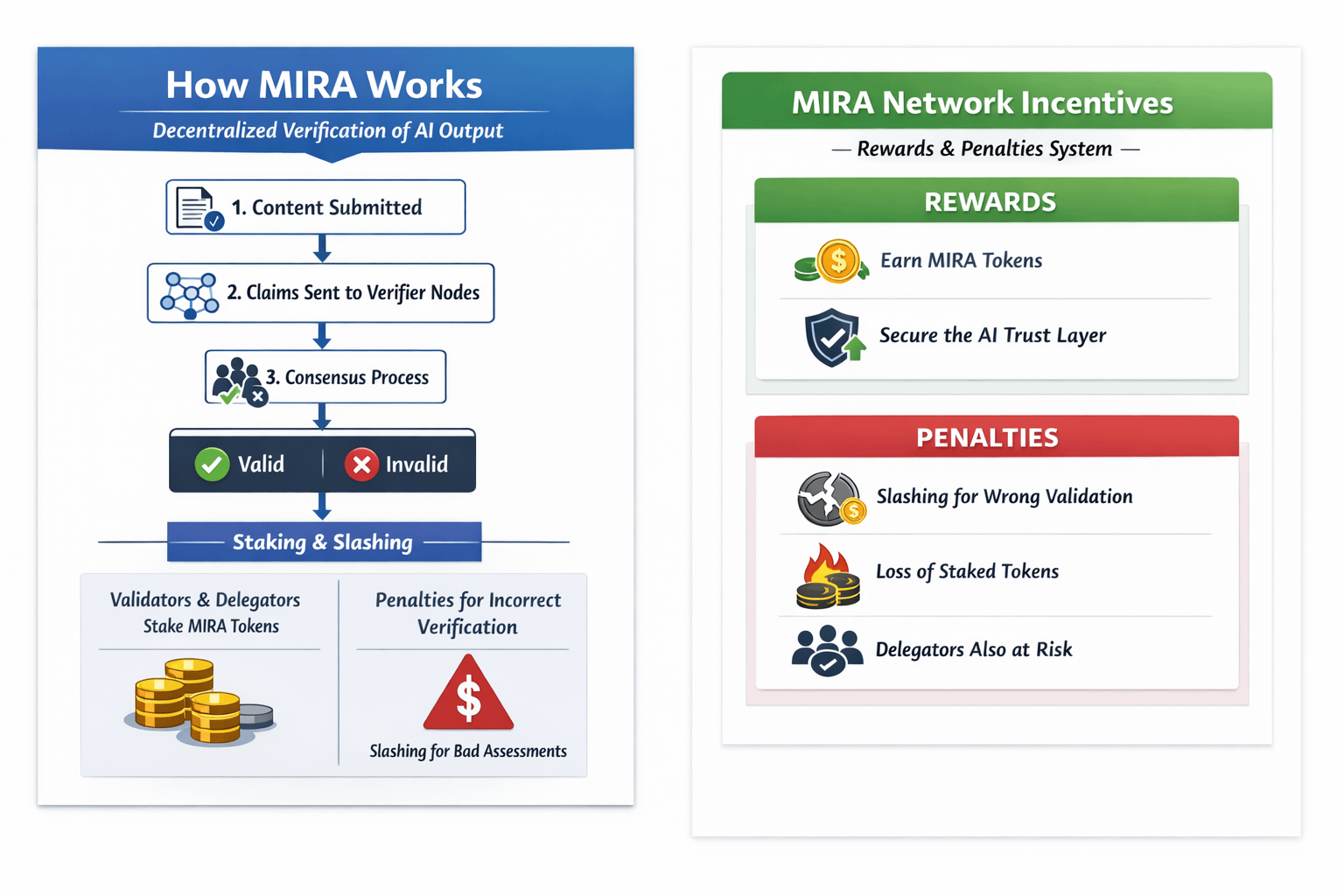 MIRA’s core idea is straightforward. The project is building a decentralized verification layer for AI generated output. In its whitepaper, Mira says the network breaks content into verifiable claims, sends those claims to independent verifier nodes, and then uses consensus to decide whether the output is valid. The security angle matters here. According to its published token documentation, node operators stake MIRA to participate in verification and can face slashing penalties for incorrect assessments. Delegators are also exposed, because they can suffer slashing if the validator they choose misbehaves. That means the system is not relying only on rewards. It is relying on consequences. For traders and investors, that matters because slashing changes the incentive map. A network that only pays participants can attract mercenary capital. A network that also penalizes bad verification is at least trying to filter for operators who believe they can perform honestly and consistently. In plain language, MIRA is saying this: if you help secure the trust layer for AI, you get paid. If you damage it, you pay. That is a cleaner model than a lot of crypto systems that talk about security but never really make dishonesty costly. The market is not ignoring MIRA, but it is still early enough that structure matters more than slogans. BaseScan currently shows about 13,000 holders for the MIRA token, a 1 billion max supply, and a circulating supply figure around 244.9 million. BaseScan also shows a price around $0.0828 and a circulating market cap around $20.27 million, while CoinGecko and CoinMarketCap both place the token in roughly the same price zone with daily volume in the mid single digit millions. That tells me there is real trading interest, but not enough maturity yet to assume the network effects are proven. This is where the retention problem comes in. Slashing can make a network safer, but only if enough good operators stay. If short term speculation dominates and serious verifiers do not stick around, the network can end up with weak participation, concentrated stake, or lower quality consensus. In a system built around AI verification, retention is not a side issue. It is part of the security budget. You need people willing to keep capital locked, run models, accept accountability, and stay engaged even when the token is quiet. Without that, slashing becomes more of a threat on paper than a stabilizer in practice. That risk is real, and Mira’s own materials already flag governance, centralization, and liquidity risks around the token and network. What would make me more constructive from here is simple. I want to see broad validator participation, healthy delegation patterns, and evidence that developers are using the verification layer because they need reliable outputs, not because the token is trending. What would change my mind in the other direction is also simple. If stake gets too concentrated, if false assessments still slip through often, or if the token keeps trading actively while real network usage stays thin, then the slashing story starts to look less like protection and more like marketing. So if you are watching MIRA, do not stop at price or narrative. Watch whether the network can retain serious participants and whether slashing actually supports credible verification over time. In this kind of market, the safest looking chart can still hide weak incentives, and the strongest signal is usually the part that hurts when someone gets it wrong.

Articolo
Mess Up, Pay Up: How MIRA’s Slashing Keeps the Network Safe
Disclaimer: Include opinioni di terze parti. Non è una consulenza finanziaria. Può includere contenuti sponsorizzati. Consulta i T&C.