

 Artificial intelligence is rapidly becoming a foundational technology in finance, automation, and digital infrastructure. At the same time, blockchain is transforming how trust is established in decentralized environments. When these two worlds intersect, a critical question emerges. Who verifies the intelligence that machines generate?
Mira Network attempts to answer this challenge through a decentralized verification model supported by token based incentives. While the technology behind AI validation is important, the true engine that powers the system is its economic design. Tokenomics determines whether participants behave honestly, whether validators remain active, and whether the network can scale sustainably.
From my perspective, the most interesting aspect of Mira is not just the concept of verifying AI outputs. It is the economic architecture that turns accuracy into a financially incentivized activity.
Understanding how Mira tokenomics works helps reveal why decentralized AI verification could become a new infrastructure layer within the crypto economy.
The Problem Mira Tokenomics Attempts to Solve
Most AI systems today operate under a trust assumption. Users trust that the model output is correct because the developer claims it is accurate. In many situations this assumption is acceptable. However, when AI begins influencing financial markets, executing automated trades, or analyzing smart contracts, incorrect outputs can lead to major consequences.
Traditional systems rely on centralized monitoring and internal testing to maintain accuracy. But these methods lack transparency and independent verification.
Mira introduces a different structure. Instead of trusting the model blindly, the network allows validators to independently verify outputs and stake tokens behind their evaluations.
This mechanism transforms AI reliability into an economic process rather than a technical promise.
The token economy becomes the system that coordinates participants and enforces honesty.
The Core Role of the Mira Token
The Mira token sits at the center of the entire network economy. It performs several key functions that maintain the stability and security of the verification system.
The first function is staking. Validators must lock tokens in order to participate in verifying AI outputs. This requirement ensures that participants have economic exposure when making validation decisions.
The second function involves rewards. Validators who provide correct verifications receive token incentives. These rewards encourage participation and maintain an active validator network.
The third role involves penalties. When validators submit incorrect or malicious validations, a portion of their staked tokens may be slashed. This penalty mechanism discourages dishonest behavior.
The fourth function relates to ecosystem usage. Applications integrating Mira verification services may use the token to access validation infrastructure, creating transactional demand within the ecosystem.
These functions together create a circular token flow that connects developers, validators, and users.
Economic Incentives as the Security Backbone
One of the most powerful ideas in blockchain design is the use of economic incentives to align behavior.
In proof of work systems, miners invest in hardware and electricity to compete for rewards. In proof of stake systems, validators lock tokens to secure the network.
Mira applies a similar concept but focuses on intellectual accuracy instead of computational power.
Validators earn rewards when their evaluation of AI outputs matches the network consensus. Incorrect decisions lead to financial loss.
This system encourages careful verification rather than blind approval.
From my perspective, this incentive model transforms knowledge and analysis into an economically valuable skill. Validators must actively evaluate outputs rather than simply maintaining network uptime.
Token Flow Within the Mira Ecosystem
The movement of tokens across the ecosystem forms the foundation of the network economy.
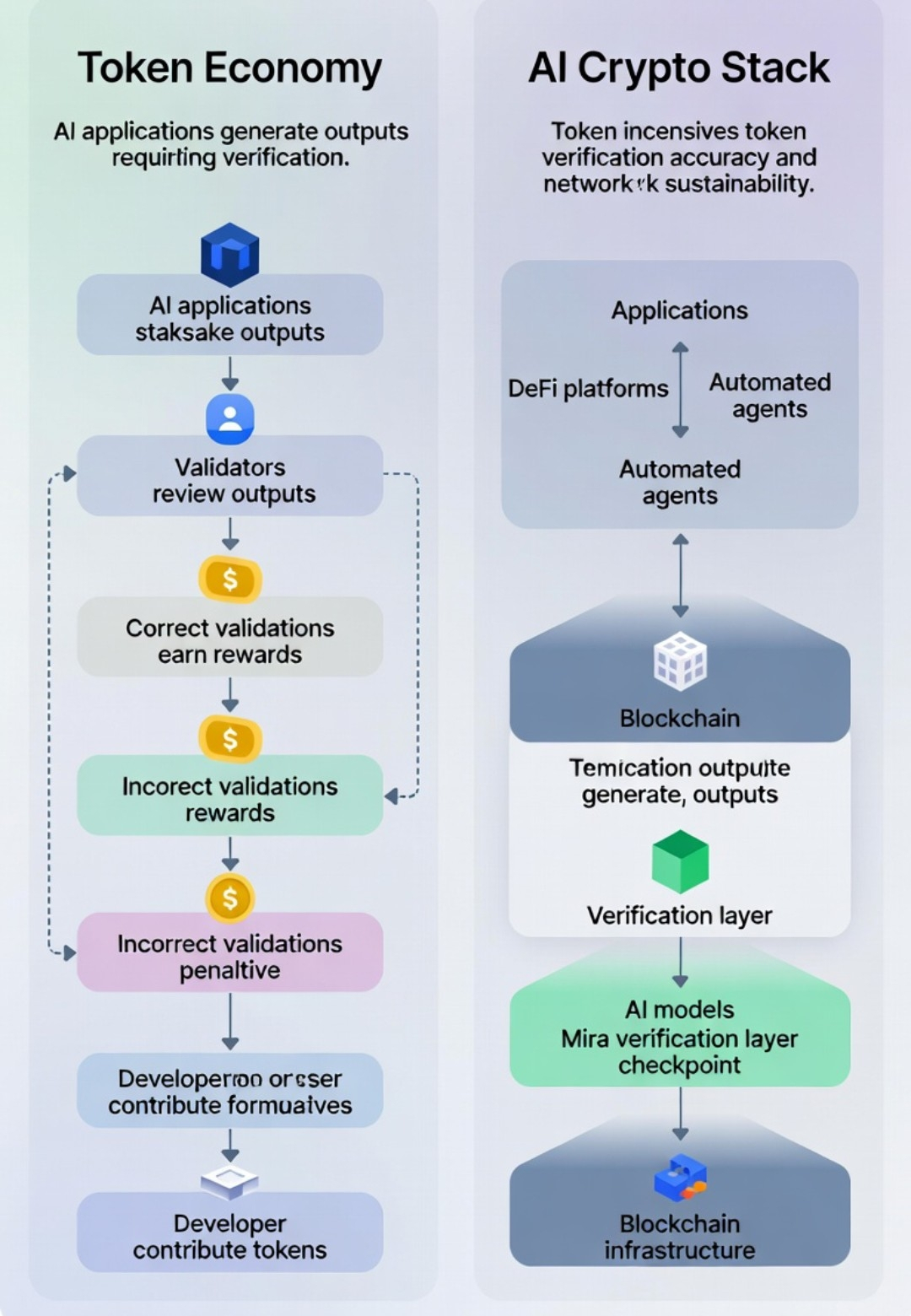
When an AI application generates an output requiring verification, it interacts with the Mira network. Validators review the output and submit their evaluations while staking tokens.
After consensus is reached, validators who participated accurately receive rewards. Those who provide incorrect validation may face penalties.
Developers and applications using the network may also contribute tokens as part of the verification process, reinforcing the economic loop.
Chart Idea 1
A token flow diagram showing the interaction between AI applications, Mira validators, and token rewards. The visual can illustrate how tokens move from application usage to validator incentives and back into the staking pool.
This chart helps readers understand how economic activity circulates across the verification network.
Supply Dynamics and Long Term Sustainability
A token economy cannot survive on rewards alone. Sustainable ecosystems require a balance between incentives and utility driven demand.
If reward distribution significantly outpaces real network usage, inflation pressure may weaken the token’s value over time.
For Mira, the long term strength of its tokenomics will depend heavily on adoption. As more AI driven applications integrate with the verification layer, demand for validation services increases.
Higher network activity leads to more token utility and stronger economic circulation.
In simple terms, token value becomes linked to the importance of verified intelligence within the digital economy.
From my perspective, this demand driven model is critical. Infrastructure tokens succeed when their utility grows alongside technological adoption.
The Role of Mira in the Emerging AI Crypto Stack
The crypto industry is currently exploring several different AI related sectors.
Some projects focus on decentralized computing power. Others build data marketplaces or autonomous AI agents that interact with blockchain systems.
However, the verification of machine generated intelligence remains an underdeveloped area.
Mira positions itself as a middleware layer that validates AI outputs before they are executed in real systems.
This role could become particularly important in environments such as automated trading, decentralized governance analysis, risk assessment engines, and enterprise decision systems.
Chart Idea 2
A layered ecosystem diagram showing four levels.
Blockchain infrastructure at the base
AI models generating outputs above it
Mira verification layer acting as a checkpoint
Applications such as DeFi platforms and automated agents at the top
This visualization demonstrates how Mira tokenomics supports a verification layer connecting multiple parts of the AI crypto ecosystem.
Opportunities Created by the Token Economy
If Mira’s token model succeeds, it could unlock several major opportunities.
The first opportunity lies in infrastructure demand. As AI driven applications expand across financial markets, the need for reliable verification may increase significantly.
The second opportunity involves validator participation. Skilled validators who consistently evaluate outputs accurately may benefit from long term reward streams.
The third opportunity involves enterprise adoption. Companies using AI systems may prefer decentralized verification mechanisms that provide transparent audit trails.
These factors could transform Mira from a niche protocol into a key component of decentralized intelligence infrastructure.
Risks and Limitations
Despite its promising concept, several risks must be considered.
Adoption risk remains the most important factor. Without widespread integration with AI applications, the verification economy may struggle to maintain demand.
Validator concentration could also impact decentralization. If a small number of participants control large staking pools, consensus may become less resilient.
Economic sustainability is another challenge. Reward structures must remain attractive while avoiding excessive token inflation.
Finally, the AI verification sector itself is still evolving. Competing approaches may emerge as the industry experiments with different validation models.
Understanding these risks allows investors to evaluate the project with realistic expectations.
Investor Takeaways
For investors exploring Mira Network, several indicators can help assess the strength of the token economy.
Growth in validator participation suggests increasing network security.
Higher staking ratios demonstrate long term commitment from token holders.
Integration with AI applications signals expanding demand for verification services.
Developer activity and ecosystem partnerships indicate long term technological relevance.
Monitoring these factors provides a clearer picture of whether Mira tokenomics is developing into a sustainable economic model.
Final Perspective
Artificial intelligence is becoming deeply integrated with financial systems, automated decision engines, and decentralized applications. As machines increasingly influence economic activity, the reliability of their outputs becomes a critical concern.
Mira Network approaches this challenge through a decentralized verification layer powered by token incentives.
In my view, the most innovative aspect of this system is not simply the verification process itself. It is the economic design that turns accuracy into a financially rewarded activity.
Blockchain technology proved that decentralized networks can secure financial transactions without centralized authorities. Mira attempts to apply the same principle to machine intelligence.
If verified AI becomes an essential requirement for autonomous systems, token economies designed around accuracy and accountability could become one of the most important infrastructures in the digital world.
@Mira - Trust Layer of AI #Mira $MIRA
