Robots are everywhere now warehouses, hospitals,delivery routes,factories.What’s strange is,even as they take on more work in the real world,robots still can’t actually join the economy.They don’t have their own identities or bank accounts.They can’t make deals or manage money on their own.That’s the gap the Fabric Foundation wants to close.
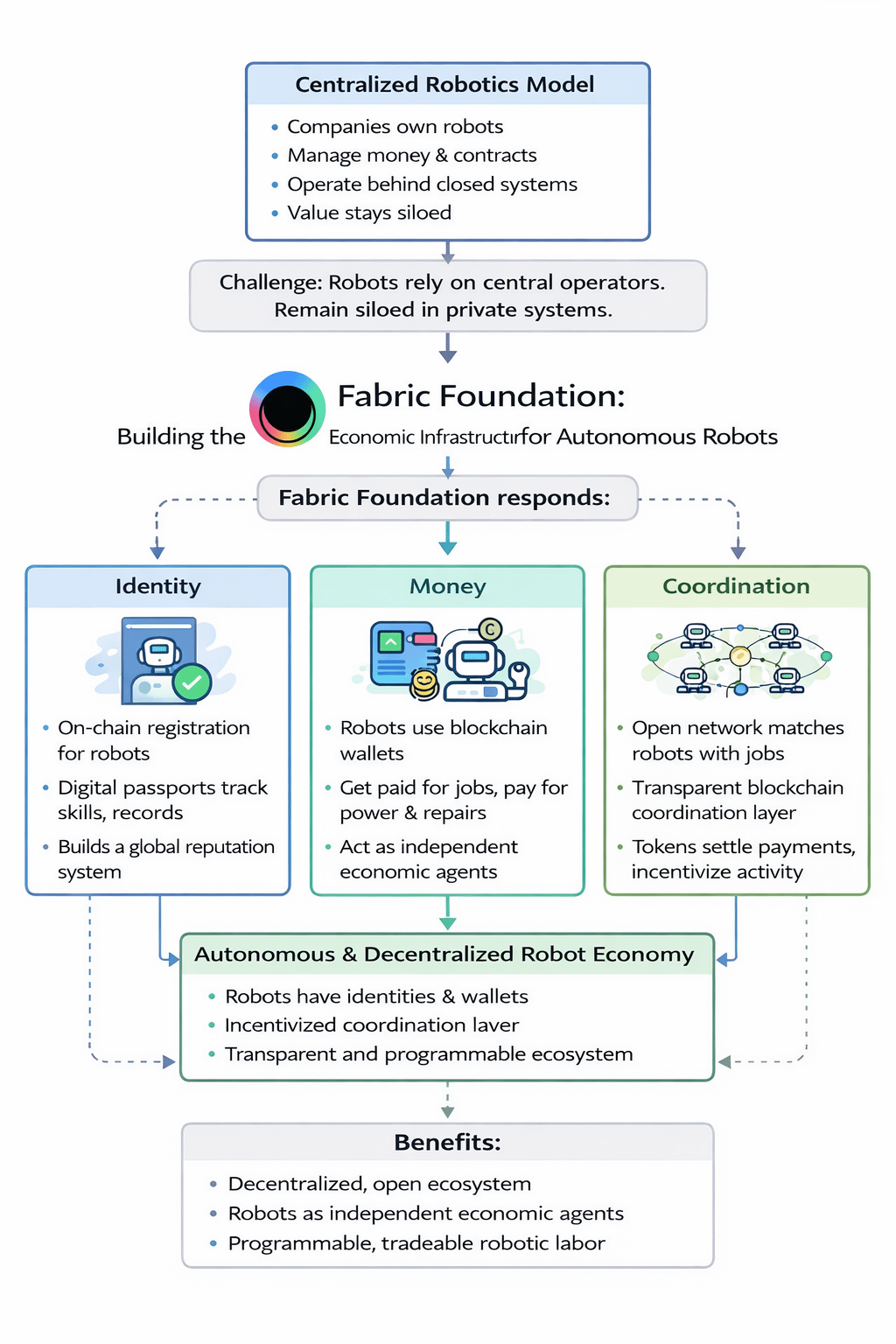
The real bottleneck in robotics isn’t intelligence or hardware anymore.AI keeps getting smarter.Building robots costs less and they break down less often.The real challenge is coordination.Right now,robots still depend on central operators.These companies own the robots,handle the money,and decide where robots go.All the value robots create gets stuck inside private, walled off systems.
Fabric Foundation wants to flip that model. Instead of treating robots as property locked inside one company,Fabric imagines an open network robots as independent players in the economy.This isn’t just about rolling out more robots.It’s about building a global system that connects robots’ work with people and companies who need it.
Look at how fleets work today:A company raises money,buys robots,uses them for its own projects,signs contracts,and runs the show behind closed doors.It works,but everything stays siloed.Every company runs its own tech,its own rules,its own bookkeeping.As demand for robots explodes worldwide,this approach starts to look brittle.
Fabric’s answer is to combine robotics with blockchain.The big idea?Give robots the same building blocks humans use in the economy identities,wallets,a way to participate.With these,robots can plug into digital financial systems,and everyone can see what they’re doing and how well they’re doing it.
First,identity.If a robot is going to work in a warehouse or deliver groceries,it needs a digital passport.Fabric wants an on chain registry for robots each machine gets logged with its skills,permissions,and performance record.It’s a reputation system anyone can check.Companies or people in different countries could trust the same robot, because its record is right there.
Next,money.Robots can’t open a bank account, but they can use crypto wallets. With blockchain wallets,robots can get paid when they finish a job,then automatically spend on things they need power,repairs, computing,software updates.Suddenly, robots aren’t just expensive tools.They become economic agents you can program.
Then,coordination.This is Fabric’s main focus now:a coordination layer for robotic labor. Instead of fleets operating in isolation,an open network matches robots with jobs wherever demand pops up.Anyone can help deploy or manage robots,all tracked on the blockchain for transparency.
Tokens pull this all together.Inside Fabric,the native token isn’t just another speculative crypto.It settles payments for robotic work, coordinates the network,and powers incentives for real activity.
In the bigger crypto world,Fabric is part of a trend decentralized infrastructure. Blockchains already help manage wireless networks,computing,and storage.Now,with robotics,physical work itself becomes programmable and tradeable.
But none of this is easy.Deploying robots in the real world means dealing with repairs, safety rules,insurance,uptime.The strength of networks like Fabric depends on more than blockchain tech;it needs real partnerships and solid integration with hardware companies.
Incentives matter,too.Token systems have to reward real contributions,not just speculation.If the incentives are off,people chase token profits instead of building lasting robotic services.Getting this right is critical for Fabric and the future of open,autonomous robotics.
@Fabric Foundation $ROBO #ROBO