

For a long time, I assumed the hardest problem in robotics would be hardware.
Better sensors.
Better motors.
Better batteries.
But the deeper you look, the more obvious another problem becomes.
Robots don’t have an economy.
They can perform tasks.
They can generate value.
But they still cannot participate directly in economic systems.
Every transaction today still passes through human institutions.
And that creates a bottleneck.
The Invisible Settlement Problem
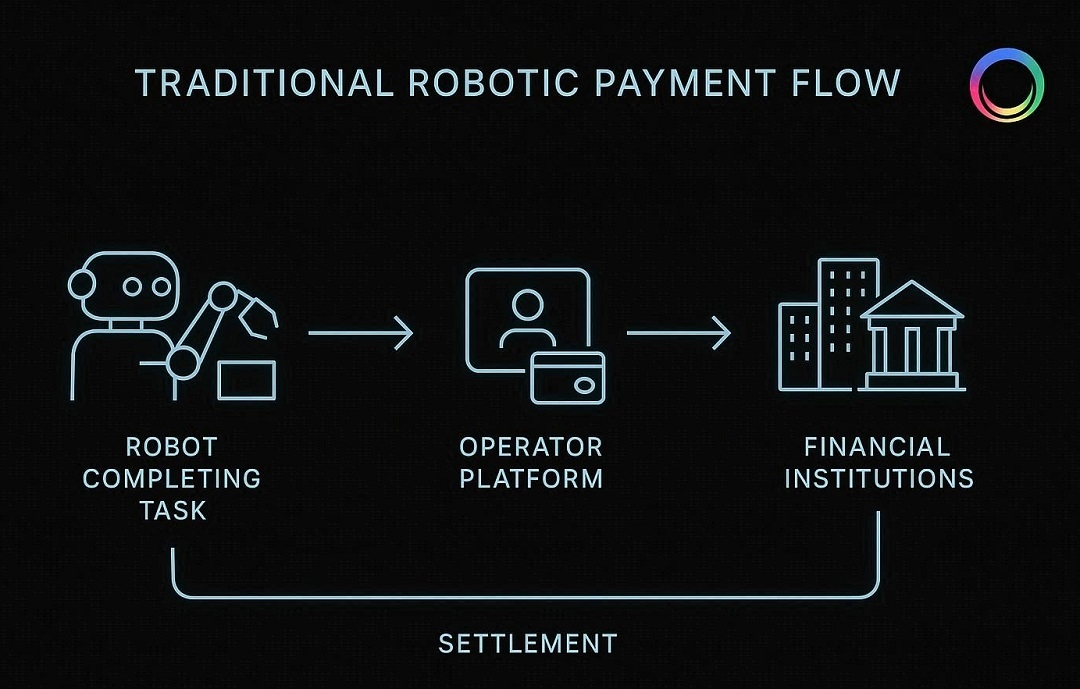
Imagine a robot completing a delivery.
The robot performs the task.
The robot generates the value.
But the payment?
It does not go to the robot.
Instead it travels through a chain of intermediaries:
Operator platforms.
Corporate accounts.
Payment processors.
Financial institutions.
Only after that chain does the value finally settle somewhere.
Not with the machine that produced the work.
The system was never designed for machines.
It was designed for humans.
Robots Need Native Settlement
If robots are going to operate autonomously, they need something very simple:
A way to settle transactions directly.
Not through companies.
Not through banks.
Not through manual reconciliation.
But through programmable infrastructure.
That is where network-native settlement becomes critical.
Because the moment machines can verify work and settle value autonomously, the entire architecture of robotics changes.
Why $ROBO Exists
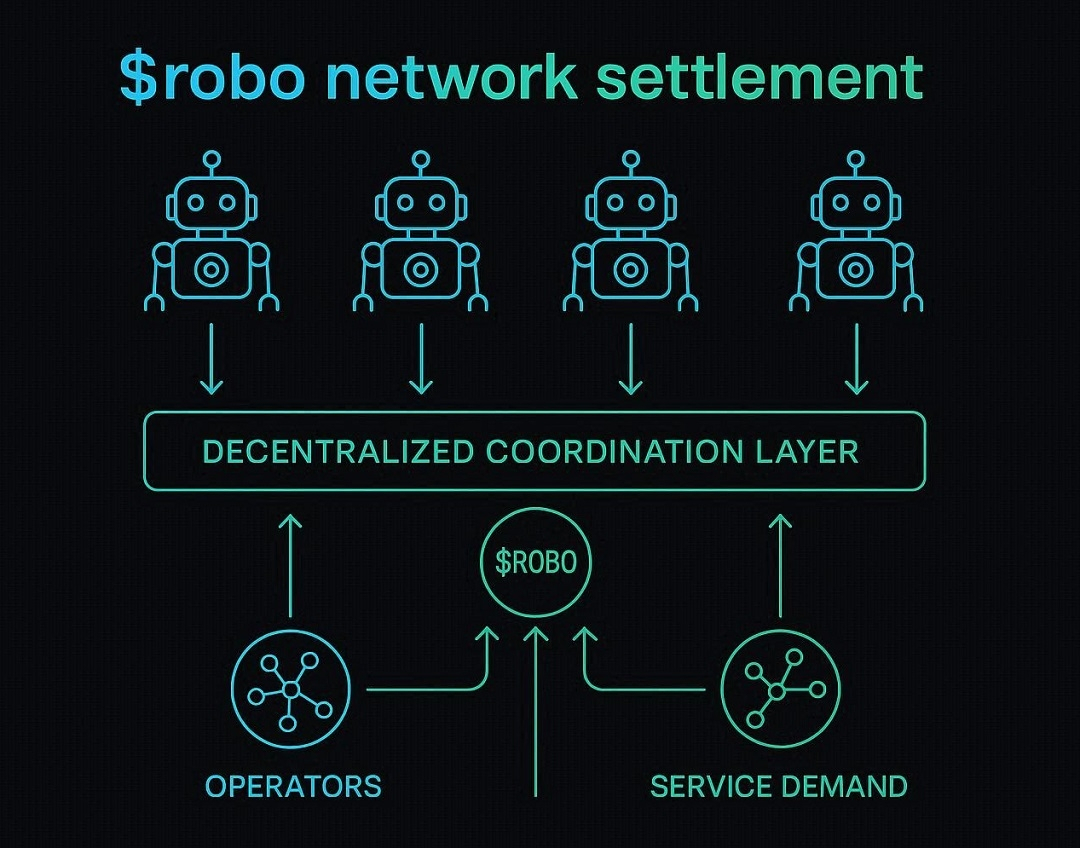
The Fabric network introduces ROBO as the settlement primitive for robotic activity.
Instead of routing every transaction through external systems, the network allows value to settle directly within its coordination layer.
This means that when robotic work is verified, settlement can happen immediately inside the system that coordinates it.
No institutional bottlenecks.
No fragmented infrastructure.
Just machine-to-network transactions.
Settlement Is the Real Infrastructure
Most people think robotics infrastructure is about hardware or AI.
But the real infrastructure is economic.
If robots cannot settle value directly, they remain dependent on centralized operators.
And centralized operators create closed fleets.
Closed fleets slow innovation.
Closed fleets limit participation.
Closed fleets concentrate capital.
Open robotic networks require open settlement.
The Role of $ROBO
Within the Fabric network, $ROBO becomes the unit that powers settlement.
It functions as the mechanism through which robotic transactions are processed and verified.
Every task completed.
Every service provided.
Every economic interaction between machines.
All of it flows through the same settlement layer.
That layer is powered by $ROBO.
The Machine Economy Needs a Native Currency
Think about the internet.
The internet only scaled once protocols allowed information to move freely across networks.
Robotics faces a similar moment today.
Without native economic infrastructure, robots remain isolated inside institutional systems.
But once machines can coordinate work and settle value natively, something entirely new becomes possible.
An open machine economy.
The Real Implication
The most important change is not technological.
It is structural.
When robots can transact directly through shared infrastructure, the robotics industry stops being a collection of closed fleets.
It becomes a network.
And networks scale very differently.
Without native settlement, robots remain tools.
With native settlement, robots become economic agents.
If robotics is going to scale globally, machines must be able to coordinate work and settle value autonomously.
That is the problem ROBO designed to solve.
One question remains.
If robots begin to transact and generate economic value independently…
who should ultimately control that value?
The operators?
The infrastructure?
Or the machines themselves?