
I set out to explore the alignment between the ROBO token and the concept of Instantaneous Skill Sharing at the core of Fabric Protocol’s economic architecture. These ideas appear throughout the project’s whitepaper, press releases and community communications.
The goal of this model is to transform machine productivity into a fair public infrastructure where value is created and distributed transparently across the entire ecosystem.
As I studied the design more carefully, I began to see that ROBO functions as the economic engine behind the sharing of skills in a robot society.
While humans need thousands of hours to learn a skill, robots can share “skill chips” with each other almost instantly. This opens the possibility for labor capabilities to spread at nearly the speed of light. Inside the Fabric ecosystem, the ROBO token acts as the economic fuel that powers this process.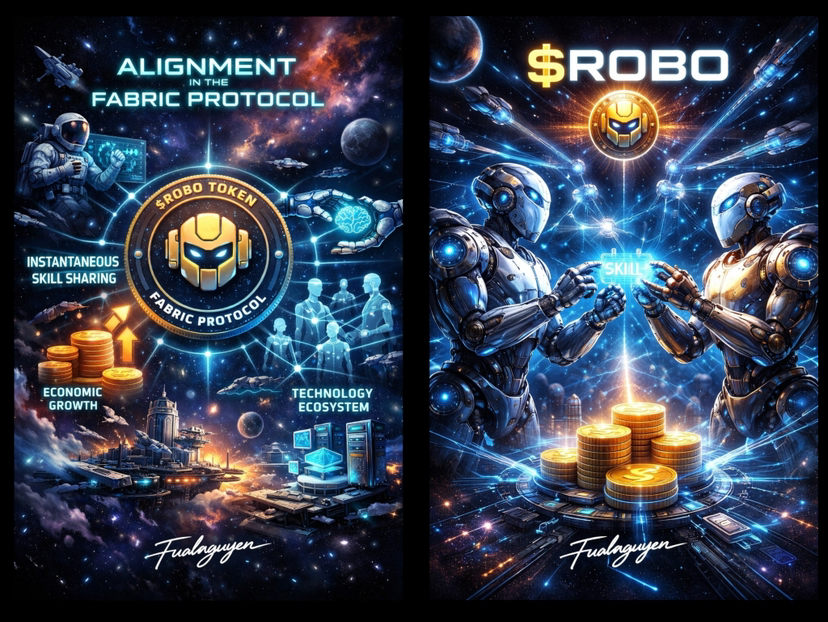
Fabric also proposes that individuals who contribute to the ecosystem such as developers, engineers or experts can build skill models for robots. These contributions are recognized through a Proof of Contribution mechanism. Contributors receive ROBO tokens as rewards for providing data, models or new capabilities to the network. In this way the token becomes both recognition and accumulated value that creators can later use to access robotic capabilities within the Fabric economy.
Another interesting aspect is revenue sharing. When a robot uses a learned skill to perform work and generate revenue, the system automatically distributes part of that revenue back to the people who helped create the skill. This allows economic value to circulate across the ecosystem instead of being concentrated in a small number of companies that own the technology. I believe this mechanism helps reduce monopolies while encouraging developers around the world to contribute through blockchain infrastructure.
Fabric also introduces the idea of a Robot Skill App Store where skills are packaged as modules that can be easily installed or removed. When I first read about this concept I thought, how could something like this really happen? But then I looked at the smartphone in my hand and realized that every major technological revolution started with an idea that once seemed impossible. In many ways Fabric’s ecosystem resembles an app store for robots and automated machines, which actually makes the idea feel much more realistic.
The ROBO token is also used for payments and access within the ecosystem. It can be used to pay subscription fees, pay for skill usage and purchase access to skill modules. This allows the robot skill marketplace to function as an open economy. At that moment I realized something interesting. In the future we might not need to own the most advanced robot that can do everything. Simply holding $ROBO tokens in a strong Fabric economy could allow us to access robotic capabilities whenever we need them.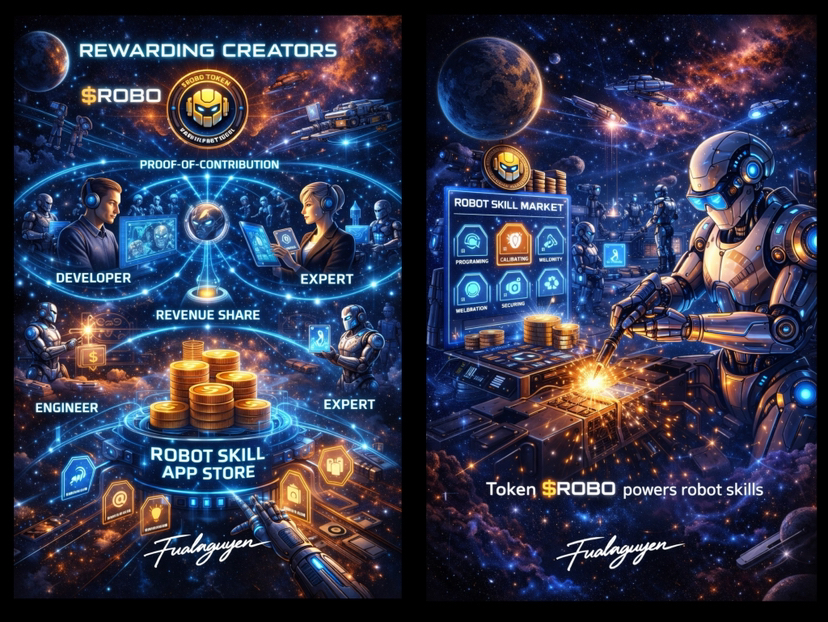
There is also a fascinating financial mechanism that allows robots to borrow capital in order to learn skills. A robot can borrow economic commitments within the network to pay developers upfront for skill models. Later the robot repays the loan using the revenue generated from applying those skills in real work. This design accelerates learning and expands the capabilities of the robot network.
Some people might ask why robots would want to learn or improve themselves. The truth is they do not have such intentions. What I see in Fabric’s design is that robots start with the same foundational platform and new skills are continuously added through the Robot Skill App Store. From an economic perspective they simply pay tuition through future productivity. This creates a fair and transparent system that aligns incentives and encourages continuous contribution.
At the same time Instantaneous Skill Sharing introduces a potential risk known as the Winner Takes All model. In such a system a single entity could end up controlling the most essential skills of the entire economy. Fabric Protocol attempts to address this risk by decentralizing ownership and control of machine capabilities.
Today when a company develops a robot or an AI system that company usually controls how the technology is used through capital and power. In contrast the $ROBO token moves control away from corporate data silos and places it into a transparent public ledger. This approach transforms robotic capabilities into a shared infrastructure instead of a proprietary asset controlled by a handful of technology giants.
It may sound difficult to achieve but over time it could become increasingly necessary. AI and robotics developed in isolation cannot reach their full potential without connection and knowledge sharing. In the world that Fabric envisions, instead of a single corporation owning all medical robots, engineering robots or service robots, the community can collectively own and govern these skills through participation in the tokenized ecosystem. It may sound like a crazy idea but it is also an exciting one.
Another part of the design focuses on verification and skill quality. This area involves cryptography and economic security mechanisms. The alignment between Instantaneous Skill Sharing and the $ROBO token helps ensure that shared skills remain safe, reliable and efficient.
Robot operators must stake ROBO tokens as work bonds. These tokens act as collateral that guarantees the quality of the work being performed. If a robot uses a skill incorrectly or causes an error the staked tokens can be slashed, creating economic accountability.
Humans also play an important role through a system called the Global Robot Observatory. Using governance rights through veROBO, people can evaluate robot behavior, provide feedback about performance and suggest improvements. Over time this feedback helps refine skill chips and ensures that they become safer and more reliable.
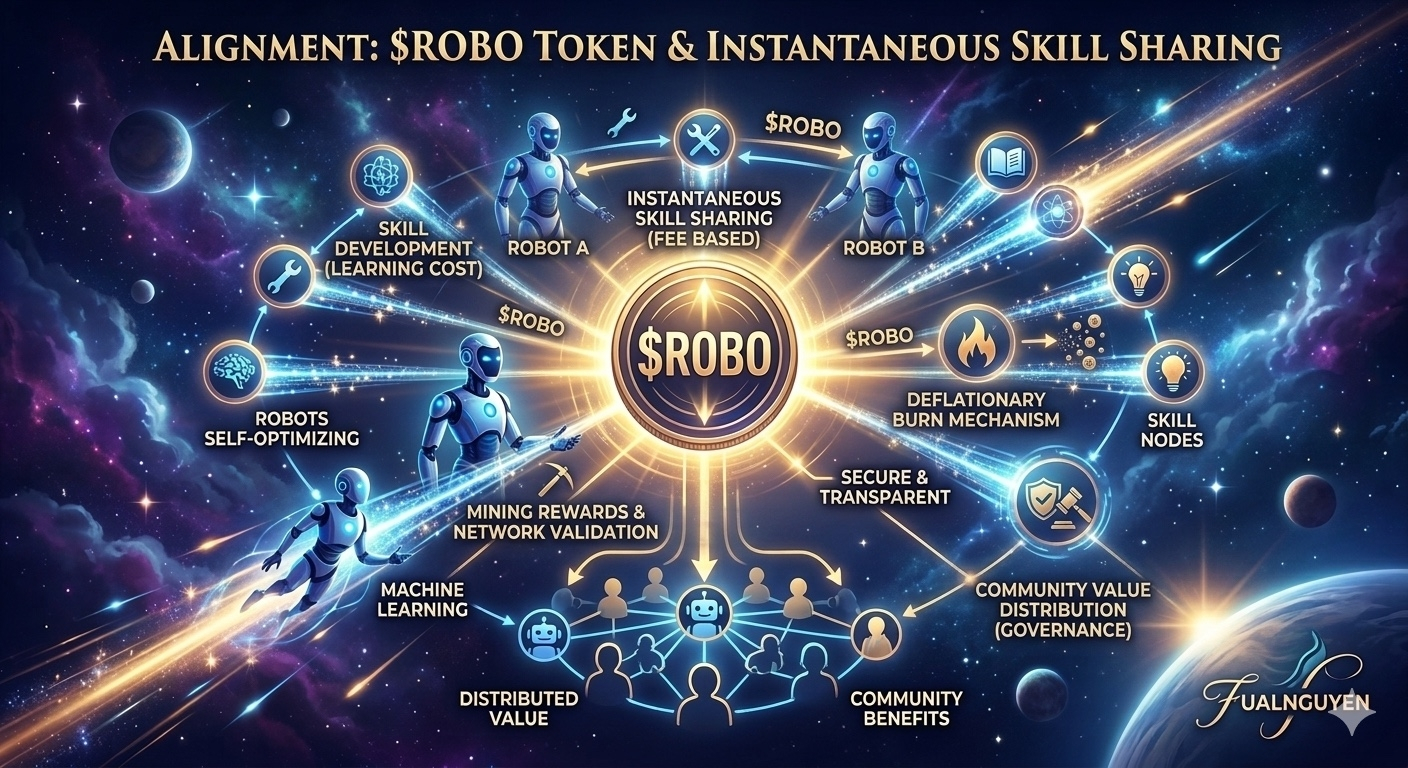
Instantaneous Skill Sharing creates enormous productivity while the ROBO token ensures that the value generated from that productivity is distributed transparently, fairly and sustainably. When these two elements come together they form the foundation of a new economic model where skills can spread instantly, machines can learn continuously and value can flow back to the community.
Understanding these ideas may be one of the reasons to believe that a robot economy and a new model of technological governance could emerge in our digital future. I will continue researching Fabric Protocol and share more perspectives so we can keep exploring these ideas together.
@Fabric Foundation #Fualnguyen #ROBO $ROBO
