
When I first started studying robotics networks, I assumed the hardest problem would be intelligence.
Better sensors.
Better models.
Better machines.
But the more I examined systems like Fabric Foundation, the more I realized the real bottleneck isn’t intelligence.
It’s coordination.
Robots today operate inside isolated environments.
A warehouse robot can move inventory.
A delivery drone can transport packages.
An industrial arm can assemble components.
But those machines rarely coordinate across open systems.
They operate inside closed infrastructure owned by companies.
That limitation becomes critical the moment robots begin interacting with broader economic systems.
Because coordination requires something deeper than automation.
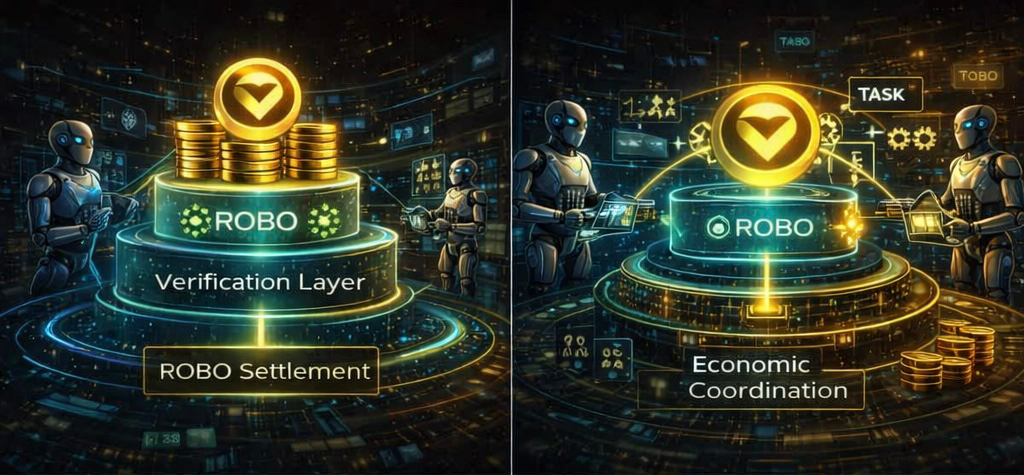
It requires verification, incentives, and settlement.
This is where the architecture behind ROBO becomes interesting to me.
The protocol attempts to introduce a coordination layer where autonomous machines can interact through a shared economic system.
The way I think about the structure is simple.
Machines perform tasks.
Tasks generate verifiable activity.
Activity settles through the network using ROBO.
Inside that framework the token performs several roles.
It pays for network transactions.
It supports identity verification.
It enables staking for coordination and governance.
Those mechanisms create something robotics networks rarely have.
Economic alignment.
If machines generate useful work, economic signals flow through the network.
If they behave incorrectly, staking mechanisms create penalties.
That combination verification plus incentives is what allows coordination to scale.
But I also recognize the challenge.
Building robots is difficult.
Building open coordination infrastructure for robots is even harder.
For this system to succeed, machines must actually produce real economic activity that flows through the network.
If that happens, the protocol becomes infrastructure.
If it doesn’t, the idea remains theoretical.
So when I evaluate Fabric, I’m not just watching the robotics side.
I’m watching whether the coordination layer begins to work.
Because the moment machines start coordinating work through a shared economic system, something bigger begins to emerge.
Not just robotics.
A machine economy.
@Fabric Foundation #ROBO $ROBO
