
When I first came across Fabric Protocol, I felt the familiar twinge of cautious excitement that comes with spotting a project quietly tackling something genuinely structural. In a market flooded with AI and crypto tokens, most projects are racing to demonstrate flashy demos or hype-driven narratives. Fabric doesn’t play that game. Instead, it’s quietly building what could become the foundation of a decentralized robot economy a system where machines have identities, wallets, and can transact and coordinate autonomously on-chain. It’s a thesis that isn’t about marketing buzz or short-term gains. It’s about bridging the gap between real-world robotics and blockchain infrastructure, and that’s exactly why it deserves a closer look.
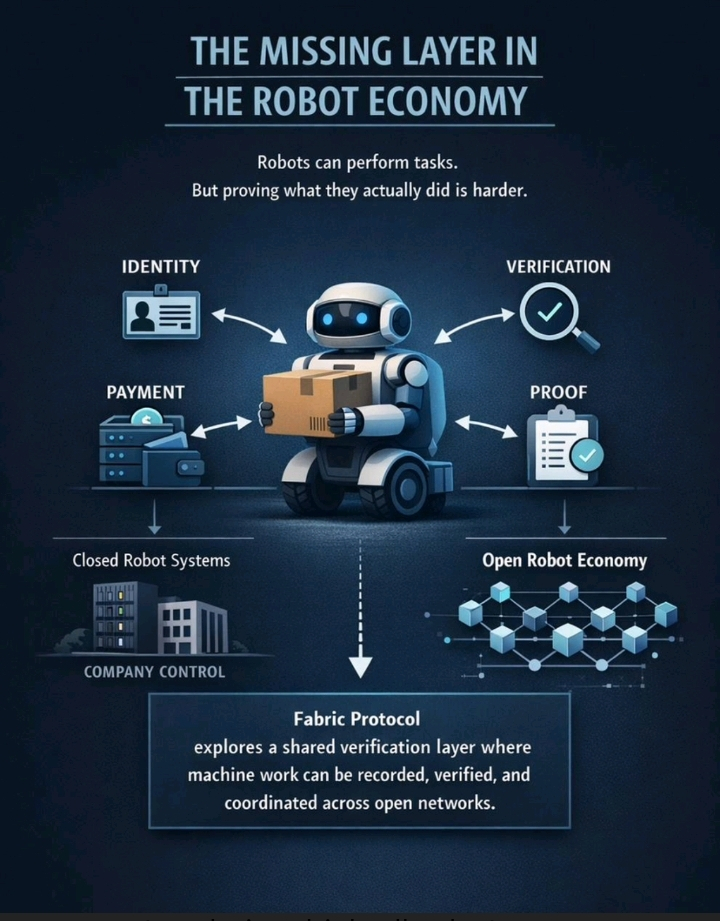
Fabric Protocol positions itself as a coordination and settlement layer for autonomous machines. On the surface, that might sound abstract, but the implications are enormous. The protocol allows robots to have cryptographically verified identities, manage wallets, participate in task markets, and earn rewards for completing verified work. The native token, $ROBO, is at the heart of these transactions. Beyond mere staking, it underpins what the team calls Proof of Robotic Work rewarding robots not for holding tokens, but for actually performing tasks that contribute to the network. This is a subtle but critical distinction: token supply is tied to utility rather than speculation, at least in theory.
From a market perspective, $ROBO is intriguing. It launched with coordinated listings across major exchanges including Binance, Coinbase, KuCoin, and MEXC in early 2026, giving it immediate access to both retail and institutional liquidity. That’s rare for a token that is still pre-utility. The liquidity on centralized exchanges is healthy, generating real-time price discovery, though decentralized exchange depth remains thin. This is a common pattern for infrastructure plays at the start of their lifecycle: trading volumes are high, but they are driven more by listings and incentive programs than organic usage of the protocol.
Tokenomics adds another layer of nuance. Fabric has a total supply of 10 billion tokens, with nearly half allocated to investors and the team under a 12-month cliff followed by a 36-month linear vesting schedule. The foundation and community reserves are structured to gradually distribute tokens over time, often tied to contributions or activity on the network. Early unlocked supply exists for liquidity and airdrops, but the majority of tokens will unlock later, coinciding with the first meaningful milestones in adoption. The risk here is obvious: if actual robot usage lags behind the token schedule, the market could experience heavy sell pressure when the cliffs expire.
On-chain signals, for now, reflect the project’s early stage. Most activity consists of airdrop claims, exchange deposits, and transfers between wallets. There’s not yet significant usage coming from robots actually performing tasks or earning $ROBO. These metrics are worth watching closely, because they will ultimately tell us whether the protocol is gaining genuine traction or whether it’s just a narrative play circulating through early adopters.
Competitive positioning is subtle but important. Fabric isn’t competing directly with AI compute tokens or traditional DeFi infrastructure. Its closest peers are agent coordination networks like Fetch.ai or machine finance experiments such as IoTeX. What sets Fabric apart is its focus on economic coordination for machines, not just identity or messaging. If robots are ever going to function as autonomous economic actors, someone will have to provide the rails. Fabric wants to be that infrastructure, and for now, it’s one of the few projects betting on that idea early.
There are, of course, significant risks. The project is betting on technology adoption that is still futuristic. Robots with wallets capable of executing complex economic tasks aren’t commonplace yet, and regulatory questions around autonomous economic actors remain unresolved. Narrative fragility is another concern: the token’s early price action is largely fueled by hype and listing events. If the market rotates out of the AI/robotics narrative, momentum could fade quickly. Finally, liquidity is concentrated on centralized exchanges, meaning price volatility could be sharp if large participants move aggressively.
Looking at the current crypto cycle, $ROBO is a momentum-driven asset. In bull markets, it can outperform due to hype, institutional attention, and the convergence of AI, robotics, and infrastructure narratives. In sideways markets, it may grind lower as narrative alone fails to sustain demand. And in bear markets, speculative tokens without on-chain utility will likely be among the first to be repriced. The asymmetric opportunity exists in trading around catalysts token unlocks, network milestones, robot onboarding, or proof-of-work events rather than blindly holding for a multi-year payoff.
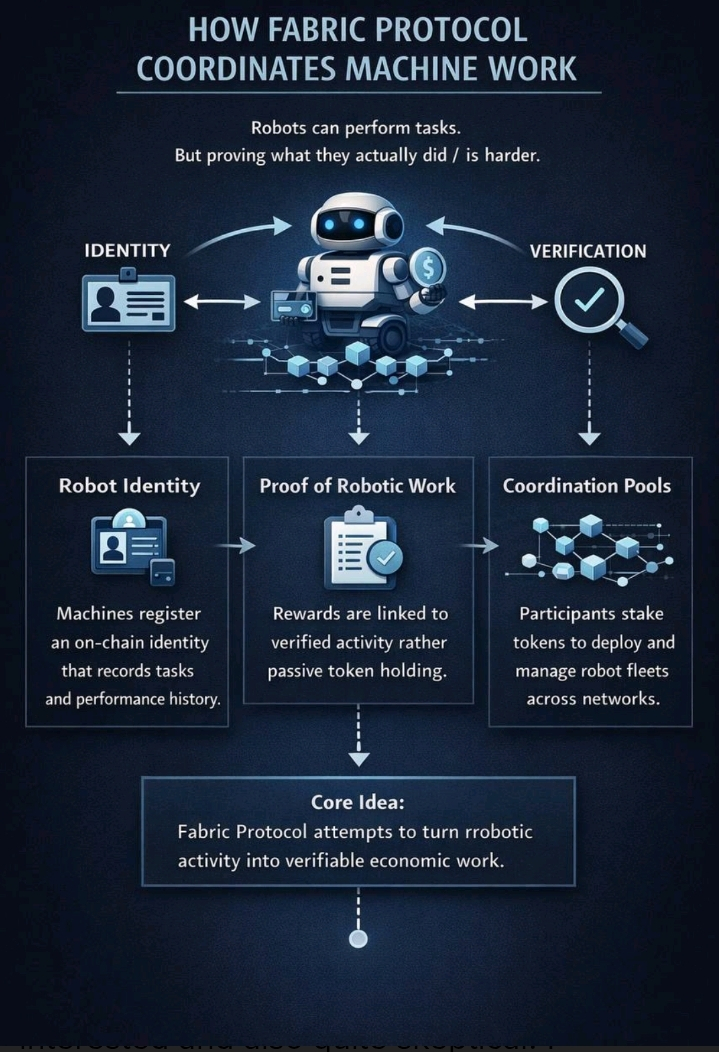
In practical terms, ROBOis not yet a buy-and-hold asset for the average investor. For traders and early adopters, it’s a narrative + structural play, but one that demands careful attention to timing, liquidity, and milestones. The best way to approach it is selectively: position around network adoption events and real usage indicators rather than just price action. The reward can be high if Fabric achieves its vision, but the risk of mispricing, unlock pressure, or slow adoption is equally high.
Ultimately, Fabric Protocol represents a rare kind of crypto thesis: it’s not about hype or memes; it’s about infrastructure and real-world economic coordination. Whether or not ROBObecomes a mainstream success depends on how quickly the robot economy actually materializes, but the opportunity to understand and position for it is already here. For those paying attention, this is the kind of structural story that can pay off handsomely for traders and builders who are willing to watch, wait, and engage selectively with the catalysts as they appear.
#ROBO @Fabric Foundation $ROBO
