Imagine being given a cookie, but being told you cannot eat it for one whole year. This is the exact test the $ROBO token is currently running on its biggest holders—and how they react will determine the token's future.
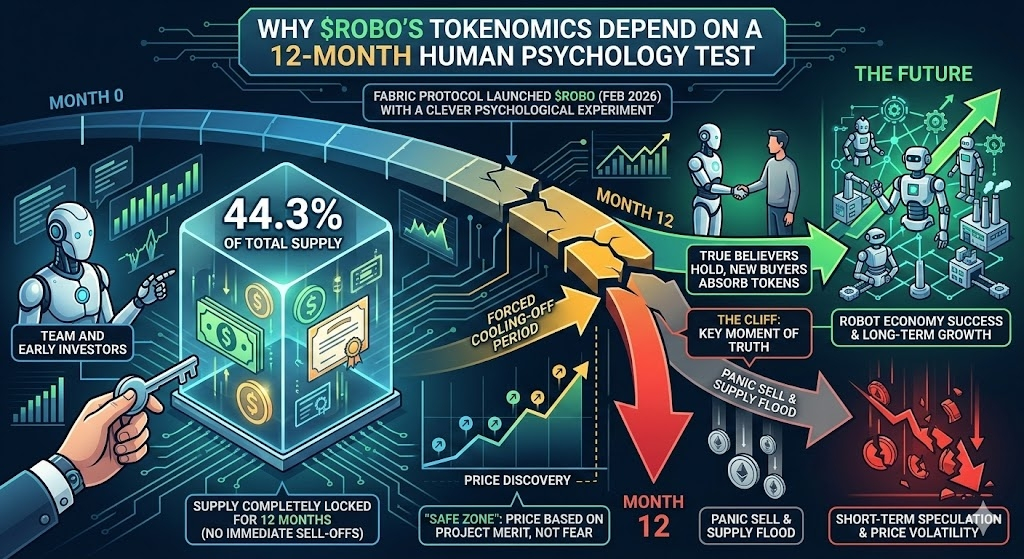
When Fabric Protocol launched $ROBO in February 2026, it built in a clever psychological experiment. A massive 44.3% of the total supply (held by the team and early investors) is completely locked up for 12 months . This means the people who usually have the power to sell immediately are forced to sit on their hands.
Why is this a "psychology test"?
For the next year, the market doesn't have to worry about insiders dumping their bags. This creates a "safe zone" where price discovery can happen based on the project's actual merit—its vision of creating an economy for robots—rather than fear of immediate sell-offs .
However, the clock is ticking. As the one-year mark approaches, a new psychological game begins. Will the early backers believe in the project's long-term success and hold? Or will they panic sell at the same time, causing a supply flood? .
This 12-month cliff acts as a forced cooling-off period. It separates short-term speculators from true believers. The project is betting that by the time those unlocks happen, the network will be so useful that new buyers will eagerly absorb any tokens sold .
In essence, $ROBO isn't just testing technology; it is testing human patience. The holders' ability to resist the urge to sell in the future will be the ultimate proof of whether this robot economy has real legs. @Fabric Foundation #robo