At first, I was using Price Action and Volume Profile, but I wanted more, so I went into tape
reading using DOM (Depth of Market). DOM is a feature that shows all the orders that appear
in the market—including the “pending orders.”
DOM (Depth of Market):
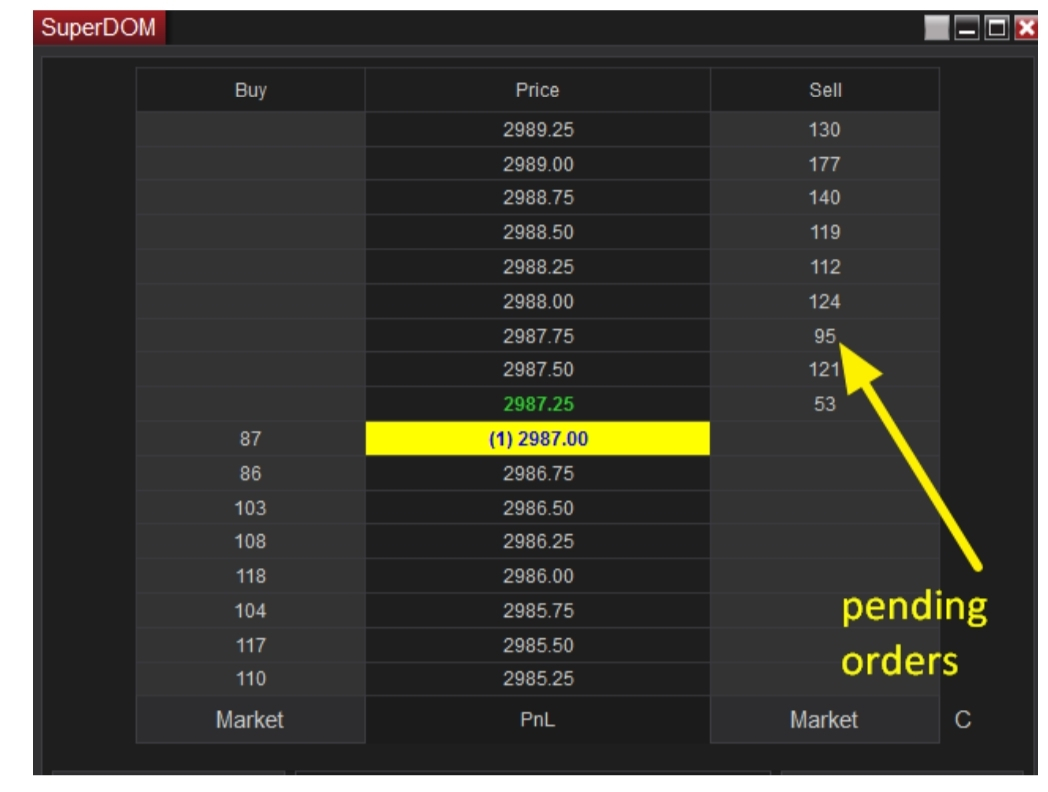
This seemed like the right way to go until I realized that most pending orders never get filled.
These orders are only placed in the market to move the price in the desired direction. When
the price comes close to them, they are, in most cases, withdrawn. Sort of like a carrot in front
of a donkey, he remains in constant pursuit but never actually gets it.
For me, DOM was just full of noise and too hard to read. I knew there was a lot of useful info
there, but I needed something to help me read that crazy matrix. This is where the Order Flow
came into play.
The big advantage of using the Order Flow is that it prints orders that matter—orders that
actually got filled (not the pending orders, which are often never filled). Order Flow also prints.
those orders in a way that is much easier to read as well as backtest. Exactly the thing I
needed!
At first, I started to use a third-party Order Flow software. After some time, I came up with a
few ideas for how the Order Flow could be improved by adding some specific and helpful
features. Long story short—I had a custom-made Order Flow developed with the additional
features built in!
Now I use my Order Flow every day for my intraday trading. I prefer to use it with Price Action
and Volume Profile as those show me the bigger picture. Still, there are others who prefer to
use Order Flow as a standalone indicator you build your trading around.
#BinanceSquareFamily #Orderflow #MarketProfile