
stayed up reading the economic security model last night. something kept nagging at me about the incentive structure and i couldn't place it until about 1am. and honestly once i saw it i couldn't unsee it 😂
here's what clicked.
MIRA's verification network works because diverse AI models vote on claims indepenndently. diversity is the entire security argument. different training data. different architectures.
different knowledge bases.
when diverse models reach consensus the result is genuinely more trustworthy than any single model's output.
that's not marketing.
that's the actual mechanism. whitepaper is explicit. diversity reduces both hallucination rates and systematic bias simultaneously. ensemble verification only works if the ensemble is genuinely diverse.
now here's where the economics come in.
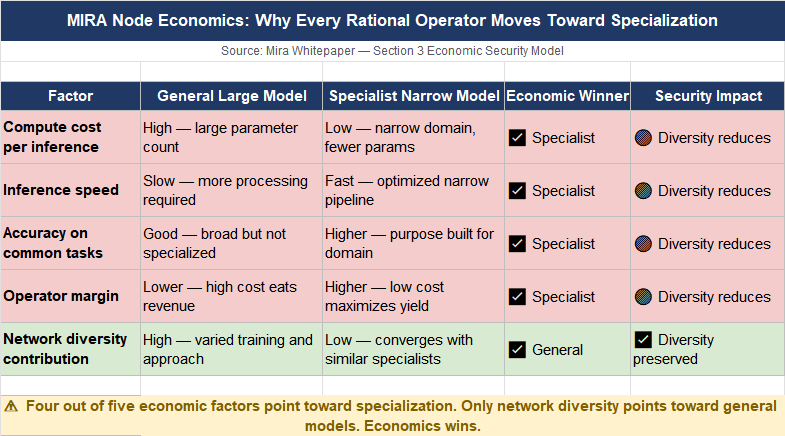
node operators achieve success by reaching correct answers at the lowest cost. whitepaper states this directly. lowest cost wins. that's the optimization target baked into validator economics.
and lowest cost has a very specific solution in AI inference.
general purpose large models are expensive to run. theey consume significant compute per inference. they're slow. they cost real money per verification round. specialized smaller models trained on narrow domains are dramatically cheaper.
faster inference.
lower compute.
higher accuracy within their specific domain.
so economic pressure on every node operator points in exactly one direction. build or acquire the most specialized narrow model possible for the most common verification tasks.
cut compute costs. increase margin. outcompete operators running expensive general models.
i ran through this logic three times because it felt too clean. but it holds every time.
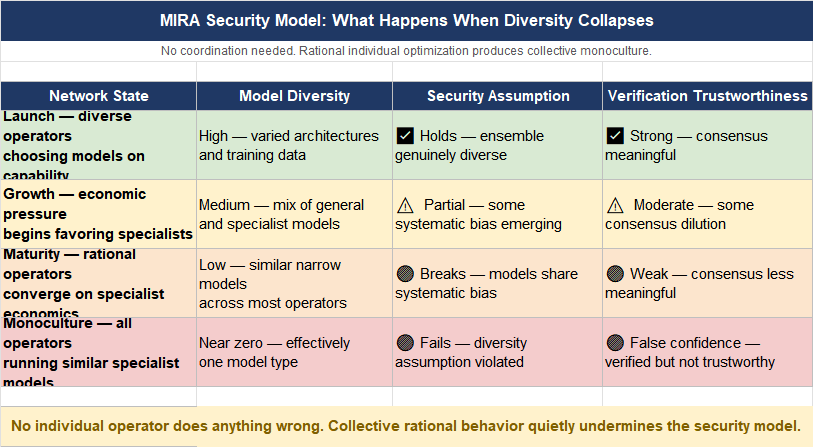
individual operator following rational economic incentives builds specialist model. every operator following rational economic incentives builds specialist models. network of rational operators converges toward specialist models. network of specialist models is no longer diverse in the way the security argument requires.
that's the tension. economic optimization and security assumption pulling in opposite directions.
what they get right though.
whitepaper actually acknowledges this dynamic directly. specialist models achieving comparable performance to larger models on specific tasks creates legitimate optimization opportunities.
they frame it as a feature not a bug. efficient task specific models benefit the ecosystem through higher accuracy rates lower costs and reduced latency.
and that framing has genuine merit. a specialist medical verification model that's cheaper faster and more accurate on medical claims than a general model is genuinely better for medical claim verification.
specialization serving the verification task well is real value.
sharding mechanism adds important protection too.
verification requests randomly distributed across nodes means specialists can't predict which claim types they'll receive. operator with narrow specialist model encounters claim outside their specialty and either runs expensive general fallback or submits lower quality verification.
random sharding creates economic pressure to maintain broader capability even while specializing.
network's detection of response pattern anomalies also catches operators who specialize too narrowly. node consistently outperforming on one claim type and underperforming on others creates detectable pattern.
slash risk discourages pure narrow specialization.
but here's what i still cant resolve.
sharding protects against pure specialists. it doesn't protect against coordinated specialization across operators. if most operators independently converge toward similar specialist models because economic incentives point the same direction, network diversity collapses without any individual operator doing anything wrong
no coordination required. no collusion required. just rational individual optimization producing collective monoculture
and the diversity claim in the security model assumes diverse training approaches and knowledge bases across operators. that assumption holds when operators choose models based on capability. it breaks when operators choose models based on cost optimization toward the same economic target
honestly checked my own thinking on this twice this morning before writing it up. the math seems right but happy to be wrong about this one
honestly dont know if economic incentives drive healthy specialization that improves verification quality or systematic convergence that quietly undermines the diversity the security model depends on.
watching whether node operator distribution data ever gets published and whether model diversity across validators gets tracked transparently
what's your take - specialization that strengthens the network or optimization pressure that hollows out the thing that makes it trustwortthy?? IDK 🤔
#MIRA @Mira - Trust Layer of AI $MIRA
