
@Mira - Trust Layer of AI $MIRA #Mira
Why Mira Network was created
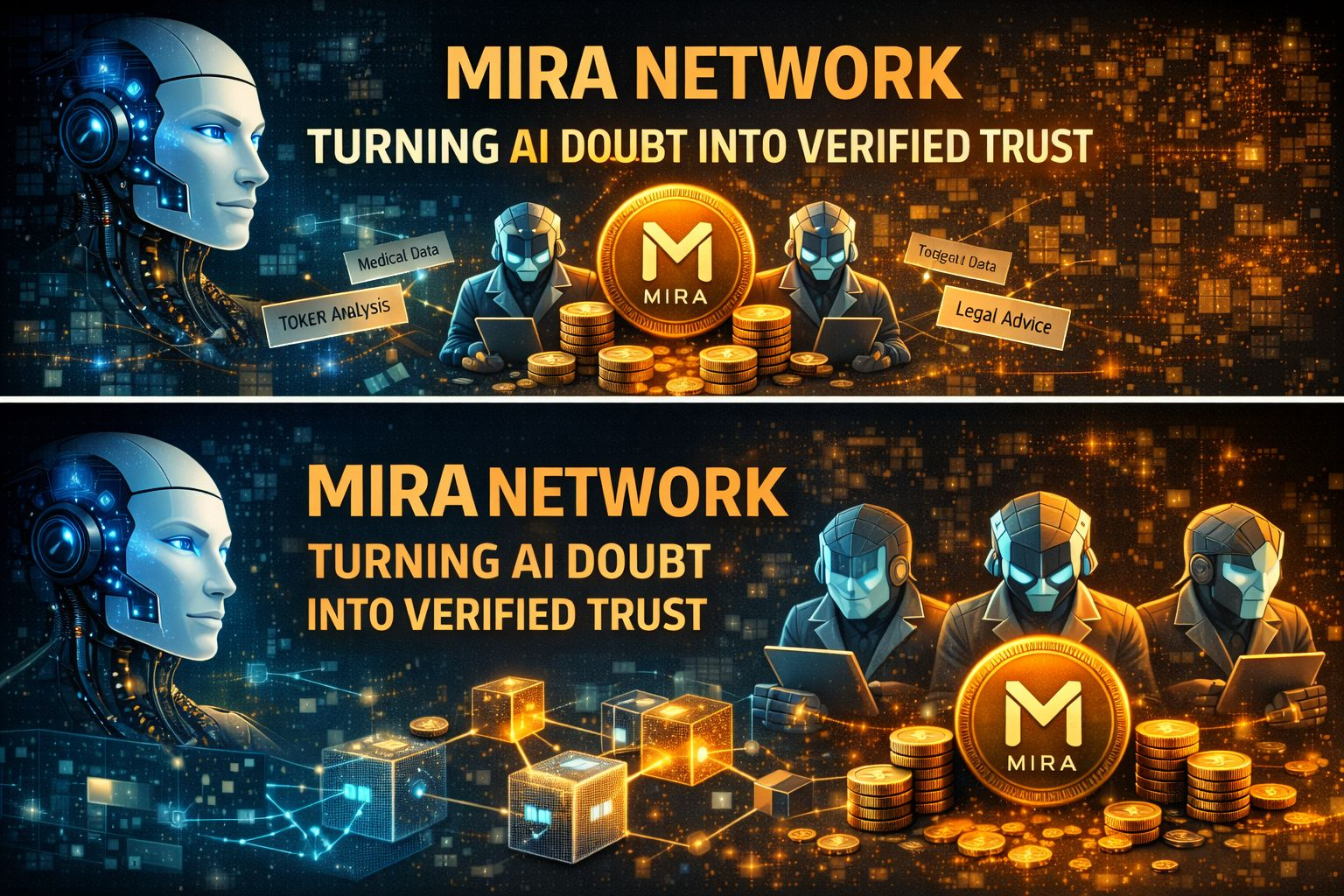
When I look at how fast artificial intelligence is moving, I’m always holding two feelings at the same time, on one side there is excitement because the tools feel powerful, creative and almost magical, and on the other side there is a quiet worry that never really leaves, because deep inside we know these systems can still be wrong in very confident ways, they can hallucinate facts, carry hidden bias, and mix truth with guesswork so smoothly that an ordinary person cannot see where the cracks are until something important breaks. In fun use cases this is not a big problem, if a chatbot writes a silly poem or a casual message and it is a bit off, we just laugh and move on, but when the same style of “confident guessing” starts touching money, health, contracts, safety decisions, or automated trading, then that gap between how smart AI looks and how trustworthy it actually is becomes a real risk, and humans end up sitting on top of the systems like nervous editors, reading every line again and checking everything by hand. Mira Network was created right in this uncomfortable space, not to make another “super smart model” that promises perfection, but to become a separate trust layer that lives between AI outputs and the real world, a layer whose job is to say for every serious answer, let us slow down for a moment, break this into clear claims, and see if we can verify those claims through a wider network instead of blindly trusting one company or one model. It comes from the simple human feeling of I’m impressed by AI but I still don’t fully trust it, and instead of treating that doubt as a weakness, Mira treats it as a design requirement.
How the system works step by step
If I imagine myself as a builder using Mira inside an application, the flow starts in a very familiar way, I send a question to an AI model and I get back some output, maybe it is a financial summary, maybe it is an explanation of medical guidelines, maybe it is analysis of a token, or a piece of code for an agent to run, and at that moment I have a choice, I can either trust this output as it is, or I can route it through Mira for verification. When I choose verification, the first thing Mira does is transform the messy, long answer into something that can actually be checked, because you cannot really verify a giant paragraph as a single unit. So the system breaks the output into smaller, clear statements called claims, each claim is like a small sentence that can be evaluated on its own, for example “this regulation applies to transactions above a certain amount” or “this number comes from this specific data source” or “this project launched in this year,” and by turning a big answer into many small claims, the protocol makes the problem of verification more manageable.
Once these claims are created, the next step is distribution, and this is where the decentralized nature of Mira starts to show, because instead of sending all the claims to one central checker, the network distributes them across many independent verifier nodes. Each verifier node can run its own stack of tools and models, different language models, different retrieval systems, different specialized checkers, and sometimes even direct queries to external data when that makes sense. They’re not all clones of one another, they’re meant to see the claim from slightly different angles, so the system does not fall into the trap of asking one model to mark its own homework. Every verifier looks at the claim, uses its tools and context, and then produces an assessment, usually something like “true”, “false”, “uncertain”, or “needs escalation”, along with a confidence level and sometimes supportive details.
This is where incentives enter the picture in a serious way. To be a verifier, a participant stakes the MIRA token, which is like putting some skin in the game, and they know that over time they will be rewarded for being accurate and aligned with honest consensus, and they will be penalized if they behave in obviously dishonest or low quality ways. So when claims go out into the network, It becomes more than just a technical game, there is an economic reason for nodes to try to be careful, to use good models, to maintain uptime, and to avoid blind collusion, because mistakes and manipulation can cost them real value. After all these individual assessments are collected, the protocol runs a consensus process over them, combining the votes, confidences, stake weight and historical behavior into a final decision for each claim.
When consensus for a claim is reached within the network’s thresholds, Mira does something very important, it packages the outcome into a verifiable proof, a kind of digital receipt that includes the decision, the time, the involved verifiers and other crucial metadata, and it anchors that proof on chain so it cannot be quietly changed later. That means the final result is not simply “the AI said so”, it is “this claim was checked by a decentralized network of verifiers, here is the record, here are the participants, here is when it happened”, and the application can attach that proof to its own output or use it internally as a signal. The app then receives either a set of verified claims or a mix of verified and flagged ones, and it can decide what to do, maybe the agent continues normally when everything essential is verified, but if some key claims are disputed or uncertain, the agent pauses, asks a human, or chooses a safer path. Step by step, that is how Mira turns a raw AI answer into something that carries a traceable story of how it was checked.
Why it was built in this particular way
When I look at the choices behind Mira, I’m seeing people who accepted early that no single model, no matter how advanced, will be perfect in every context, so they designed around diversity and separation of roles instead of centralization. They built Mira as a verification protocol rather than a competing “super model” because they know models will keep changing, new providers will appear, and new architectures will shift the landscape, but the need for an independent trust layer will stay. That is why they focus so much on this idea of “breaking into claims”, “distributing across many verifiers”, and “anchoring the result on chain”, these are not just buzzwords, they’re ways to keep the trust logic independent of any one AI vendor.
They also chose to plug into existing blockchain infrastructure instead of building a whole chain from nothing, because they’re more interested in using a reliable base for security, settlement and transparency than reinventing the wheel. For liquidity and access, having the MIRA token tradable on a major platform like Binance makes it easier for participants to join, stake and exit, which supports a healthy set of verifiers rather than a tiny closed group. At the same time, they kept the verification logic flexible, with support for many different models and tools, because they understand that what works now might not be enough later, and It becomes critical to be able to plug in new models, new detectors and new evaluation strategies without rewriting the whole system.
Another quiet but important choice is the separation between the app developer and the complexity of the network, through SDKs and APIs that hide a lot of the messy orchestration details. I’m seeing this as a very practical decision, because most teams do not want to juggle model selection, routing, consensus and staking logic by themselves, they just want to say “please verify this” and get back a clear signal, and by abstracting the complexity away, Mira tries to make verification feel like a natural part of building an app rather than a huge extra project on top.
The technical choices that really matter
Under the hood there are many technical points, but some of them matter more than others when we think about trust in a human way. One big choice is multi model verification, they do not lock everything to a single large language model or a single provider, they deliberately pull in many models with different strengths and different training backgrounds. This matters because models see the world slightly differently, they have different blind spots and different weaknesses, and when you combine them under a weighted consensus, you reduce the chance that one shared bias or one shared hallucination will silently take over.
Another key choice is using staking and slashing to align behavior. Verifiers are not just doing casual work, they’re making decisions with their own stake at risk, and over time the system can reward nodes that are consistently accurate and responsive while removing or punishing those that behave badly or lazily. If It becomes normal that verifiers think carefully before giving an answer, because they know the network tracks their history, then the whole process of verification feels less like a game and more like a profession.
There is also the choice to store verification proofs on chain instead of writing them into a private, editable database. That might sound like a small detail, but from a human point of view it is a way of saying, we will not quietly rewrite history when it becomes inconvenient. If a decision is made based on a certain verified claim, and later someone asks “who checked this, what did they see, who agreed”, the on-chain proof can answer that without depending on the memory of one company. This creates a shared memory of verification events that regulators, auditors, users and other agents can all refer to if they need to.
Finally the architecture is built to be modular, so the system can improve step by step. New models can come in, new verification algorithms can be tried, new ways of scoring trust can be tested, and the protocol can adapt without destroying its core promise, and I’m seeing that as essential, because AI is not standing still, and any trust layer that freezes in time will become weak very quickly.
What important metrics people should watch
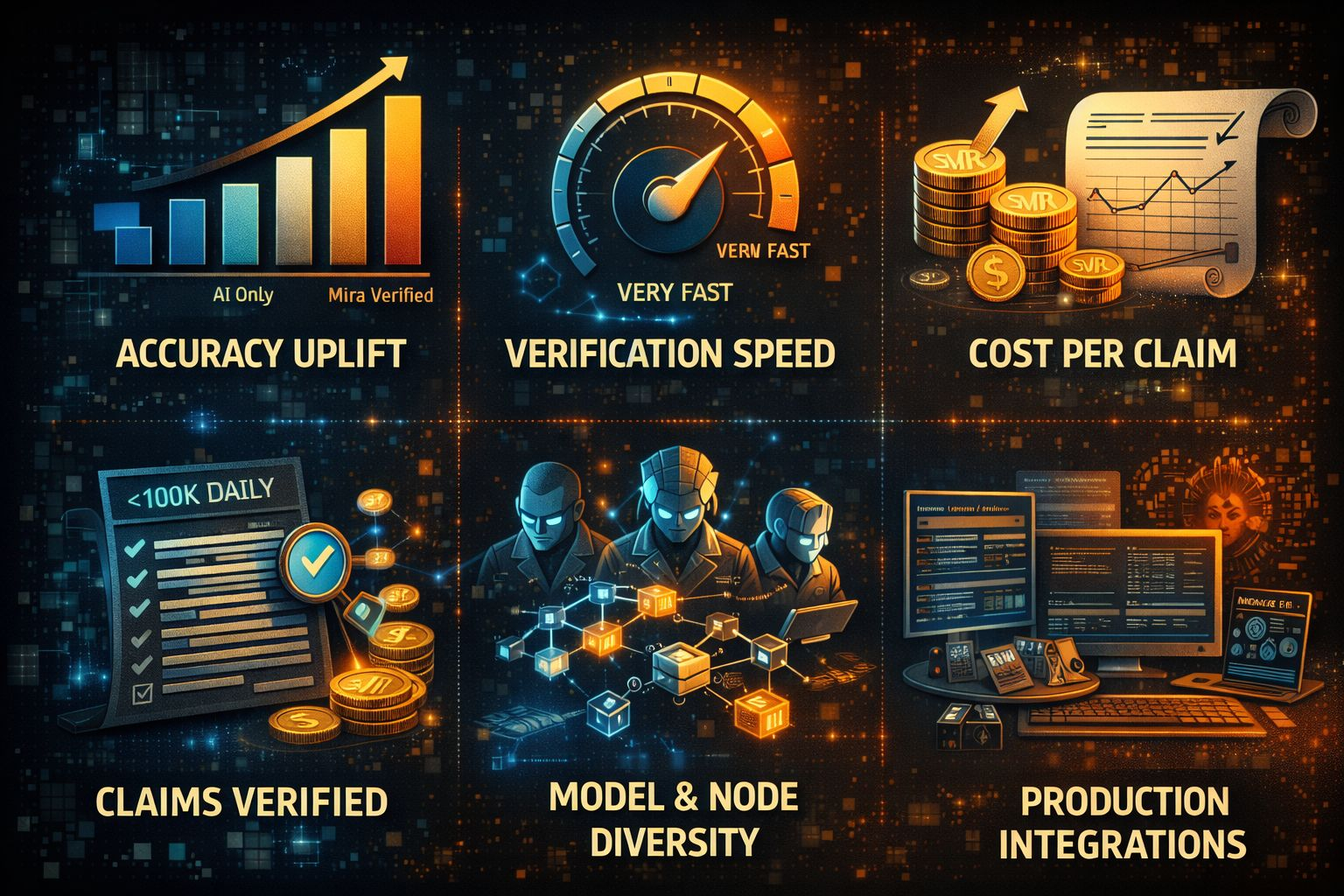
When people look at Mira only through price charts, they miss the real story. If I care about whether this network is actually doing its job, I’m looking at a different kind of data. One of the most important metrics is accuracy uplift, so I ask, when applications run outputs through Mira, how much does factual accuracy or reliability improve compared to using a single model alone. If verifiable tests show that claims passing through the network reach a significantly higher correctness rate, especially in complex or high stakes tasks, then the network is not just decoration, it is adding real safety.
Another big area is usage. I want to see how many claims are being sent for verification every day, how many different applications are plugged into the network, and how much of that traffic is real production traffic instead of tiny experiments. If I’m watching those numbers grow over time, I’m seeing a picture of verification becoming a normal part of how people use AI, and not just a niche tool for a few enthusiasts.
Diversity is also critical. It is not enough to have a high number of models or nodes on paper, what matters is how distributed the verification power really is, how many independent operators are staking, which models are used, and whether any single group is quietly controlling most of the decisions. If the system becomes dominated by a few heavy players, then the promise of decentralization starts to fade, so I would keep an eye on metrics that show how decentralized the verifier set is and how often new participants are joining.
Performance metrics like average verification time and cost per claim are also very important. If getting a claim verified takes too long or costs too much, developers will feel tempted to skip verification for all but the rarest cases, and then the trust layer will remain thin. But if Mira can keep verification fast enough and cheap enough for most critical workloads, We’re seeing a pathway where agents, dashboards and protocols can comfortably treat verification as a default step rather than a luxury.
And then there is ecosystem adoption, which is harder to measure with a single number, but you can feel it in the types of projects that integrate, such as DeFi protocols who want an extra check before executing risky actions, on chain research tools that want to attach verification receipts to analysis, or compliance systems that want to scan and verify large document sets. When those kinds of serious applications openly rely on Mira, it sends a strong signal that the network is not only interesting in theory but trusted in practice.
What risks the project faces
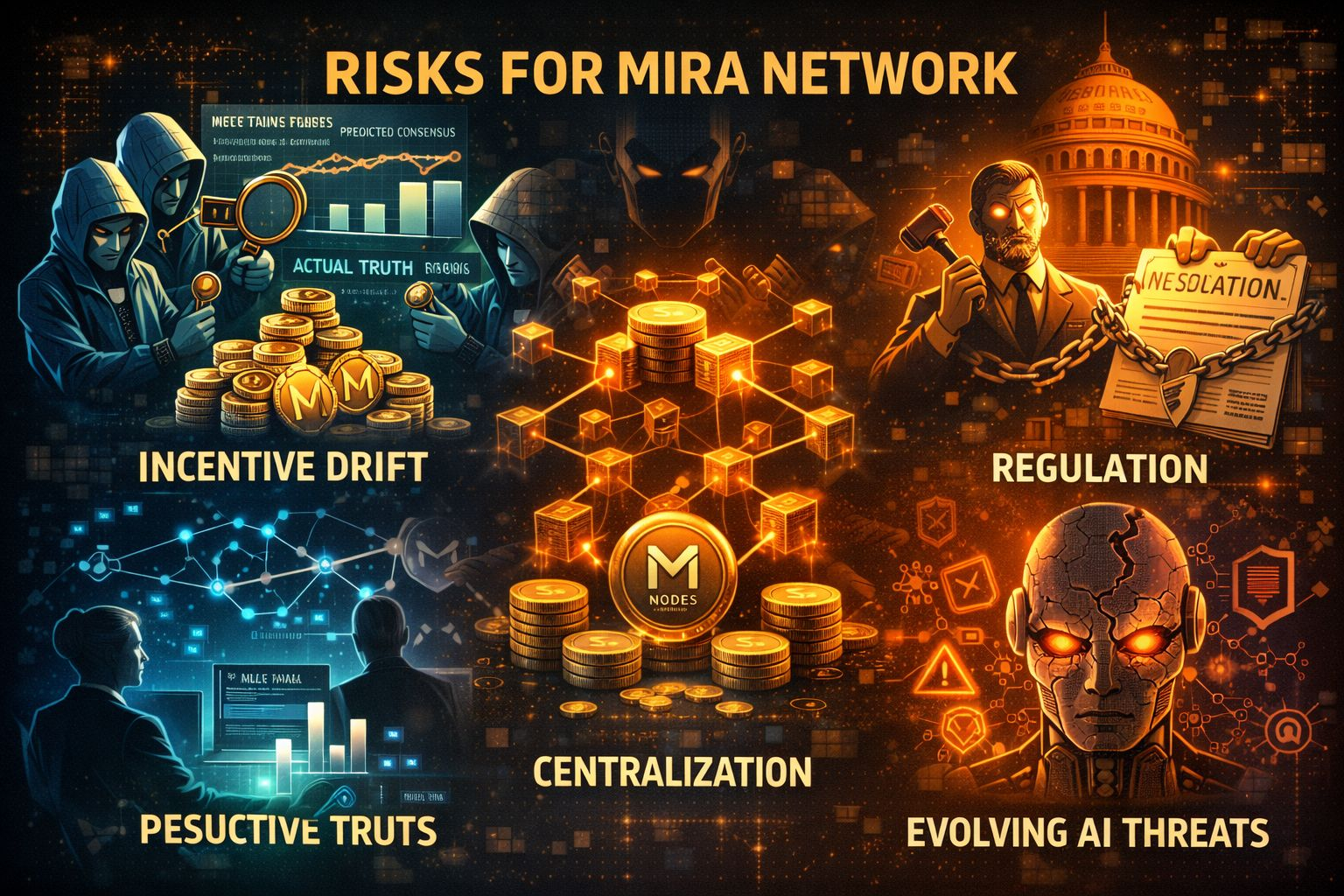
Even with all these careful choices, Mira is not magic, and I think it is honest to talk about the risks, because they’re part of the story. One risk is that incentives can drift in strange ways, if verifiers are mostly rewarded for matching consensus, there is a temptation to think “what will everyone else say” instead of “what is actually true”, and if that mindset grows, the network can slide from being a truth system to being a crowd-guessing system. To protect against that, the design has to keep rewarding diversity, encourage the use of different models, and keep slashing behavior meaningful for those who try to game the process.
Another risk is centralization of power. If over time a few big players stake huge amounts of MIRA and run many nodes, they can start to influence outcomes simply through their weight, and then we are back in a world where a small group decides what is true. Good protocol design, transparent metrics and active governance are needed to push back against that, so the network keeps space for smaller but honest and skilled operators.
There is also a wider risk around regulation and public perception. As soon as people and institutions start making real decisions based on verification proofs, any failure or major dispute can become very visible, and regulators may ask Mira and similar networks to meet strict standards. If that pressure is handled well, it could help the network mature, but if it is handled badly, it might force compromises that hurt openness or innovation. The community will need to be ready for serious conversations with legal and social actors, not just technical debates.
And of course there is the moving target of AI itself. New models, new attack techniques, new forms of data poisoning and new kinds of hallucination will keep appearing, and a verification layer that does not evolve alongside them will slowly lose relevance. That is why the modular design and the governance around updating the system are not just nice extras, they’re survival tools. If It becomes rigid, it will eventually break.
How the future might unfold
If Mira’s vision takes hold, the future of AI starts to look different in a subtle but important way. Instead of living in a world where agents and models speak with total confidence and we just hope they are correct, we move into a world where serious systems treat verification as a normal reflex, like checking a seat belt before a long drive. We’re seeing early examples of this mindset already, where builders ask not only “what can the model do” but also “how can we be sure before we act”, and Mira tries to give them a concrete path to answer that second question.
In that future, an AI trading bot might not be allowed to move real funds unless key claims in its reasoning are verified, a research assistant might not be allowed to add certain statements to a report unless they carry a proof, and a compliance tool might only mark something as safe if its verification pipeline has passed. Human experts will still exist, they will still review edge cases and design policies, but they will no longer need to stare at every token the model generates, because the trust layer will filter out many of the obvious and hidden mistakes before the output reaches them.
From an ecosystem angle, having MIRA available on a major exchange like Binance makes it easier to connect capital, infrastructure providers and application teams into one loop, where new verifiers can join, stake and participate without exotic barriers, and where the health of the network can be reflected not only in technical metrics but also in how confidently people are willing to hold and use the token. If this relationship stays grounded in real usage rather than pure hype, the financial layer can actually strengthen the trust layer instead of distracting from it.
If verification becomes a habit, not a rare exception, people’s relationship with AI might shift from fear and blind faith to something more balanced, where we say yes, these systems are powerful and sometimes they will still fail, but we have built processes, networks and incentives that catch many failures and leave an open trail when things go wrong. Mira cannot remove all risk from AI, and I don’t think it is trying to, but it can help move us from “AI that sounds right” to “AI that has to show its work”, and that change alone could reshape how comfortable we feel letting these tools into the core of our financial, scientific and everyday lives.
A soft and inspiring closing note
When I think about Mira Network in a very simple way, I’m not just seeing code, nodes, tokens and diagrams, I’m seeing a group of people who looked at the same nervous feeling many of us have about AI and decided not to ignore it, they turned that feeling into a protocol. They’re saying it is okay to love what AI can do and still demand proof, it is okay to be amazed and still ask “how do you know this”, it is okay to slow down in the places where errors really matter. If they succeed, we may end up with a world where our agents and systems move quickly, but the most important steps always carry a traceable story of how they were checked, who looked at them, and why we decided to trust them. That kind of world does not remove uncertainty, but it respects it, and it lets us grow into the AI era with a little more calm. For me, that is what makes Mira feel special, not just as a piece of technology, but as a quiet promise that intelligence and responsibility can grow together if we are willing to design for both.