I remember watching a small delivery robot moving slowly across a sidewalk near a university campus. The robot paused at the curb waited for people to pass then rolled forward again. It seemed like the robot had all the time in the world. At the time it felt pretty ordinary. Just another machine doing a job.. Later I thought about it some more and realized that something strange was happening behind the scenes. The delivery robot was moving through space interacting with people and making small decisions all the time.. Yet no one nearby could really say who was responsible for each of those decisions.
The question of who's responsible becomes more interesting when robots start acting less like tools and more like participants in systems. For example a warehouse robot sorting packages, a drone inspecting infrastructure or a small delivery vehicle navigating sidewalks. These machines operate quickly and often independently. Regulators are used to supervising companies and people.. Machines are different. They do not file reports they do not explain themselves. They can generate thousands of actions in a single day. So oversight starts to feel messy.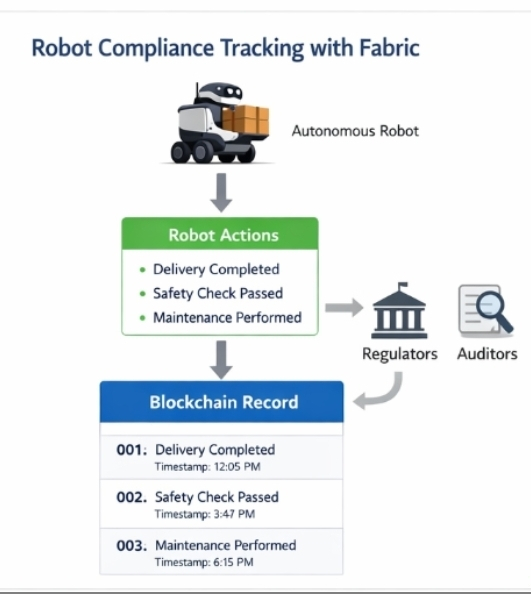
Most compliance systems today are built around institutions. Governments ask companies to keep records produce audits and show documentation when needed. The company becomes the layer between the machine and the regulator. This works fine when machines behave like equipment.. Once automation spreads across logistics, manufacturing and public services the number of machine actions grows beyond what human reporting systems were designed to handle.
This is where the idea behind Fabric becomes interesting. Fabric is not really about building delivery robots or better drones. The focus is on identity and accountability for machines like delivery robots and drones. The proposal is simple: give machines like delivery robots and drones verifiable identities on a blockchain so their actions can be recorded in a way that cannot easily be changed later.
A blockchain is basically a shared ledger. Imagine a record book that many independent participants maintain together of a single company controlling it. Once information is written into that ledger it becomes very difficult to alter without everyone noticing. Fabric uses this idea to track the activity of machines like delivery robots and drones. A delivery robot could have its digital identity and each operation it performs could be attached to that identity as a permanent record.
At first I thought this sounded a bit excessive. Do delivery robots and drones really need identities the way people or organizations do?. The more I thought about it the more the regulatory angle started to make sense. Regulators struggle when information about machine behavior is scattered across systems. A warehouse company might store its logs. A drone operator might keep flight records internally. Each dataset sits in a place, controlled by a different company.
Fabrics approach changes the location of those records. Of living entirely inside corporate systems machine activity could be anchored to a shared infrastructure. A delivery robot delivers a package performs maintenance or receives a payment for completing a task. Each event becomes an entry tied to its identity. Over time the machine builds something to a history.
History matters more than it might seem. Regulators usually care less about an incident and more about patterns. If a delivery robot fails safety checks repeatedly or operates outside allowed conditions that pattern is what triggers attention. When activity logs exist in an verifiable form spotting those patterns becomes easier. The oversight process shifts away from chasing paperwork and toward observing behavior
There is another layer to this. It reminds me a bit of how online communities evaluate credibility. On platforms like Binance Square people rarely read every post a creator has ever written. Instead they look at signals. Rankings, engagement patterns, visibility on dashboards. Those signals are imperfect. They help people decide whose information deserves attention.
A compliance system for machines like delivery robots and drones might evolve in a similar direction. Of regulators digging through endless logs the infrastructure could generate reliability indicators. Machines like delivery robots and drones that consistently follow rules accumulate reputational signals. Systems that produce behavior become visible much faster. Not as punishment more like an early warning system.
Still this is where things start to get complicated. Transparency sounds attractive in theory. Businesses are rarely comfortable exposing operational data. A logistics company may not want competitors seeing activity records about its delivery robots and drones. Even if the information is partially abstracted the balance between accountability and privacy becomes delicate.
Another issue is data accuracy. Blockchain systems are good at preserving records. They are not perfect at guaranteeing the truth of the data entering those records. If sensors fail or software logs information the system might faithfully store something that never actually happened. Correcting mistakes in systems is possible but it requires careful governance.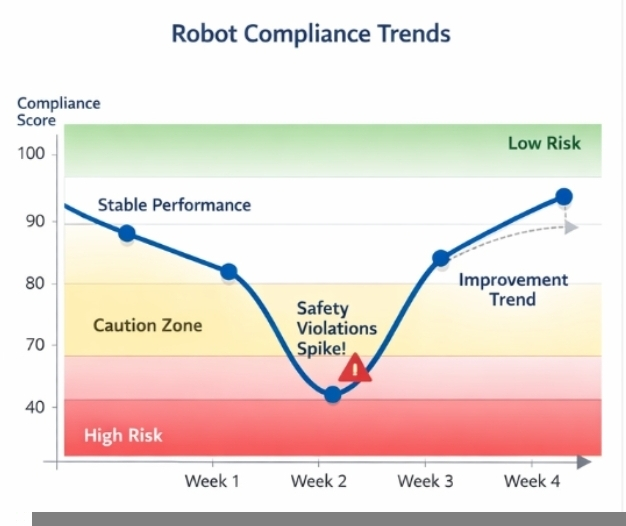
I also wonder whether regulators themselves are ready for this type of infrastructure. Governments move slowly. Technical systems evolve quickly. Fabric might build the rails for machine accountability but institutions still need to decide how to use them. Rules about behavior liability and safety standards will still come from policymakers not from code.
What interests me most is the shift in thinking behind this idea. Traditional compliance treats oversight as something that happens after the fact. An incident occurs investigators look for records. The process begins. Fabric seems to push toward a model where compliance becomes part of the systems architecture from the beginning.
If machines like delivery robots and drones carry identities and verifiable activity histories accountability starts to exist alongside the automation itself. Not as a report written months later. As a living trail of actions.
Whether regulators adopt this approach widely is still uncertain. Technologies often appear long before institutions decide how to use them.. Watching that delivery robot on the sidewalk again in my mind it becomes easier to imagine a future where machines like delivery robots and drones move through the world with something quietly following them in the background. Not a human supervisor exactly. More, like a record of where they have been and how they behaved along the way.

Articolo
The Compliance Angle: How Fabric Could Reshape Regulatory Oversight for Robots
Disclaimer: Include opinioni di terze parti. Non è una consulenza finanziaria. Può includere contenuti sponsorizzati. Consulta i T&C.
0
3
526
Esplora le ultime notizie sulle crypto
⚡️ Partecipa alle ultime discussioni sulle crypto
💬 Interagisci con i tuoi creator preferiti
👍 Goditi i contenuti che ti interessano
Email / numero di telefono