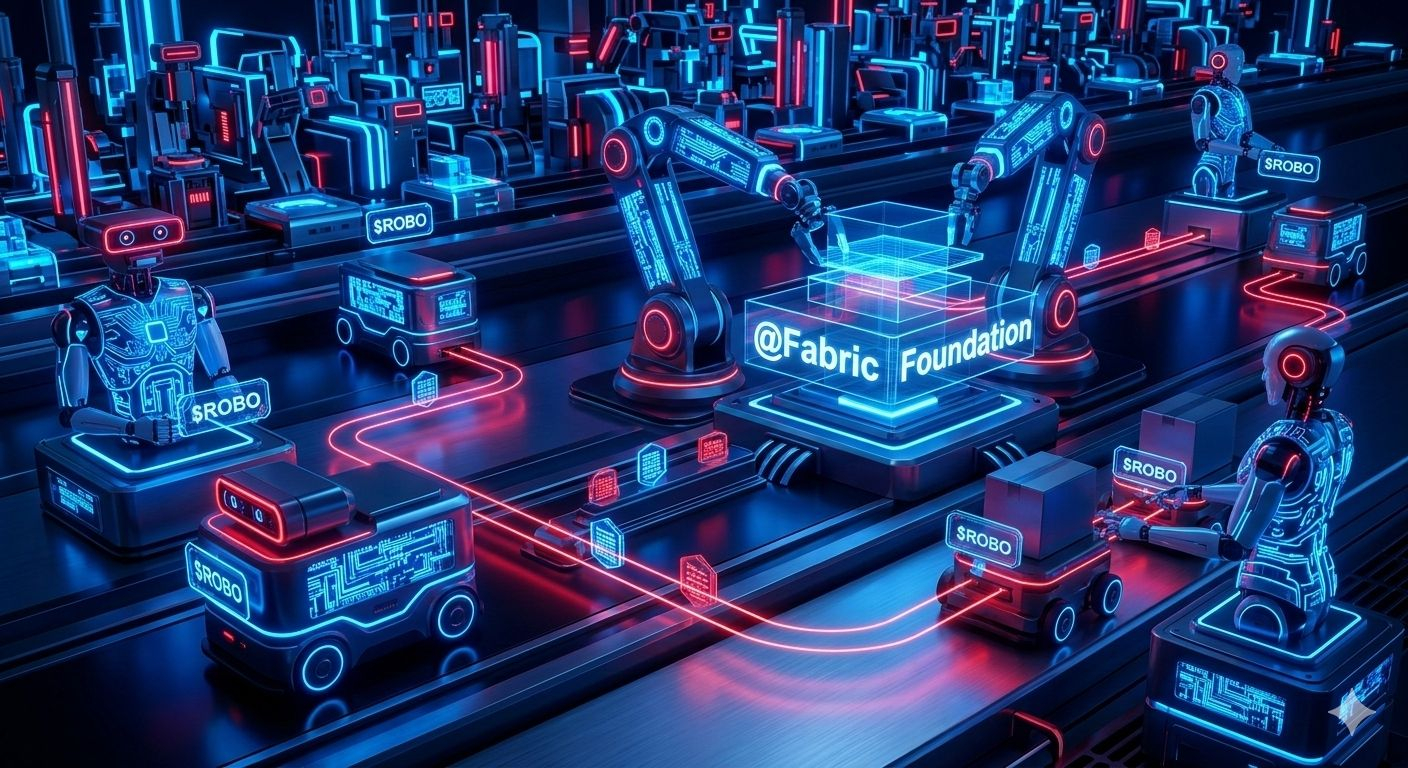
The DePIN gap nobody is talking about (and how the robotics economy fixes it)
If you’ve been paying attention to the DePIN space lately, you’ve probably noticed a massive gap between software networks and actual physical execution. We have decentralized storage, compute, and wireless networks, but the hardware layer that actually moves things in the real world is lagging behind. This is exactly where @Fabric Foundation steps in, and honestly, it’s one of the most fundamentally sound use cases I’ve seen this cycle.
Instead of just building another theoretical network, they are creating a framework where robots become sovereign economic actors. Think about that for a second. A drone, an assembly machine, or a delivery bot doing work, earning revenue, and paying for its own maintenance or power without any human intervention. This entirely new machine-to-machine economy is settled exclusively using the $ROBO token.
What makes this interesting is that $ROBO isn’t just a useless governance token; it’s the literal bloodline of this automated economy. When machines negotiate and pay each other to complete physical tasks, they need a fast, permissionless, and verifiable settlement layer.
While everyone else is endlessly hyping up software-only AI agents, the actual convergence of AI, hardware, and crypto is happening right here. The transition to autonomous physical machines is going to be a massive narrative, and fading the robotic settlement layer while it's still being built feels like a huge mistake.
#ROBO