
spent the last two days going through validator economics properly. pulled the whitepaper apart section by section. and honestly the reward structure is more complicated than the clean summary most people are sharing 😂
here's what i found.
validators on Fabric do three things. verify robot task compleiton. confirm proof of robotic work submissions.
maintain network consensus on operator quality scores. each function generates separate reward streams. understanding which stream pays what changes how you think about validator incentives entirely
task verification rewards come from operator fees. every robot task generates a protocol fee. validators who confirm task completion correctly get proportional share of that fee pool. straightforward
scales directly with network activity. more tasks equals more fees equals more validator income
quality score maintenance is different. validators who maintain accurate oparator quality scores earn stability rewards from protocol emission. not fee dependent.
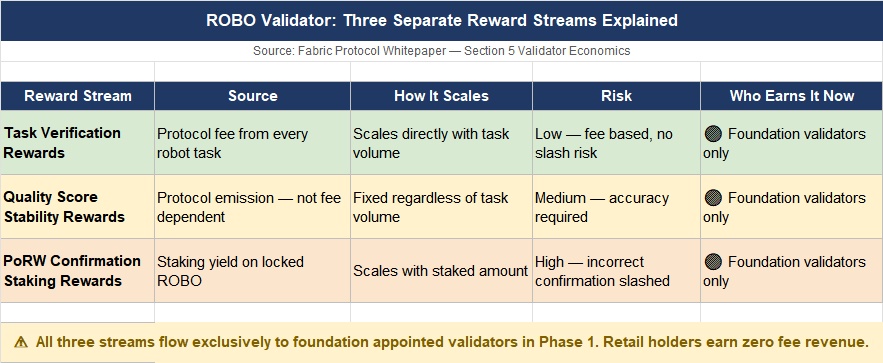
paid regardless of task volume.
this is the mechanic that keeps validators honest during low activity periods when fee revenue is thin.
proof of robotic work confirmation is the most complex stream. validators stake ROBO to participate in PoRW confirmation rounds. correct confirmations earn staking rewards. incorrect confirmations trigger slashing. asymetric risk
upside capped by reward rate. downside uncapped by slash severity
that asymmetry kept bothering me when i was reading through it.
validator running honest operation earns fee share plus stability rewards plus staking rewards. three streams compounding together. at scale that's genuinely attractive economics. whitepaper models suggest top validators could earn meaningful yield on staked ROBO as network matures.
but here's the concentration problem nobody is talking about.
phase 1 validators are foundation appointed. not elected. not permissionless. foundation selected. same centralization issue we see everywhere in early ROBO architecture. but validator concentration has a specific economic consequence that's different from governance concentration.
validators capture fee revenue. foundation appointed validators capture all fee revenue in phase 1.
every operator fee, every task completion payment, every quality score reward flows exclusively to validators foundation chose.
that's not a governance problem. that's a revenue capture problem.
retail ROBO holders who aren't foundation approved validators earn zero fee revenue in phase 1. they can delegate to operators and earn usage credits. but direct fee revenue from network activity goes entirely to permissioned validator set.
i checked this three times because it seemed too stark. whitepaper is consistent on it. phase 1 validator set is closed. fee revenue flows to closed set.
what they get right though.
three stream reward design is genuinely well thought through. separating fee revenue from stability rewards from staking rewards creates validator incentives that work across different network conditions.
fee revenue rewards growth. stability rewards reward accuracy during slow periods. staking rewards reward security participation
each stream solving a different validator behavior problem
validator slashing for incorrect PoRW confirmation is important design
without slash risk validators have no economic reason to do expensive verification work honestly. slash mechanics make lazy validation economically irrational. that protection matters for network integrity.
and foundation appointment in phase 1 solves a real bootstrapping problem. open validator set before quality standards and slashing mechanics are fully calibrated creates manipulation risk.permissioned start protects network during vulnerable early period. not ideal but not arbitrary either.
but here's what i cant get past.
transition from foundation appointed validators to open validator set has no published timeline.
same problem as phase decentralization.
decision controlled by foundation. foundation currently captures validator economics. foundation deciding when to open validator set to competition has an obvious conflict of interest.
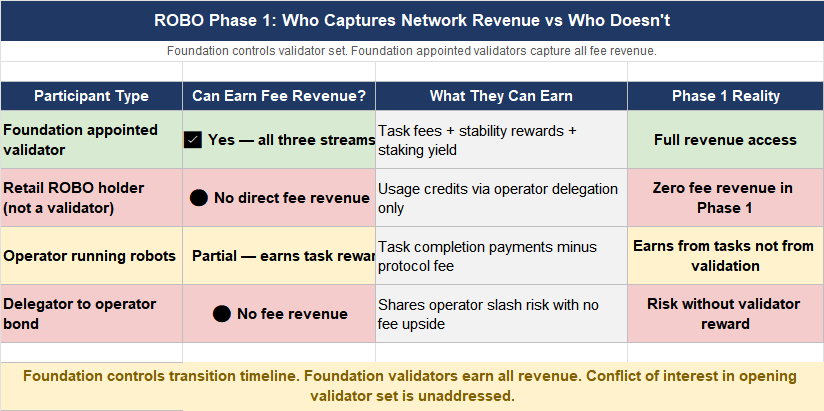
validators earning three compounding reward streams have strong incentive to delay opening validator set to new entrants.
foundation controlling that timeline while foundation appointed validators earn all fee revenue is a tension the whitepaper doesn't address directly.
honestly don't know if validator econmics deliver the compelling yield model whitepaper describes or concentrate network revenue in foundation appointed hands longer than token holders expect.
watching for any announcement of open validator applications and whether transition criteria get published before that happens.
what's your take ???
three stream reward design that democratizes validator yield or foundation controlled revenue capture dressed as open economics?? 🤔