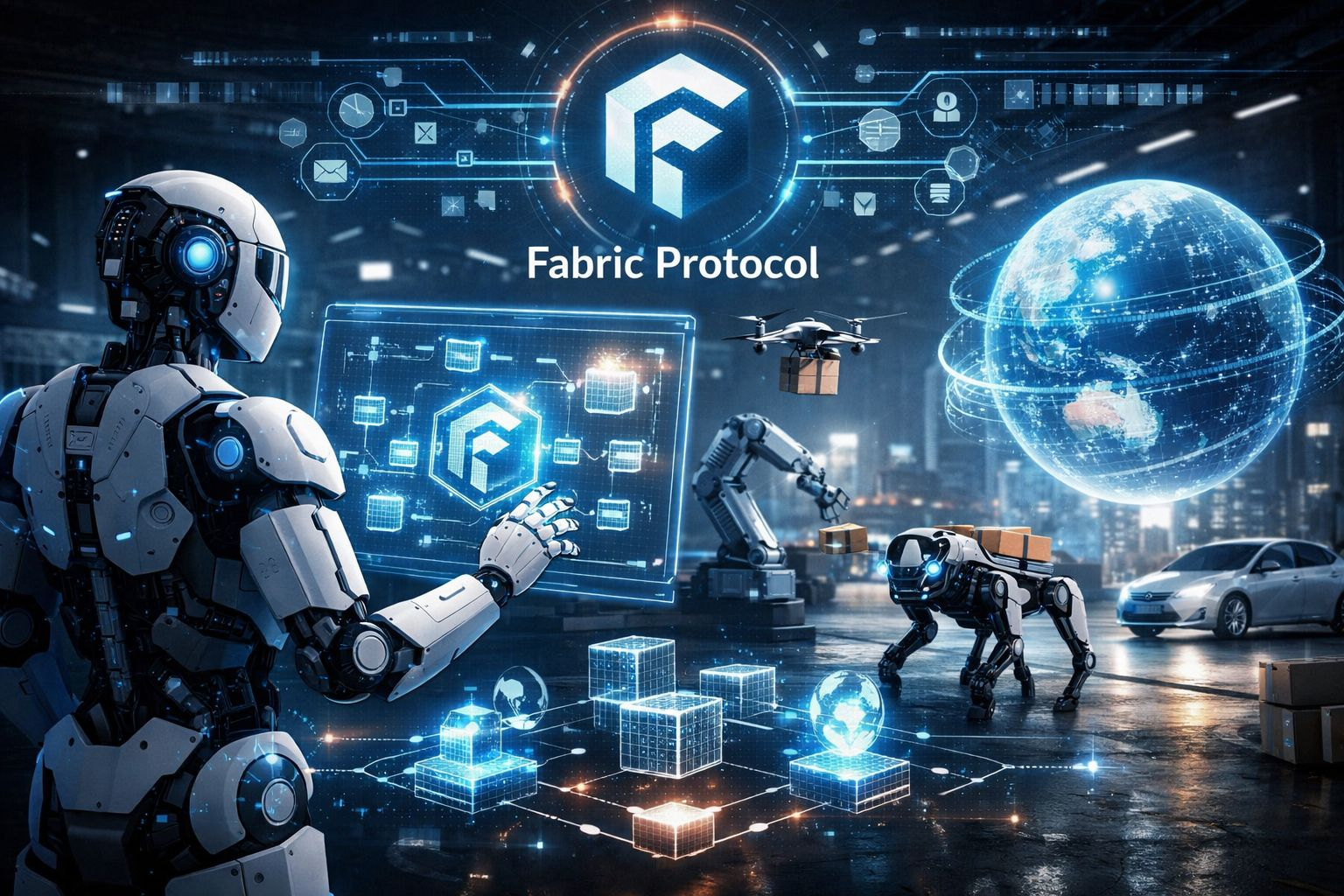
I still remember the moment I first encountered the concept behind Fabric Protocol. At first glance, it appeared to be just another experimental project sitting at the crossroads of robotics and blockchain. The crypto industry has seen plenty of bold attempts to combine emerging technologies, so my first reaction was a mix of curiosity and skepticism. However, as I spent more time learning about it, I realized the idea was aiming at something far more profound than simply linking machines to a blockchain network.
What truly grabbed my attention was not just the technical aspect. It was the possibility that robots themselves could become active participants in decentralized systems.
That idea lingered in my mind for quite some time. Most discussions around blockchain tend to revolve around finance, digital tokens, and decentralized applications. Occasionally the conversation expands into areas like data storage, digital identity, or artificial intelligence. Robotics, however, rarely appears as a central part of the conversation. Yet when I stopped to reflect on it, I realized the world is gradually filling with machines—factory robots, autonomous delivery drones, warehouse automation systems, smart home assistants, and even self-driving vehicles.
Every one of these machines produces data. They all rely on computing power. And increasingly, they must interact and coordinate with other systems.
The issue is that the infrastructure connecting these machines is typically centralized. Cloud providers host the computing environments, corporations control the data, and the rules governing how machines communicate are usually hidden within closed platforms. This creates a strange contradiction: the machines themselves may operate autonomously, but the networks managing them remain heavily centralized.
That’s when the idea behind Fabric Protocol started to make much more sense to me.
Fabric is built on a straightforward yet ambitious vision. Instead of robots functioning as isolated devices connected to proprietary systems, they could operate within an open and verifiable network where data, computation, and governance are organized through a public ledger. The project is backed by the Fabric Foundation, a non-profit organization working to develop the infrastructure required for collaborative machine ecosystems.
What fascinated me most was how the project treats robots not simply as hardware, but as agents within a digital ecosystem.
Within Fabric’s framework, machines can interact with decentralized infrastructure that verifies their actions, coordinates computational tasks, and records outcomes transparently. This creates a structure where robots can contribute information, request resources, and collaborate with other machines without relying entirely on centralized intermediaries.
As I continued researching the protocol, one phrase kept appearing: “verifiable computing.” At first, it sounded a bit abstract, but the concept is surprisingly powerful. Machines don’t just execute tasks—they also generate proof that those tasks were completed correctly. That proof can then be recorded and validated on a shared ledger.
Imagine a robot carrying out a complicated operation inside a warehouse. Instead of simply sending a log to a private company server, the machine could produce cryptographic evidence confirming that the action occurred under specific conditions. Other systems within the network could independently verify the result.
This might seem like a minor technical change, but it fundamentally transforms how trust operates in machine networks.
One of the biggest challenges in robotics today is not just designing capable machines—it’s coordinating them safely and efficiently across large systems. Industrial facilities, logistics networks, and smart infrastructure often involve dozens or even hundreds of machines interacting simultaneously. When everything relies on centralized platforms, transparency becomes limited and accountability becomes harder to maintain.
Fabric Protocol approaches this issue by combining modular infrastructure with a public ledger that serves as a coordination layer.
The modular structure stood out to me because it suggests the system isn’t trying to force every robotic environment into a rigid framework. Instead, different components—such as data layers, computational resources, and governance systems—can connect through shared standards. This type of flexibility is often essential for real-world adoption, especially in robotics where hardware diversity is enormous.
Another concept that caught my attention was “agent-native infrastructure.” This idea suggests the network is designed from the ground up to support autonomous agents rather than focusing only on human users. Robots, AI systems, and automated services could all operate within the same verifiable digital environment.
In other words, machines wouldn’t just be tools inside the network—they would become participants.
As I thought more about it, this idea began to align with broader developments across the crypto ecosystem. Over the past few years, decentralized networks have expanded far beyond financial transactions. We’ve seen experiments involving decentralized storage, distributed computing markets, AI training platforms, and identity frameworks.
The central theme behind these innovations is simple: blockchain networks can coordinate resources without relying on centralized authorities.
Fabric seems to extend that concept into the physical world.
Rather than coordinating financial assets, the protocol coordinates machines and the results of their computational work. Data generated by robots becomes verifiable. Tasks performed by machines can be audited. Governance systems can evolve collectively rather than being controlled by a single organization.
This kind of framework could become increasingly important as robotics continues to expand.
Modern warehouses are already packed with automated systems. Autonomous delivery vehicles are being tested in cities around the world. Agriculture is becoming more robotic every year. Even construction and infrastructure maintenance are beginning to incorporate machine systems that operate with a high degree of independence.
As these networks grow larger, questions around trust, safety, and coordination will inevitably become more complex.
Fabric Protocol attempts to address those challenges by offering a shared infrastructure layer where machine actions can be verified, recorded, and governed transparently.
Of course, ambitious ideas like this rarely come without obstacles. While the concept itself is compelling, transforming it into a fully operational global network is another challenge altogether.
One of the first concerns that came to mind while exploring the project was adoption. Robotics companies often operate within tightly controlled ecosystems. Convincing hardware manufacturers, software developers, and industrial operators to embrace an open protocol could take considerable time.
Another challenge is scalability. Robots generate enormous amounts of data, and verifying machine actions on a large scale requires efficient cryptographic systems and significant computational capacity. If the infrastructure cannot handle high levels of activity, real-world implementation could become difficult.
Regulation is another important factor. Machines operating autonomously within decentralized systems introduce complicated legal and safety questions. Governments and regulatory bodies may eventually need entirely new frameworks to determine how robotic agents interact with public infrastructure.
Despite these uncertainties, I couldn’t help but feel that Fabric is exploring a direction the industry may eventually need to confront.
The digital and physical worlds are gradually merging through automation. Artificial intelligence is becoming more than just an analytical tool—it is starting to make decisions. Machines are no longer passive devices; they are becoming active participants within complex ecosystems.#Robo @Fabric Foundation $ROBO