

Fabric Protocol stayed with me for a reason that had very little to do with the usual things that pull attention in this market.
It was not the noise. It was not the promise of smarter machines. It was not even the familiar combination of robotics, autonomous systems, and crypto, because on its own that combination is no longer enough to mean much. What kept pulling me back was the feeling that Fabric is looking at a harder layer of the future than most projects are willing to face.
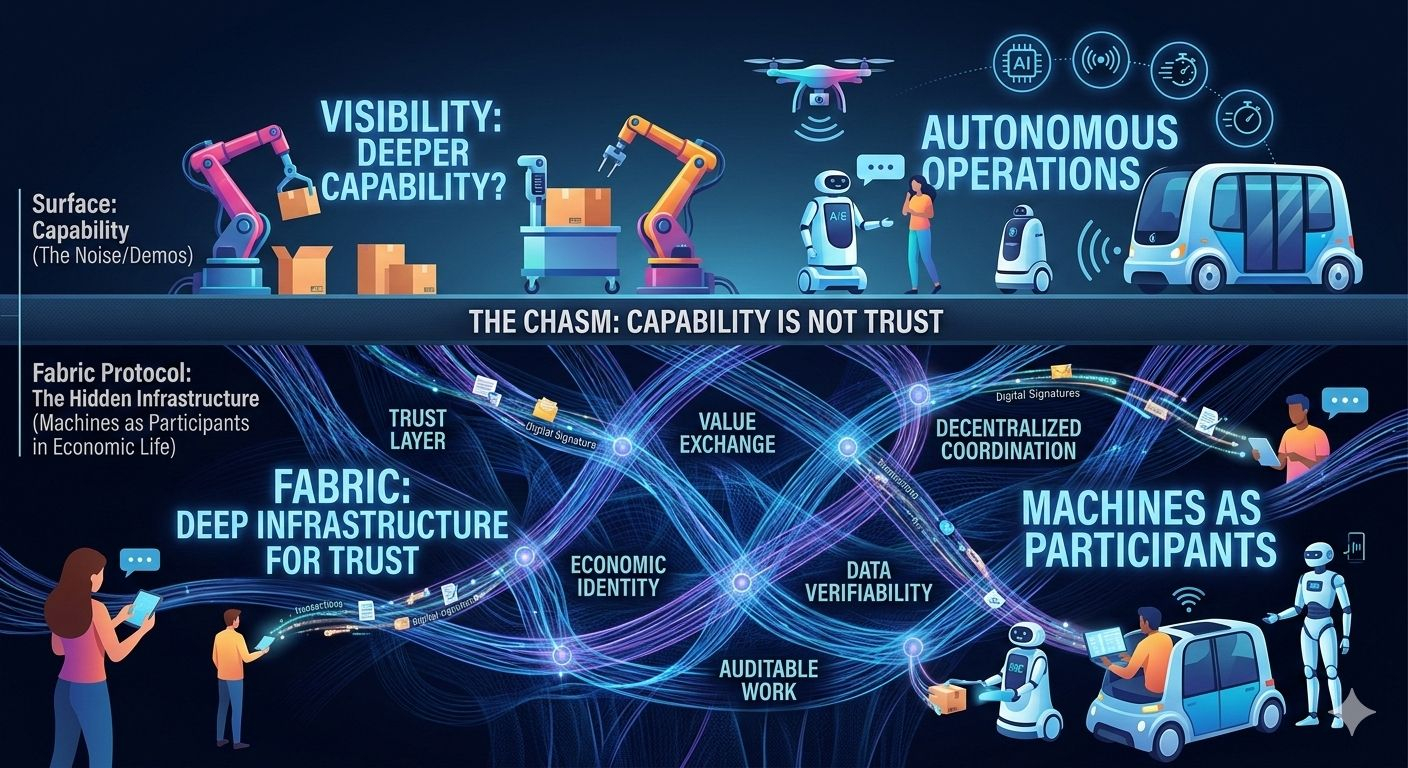
A lot of people still talk about intelligent machines as if the main question is capability. Can they see better, reason faster, move more precisely, respond more naturally, complete more tasks, operate with less supervision? That is the part everyone notices first, and it makes sense. Capability is visible. It demos well. It sells the future in a way people can immediately understand.
But capability is only the surface.
The deeper problem begins after the demo, after the headlines, after the first excitement fades. It begins when machines stop being passive tools and start becoming participants in real systems. Not toys. Not assistants in a narrow sense. Participants. Systems that perform work, handle tasks, interact with value, coordinate with people, and increasingly operate inside economic life rather than at the edge of it.
That is where Fabric becomes interesting.
Because once you take that future seriously, the questions change. The issue is no longer just what a machine can do. The issue becomes how a machine belongs inside a system that other people can actually trust. How is it identified? How are its permissions defined? How are its actions recorded? How is its contribution measured? How is payment handled? How is responsibility assigned when something fails? How does a human observer inspect what happened instead of simply trusting a black box?
Those are not side questions. They are the real questions, and most projects still behave as if they are background details that can be solved later.
Fabric does not feel like it is treating them that way.
The more I looked into it, the more the project seemed built around a blunt realization: if autonomous systems are going to do meaningful work in the world, then the surrounding structure matters more than the spectacle of intelligence itself. Machines can become more capable every year, but if the systems around them remain closed, opaque, and privately controlled, then what looks like progress on the surface may actually be a deeper form of dependency underneath.
That is the part of this story that I think many people miss.
We like to imagine advanced machines because the image is clean. A robot can deliver, inspect, transport, assist, compute, navigate, and act. It feels futuristic. But the real pressure of that future does not sit inside the machine alone. It sits in the architecture around it. Once machines begin carrying out useful functions in the open world, society needs more than capability. It needs a way to make those systems legible.
Fabric appears to be building from exactly that point.
Its thesis is not simply that robots and autonomous systems are coming. That would be too easy. Its thesis is that these systems will need identity, payment rails, coordination mechanisms, accountability layers, and contribution tracking if they are going to function inside serious economic networks. In other words, machines will need more than software and hardware. They will need institutional structure.
That is a much more serious ambition than the market’s first impression usually allows.
It is also why Fabric should not be reduced to a “robotics token” or an “AI token” in the shallow sense. Those labels are convenient, but they flatten the project into something much smaller than what it is trying to solve. Fabric is not just making a bet on smarter machines. It is making a bet that the hardest problem in the next phase of machine adoption will be coordination.
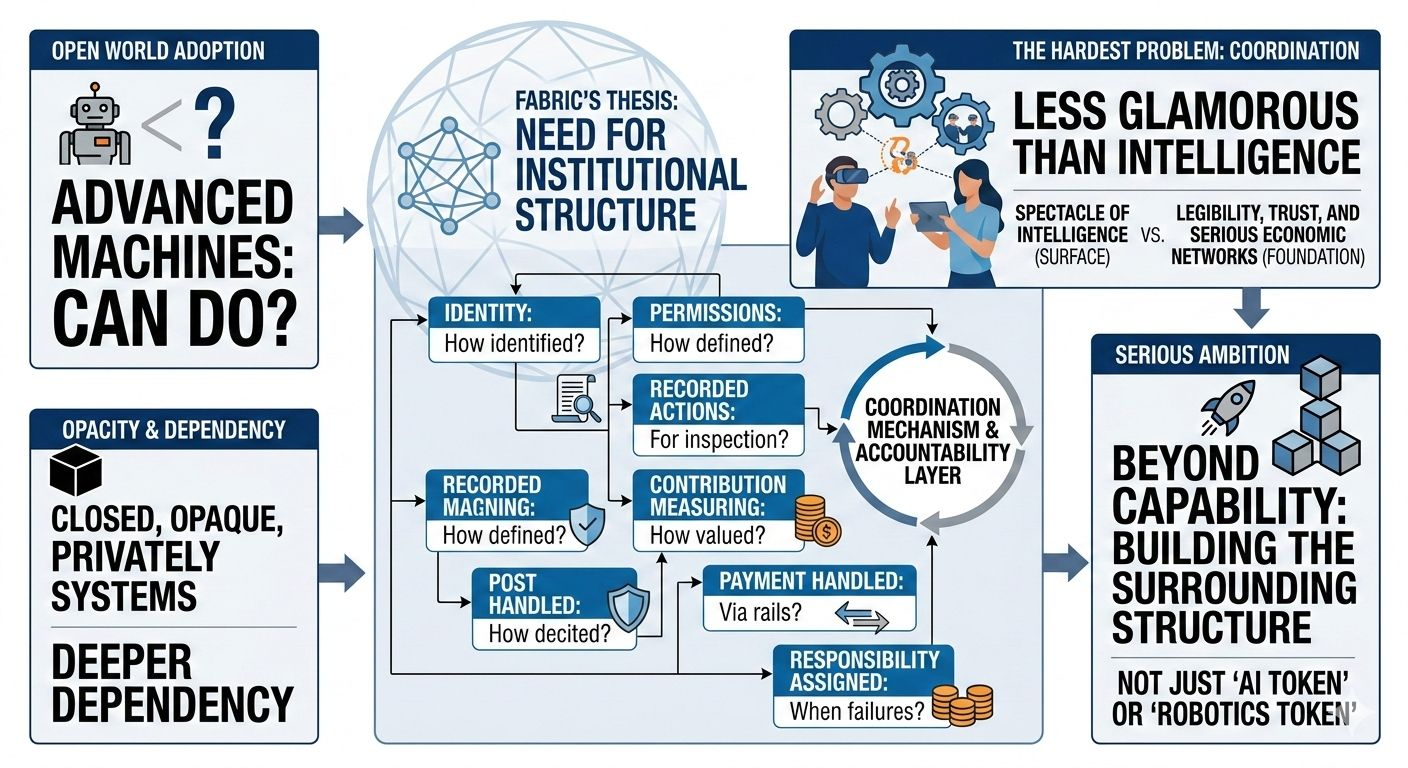
And coordination is always less glamorous than intelligence.
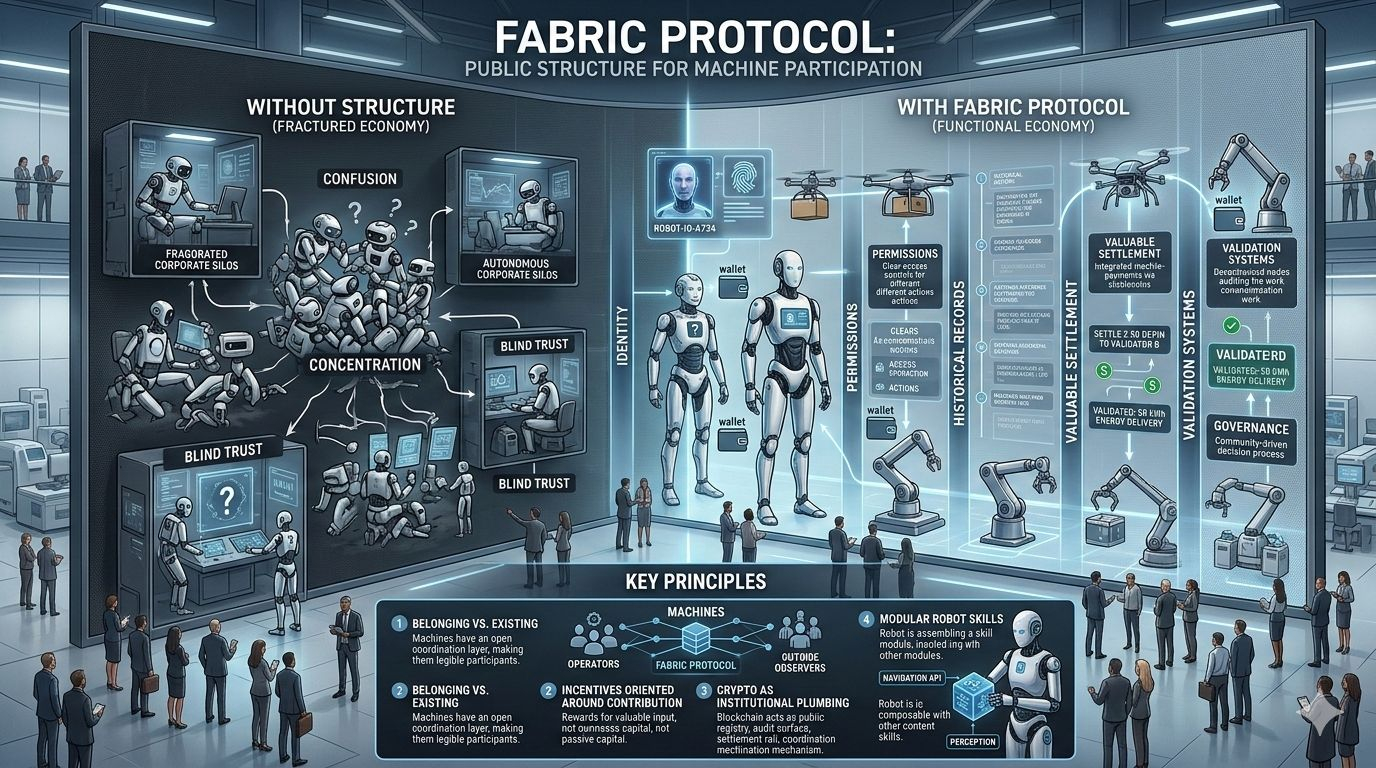
Identity is not glamorous. Permissions are not glamorous. Settlement is not glamorous. Historical records, validation systems, governance structures, and oversight frameworks are not glamorous either. But those are the things that determine whether a machine economy becomes functional or fractured. Without them, powerful systems do not create order. They create confusion, concentration, and blind trust in whoever controls the closed environment they operate in.
That is why Fabric feels important to me. It seems to understand that public trust in machine participation will not come from branding, and it will not come from raw intelligence alone. It has to come from structure.
The project’s design reflects that. It keeps returning to the idea that robots or autonomous systems cannot remain anonymous abstractions if they are doing real work. They need persistent identity. They need wallets or accounts. They need ways to receive and settle payment. They need a visible record of activity. They need a framework that lets operators, contributors, validators, and outside observers understand what is happening and why it matters.
That sounds procedural until you sit with it long enough.
A machine with no reliable identity is just a tool in somebody else’s private stack. A machine with no clear permissions is a trust problem waiting to happen. A machine with no historical record is difficult to evaluate. A machine with no transparent way to settle work remains stuck inside closed economic loops. And a machine with no public coordination layer ultimately deepens dependency on whoever owns the system around it.
Fabric is trying to solve that before it becomes normal.
There is something quietly intelligent about that move. Most emerging narratives chase the visible edge of the future. Fabric seems more concerned with the hidden edge, the place where systems either become usable at scale or begin breaking under the weight of their own complexity. It is looking less at the machine as a marvel and more at the machine as a participant that needs rules, rails, and context.
That shift in perspective changes everything.
It means Fabric is not really about robotics in the narrow sense. It is about the social and economic architecture required for machine participation. It is about how autonomous systems enter networks that involve value, labor, coordination, and trust. It is about what kind of infrastructure is needed if machines are going to work across open systems instead of remaining trapped in isolated corporate silos.
And that is where the crypto layer stops feeling decorative.
In weaker projects, blockchain gets added as ideology or marketing texture. In Fabric, blockchain makes more sense as institutional plumbing. A public ledger can act as registry, audit surface, settlement rail, incentive layer, and coordination mechanism at the same time. That does not mean every physical movement of a robot belongs onchain. It means the parts that matter for trust and participation can be given public structure instead of disappearing into private infrastructure.
That is an important distinction.
Because the real danger in the machine economy is not just that machines become powerful. It is that the systems surrounding them become impossible to inspect. Capability without visibility creates opacity. Capability without accountability creates liability. Capability without shared coordination creates concentration. Fabric feels like an attempt to push against all three.
The project’s economic thinking also matters more than it first appears. A lot of protocols talk about participation but end up rewarding passive capital. Fabric is trying to orient incentives around contribution instead. The logic here is simple but important: if a machine economy is going to mean anything, value should come from verified work, useful input, validation, coordination, and system improvement, not just from sitting idle and waiting for emissions. That principle may sound obvious, but in crypto it is still surprisingly rare.
What I find most compelling is that Fabric seems aware of the cold-start problem without pretending it can solve it with hype alone. It knows a machine economy cannot be summoned into existence by narrative. You need participants. You need coordination. You need ways to bootstrap activity without reducing the entire system to a speculative shell. You need incentives that attract engagement but do not hollow out the purpose of the network. That is an extremely difficult balance, and whether Fabric fully nails it remains an open question. But at least it appears to be wrestling with the real design challenge instead of dodging it.
There are also details inside the broader vision that make the project feel more grounded than people may expect. The idea of modular robot skills, for example, matters because it suggests a future where machine capability can evolve in open and composable ways rather than being locked inside a single vertically integrated stack. The emphasis on human oversight matters because trust in machine systems will not emerge automatically; it has to be built through inspectability, feedback, and shared validation. The focus on machine-native payments matters because legacy rails were built around human institutions, business hours, and frictions that make little sense in a world where autonomous systems may need to transact continuously.
All of these pieces point in the same direction.
Fabric is asking what kind of framework is necessary if machines are going to do more than impress us. What do they need if they are going to belong inside the real economy?
That word belongs is where the project gets more interesting.
Belonging is not the same as existing. A machine can exist inside a warehouse, a factory, a hospital, a city, or a logistics chain without truly belonging to a shared public system. Belonging means it can be identified, trusted, coordinated, evaluated, compensated, and held within a structure that others can engage with. Belonging means the system around it is legible enough for people to participate without surrendering all understanding to a closed operator.
That is a much harder threshold than capability.
And it is probably where the next real battle will happen.
Because if autonomous systems scale before public coordination layers do, then the future tilts toward enclosure. More intelligence, more automation, more output, but all of it hidden inside systems the wider world cannot inspect or meaningfully participate in. Fabric seems to be pushing against that possibility by proposing an open coordination layer before the dependency becomes too entrenched.
That is why I keep coming back to it.
Not because it offers a clean, easy fantasy. In truth, Fabric becomes more compelling the moment you realize how difficult its actual task is. Identity for machines is difficult. Accountability for machine actions is difficult. Verification of physical-world work is difficult. Aligning incentives across operators, contributors, validators, and machine systems is difficult. Building trust without suffocating flexibility is difficult. Almost every serious part of this problem is difficult.
But difficulty is not a weakness when the problem is real.
Sometimes it is the only sign that a project has found the right layer.
Fabric, at least to me, feels like it has found that layer. It is not just imagining intelligent machines. It is asking what kind of public structure must exist when those machines start doing real work in the world. It is trying to think beyond the machine as spectacle and toward the machine as participant. That shift may end up mattering far more than most people realize right now.
Because the future will not be shaped only by what machines can do.
It will also be shaped by the systems that decide how they are known, how they are trusted, how they are paid, how they are governed, and how they are allowed to move through shared economic life.
That is the cost of teaching machines to belong.
And Fabric Protocol feels like one of the few projects willing to look directly at that cost instead of hiding behind the excitement.