
I keep coming back to a simple question: what does it actually mean for a machine to earn money?
At first it sounds simple. But the more you think about it, the more complicated it becomes.
Right now, if a machine performs a task and creates value, it still cannot receive payment by itself. The money always passes through a human wallet, a company account, or a developer’s payment method. The machine does the work, but a person still sits in the middle of every financial step.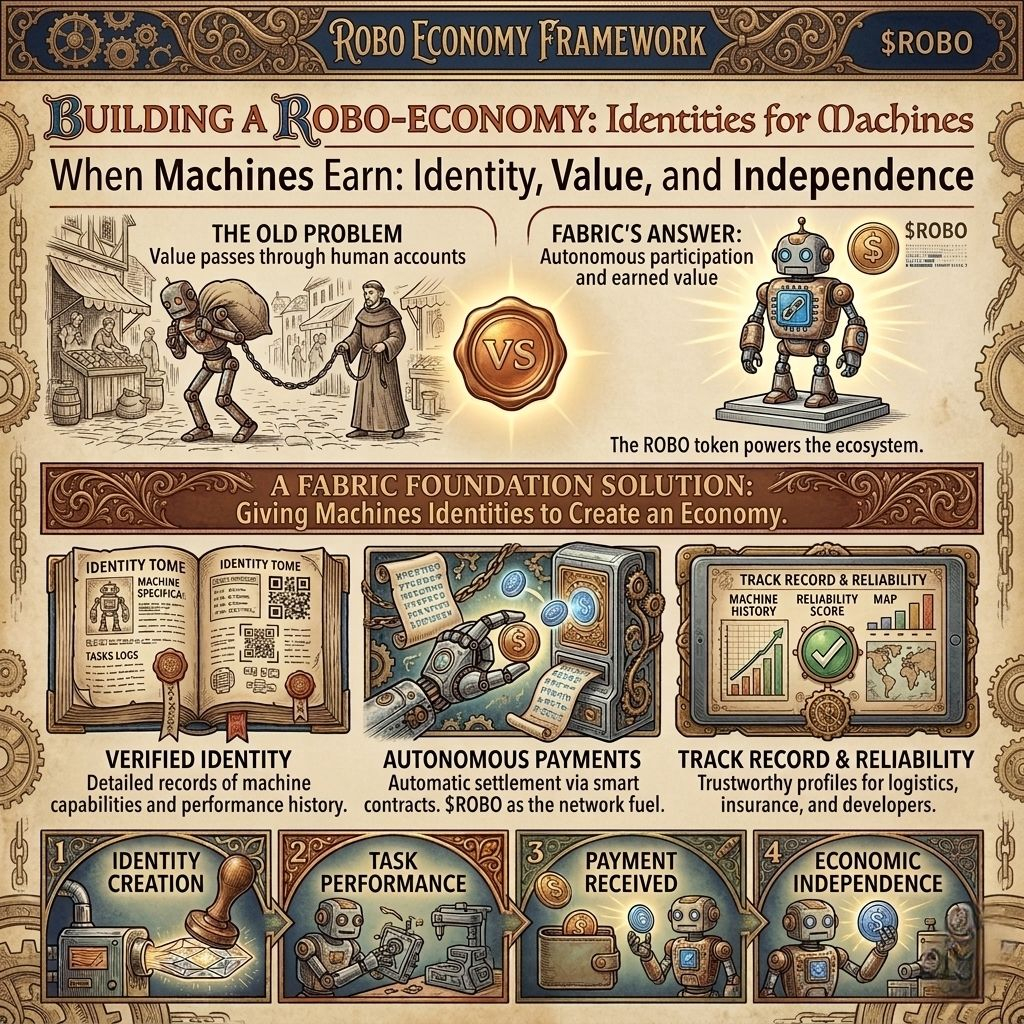
That model made perfect sense when machines were only tools. It makes much less sense when machines start acting independently.
This is the problem that Fabric Foundation is trying to address. Instead of just talking about it, they are trying to build the infrastructure for it. The idea is simple but powerful: give machines identities that exist on a blockchain. Those identities can hold records of what a machine has done, how it performs tasks, and how reliable it is. Then create a system where machines can send and receive payments without needing a human to approve every transaction. In that system, ROBO becomes the token that powers the whole economy.
But this raises an important question: why use blockchain at all?
The answer is less about theory and more about practicality.
Traditional financial systems were designed for humans and organizations. Everything from contracts to credit scores assumes there is a person or a company involved. A robot does not fit into that structure. It cannot open a bank account, sign a legal agreement, or build a credit history in the way banks understand.
Blockchain changes that.
A blockchain identity does not have to belong to a person. Smart contracts can settle payments automatically without a bank acting as the middleman. And activity recorded on a decentralized ledger does not require a central authority to confirm it. The system was originally built for strangers to interact without trust, which happens to be exactly what autonomous machines will need when dealing with each other.
In this framework, ROBO becomes more than just a token. It acts as the fuel of the system. It can be used to pay for tasks, cover network fees, stake value to prove commitment, and participate in governance decisions. Every functioning economy needs a unit of exchange, and in this case the participants are not just people but machines themselves.
What stands out in Fabric’s design is their focus on identity.
Many blockchain projects rely on simple wallet addresses that reveal almost nothing about who or what is behind them. Fabric is trying to build something more descriptive. A machine identity that includes information about what the machine can do, what tasks it has completed, and how reliable its performance has been over time. Instead of just seeing that an address made a transaction, you would see the track record of a machine’s activity.
For a machine-driven economy, that level of detail matters.
A logistics company sending robots to deliver packages would want to know which machines perform tasks efficiently before assigning work. An insurance provider covering autonomous robots would need data about how those machines behave. Developers building applications would need to identify which machines are trustworthy. Simple wallet addresses cannot provide that information, but verified identities potentially can.
Of course, the realistic argument against all of this is time.
Robotics advances much slower than the crypto market. Fully autonomous machines interacting constantly on blockchain networks are still not a common reality. The technology exists in pieces, but the widespread ecosystem is still years away. Because of that, there will likely be a large gap between market expectations and real-world adoption.
Interestingly, Fabric does not seem to hide that reality.
According to their plans, the main network is expected after 2026. The validator ecosystem is still being formed. Applications that could run on the network, like marketplaces for machine skills, energy trading, or data sharing, are still at early stages. In other words, this is clearly a project still under construction rather than a finished system.
In many ways it reminds me of the early internet.
The protocols that built the internet existed long before most people ever used them. Those who supported the technology early and had patience eventually saw the value emerge. Those who expected immediate results often left disappointed.
Whether Fabric becomes that kind of foundational project is still uncertain.
But the broader idea that machines will eventually need decentralized identities and a way to transact on their own is becoming harder to ignore. Even if Fabric is not the final answer, the question they are asking is probably the right one.
And what I find interesting is the level of honesty in their approach.
Instead of pretending everything is already built, they openly explain what exists today and what is still being developed. They talk about the parts that work and the parts that are still concepts. That kind of transparency suggests they are asking people for patience rather than blind belief.
In a market that often moves too fast, patience might be the most valuable thing an investor can have.$ROBO @Fabric Foundation #ROBO