
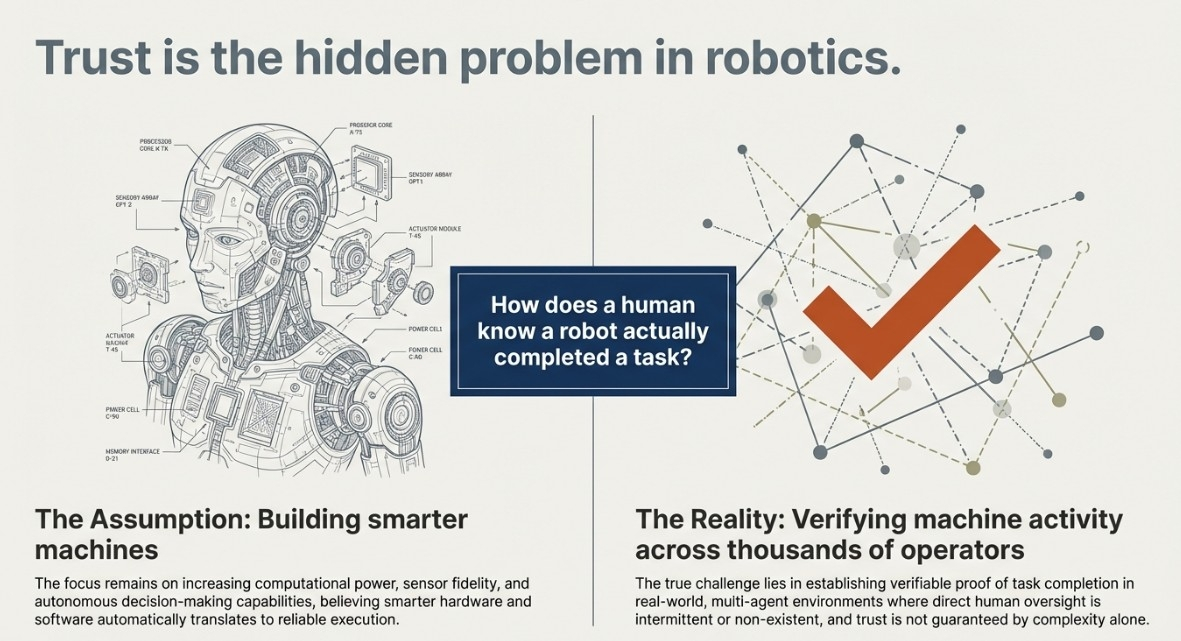
Most people assume the hardest part of robotics is building smarter machines.
But underneath the technology there is a quieter problem - trust.
How does a human know a robot actually completed a task?
How does a network verify machine activity when thousands of operators are involved?
That question sits at the foundation of Fabric Protocol.
Machines produce data constantly.
Delivery confirmations. Environmental readings. Navigation logs.
But raw data alone does not automatically create trust.
Someone has to verify where that data came from and whether the work really happened.
Centralized robotics platforms solve this by owning everything.
They control the robots, the servers, and the records.
Fabric tries a different path.
The system relies on Proof of Robotic Work.
Instead of rewarding token holders for locking capital like in Proof of Stake, rewards come from verified activity.
Work can include task completion by robots, providing compute power, submitting training data, validating results, or improving robotic skills.
Each action adds to a contribution score that determines reward distribution.
There is an interesting texture to how the system handles participation.
Contribution scores decay 10 percent each day of inactivity - meaning operators who stop contributing gradually lose their accumulated score.
Operators must also remain active at least 15 days within each 30 day reward epoch - otherwise they do not qualify for rewards at all.
The intention seems clear.
Trust is not treated as something given once.
It has to be earned through steady participation.
This changes how incentives work.
In many networks using staking, influence grows directly with the number of tokens someone holds.
In Fabric, token ownership alone does not generate rewards.
Two wallets holding tokens but doing no work both receive zero protocol rewards.
That difference matters because it shifts value from capital toward contribution.
But there is still some uncertainty around how this plays out.
There are 2,730 token holders according to current wallet data - yet only a small portion appear to operate robots or provide compute resources.
That leaves a gap between who earns rewards and who currently holds the asset.
Operators earn through work.
Investors hold tokens while waiting for the network to grow.
Whether that balance becomes stable is still unclear.
The idea behind Fabric seems grounded in a simple principle.
If machines are going to interact with humans in decentralized systems, the network needs a way to measure real activity.
Not just ownership.
Not just speculation.
Actual work performed in the physical world.
It is still early.
The structure feels thoughtful in some places, but the ecosystem around it is still forming.
What matters most may be whether more people can eventually participate in the work itself, not just the token.
Because trust between humans and machines probably will not appear all at once.
It will likely grow slowly - through systems that reward steady contribution over time.