
Introduction: A Token Trade or a Long-Term Infrastructure Bet?
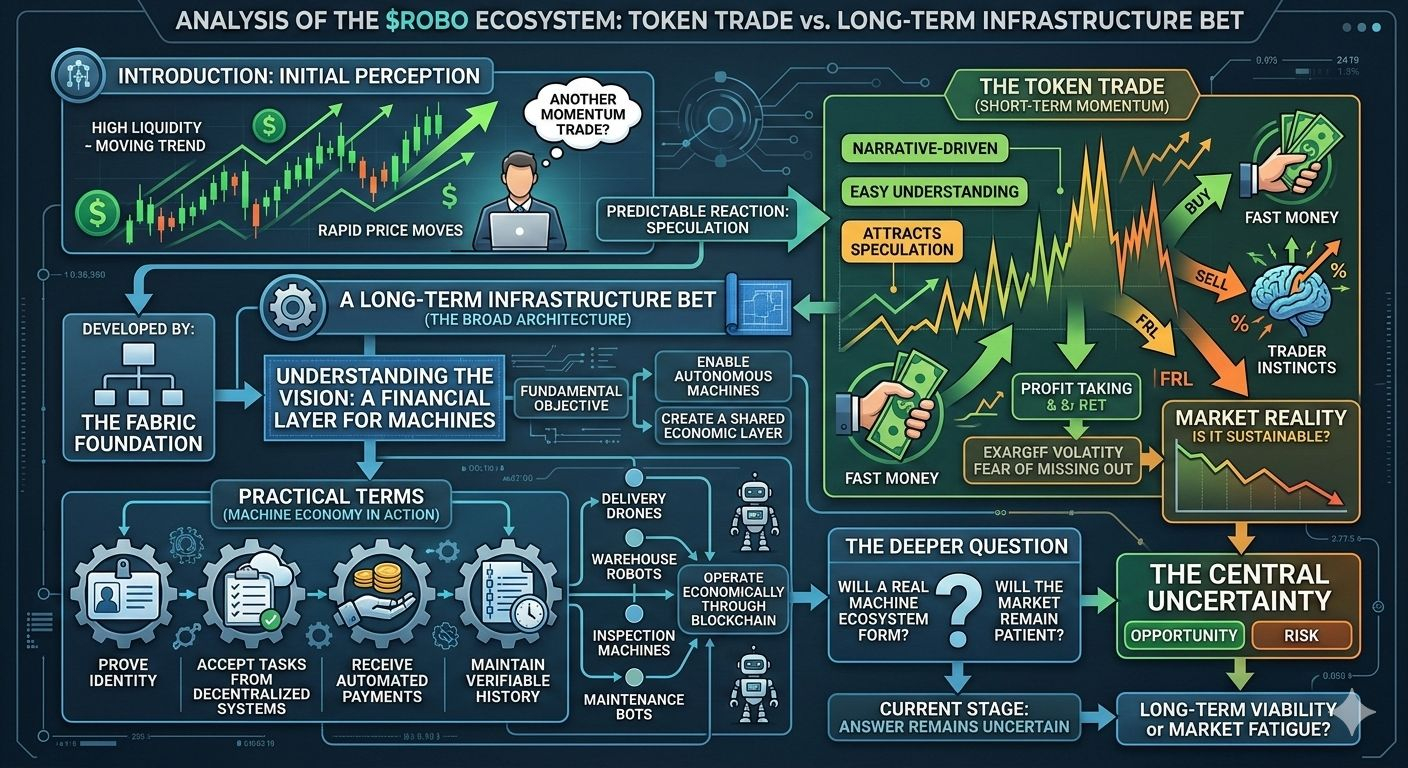
When most traders first notice $ROBO the reaction is predictable. The chart moves fast, liquidity spikes, and the narrative is easy to understand: robotics plus blockchain plus AI. In the current crypto environment, that combination naturally attracts speculation.
For many market participants the first instinct is simple—look at the price chart and decide whether the token is another short-term momentum trade.
However, when examining the broader architecture behind the project developed by the Fabric Foundation, the perspective begins to shift. What initially looks like a typical early-stage crypto token begins to resemble something else entirely: a long-term infrastructure bet on the future machine economy.
The central question is not whether robots can connect to blockchain networks. That part is technically achievable today. The deeper question is whether a real economic ecosystem of machines will form around those networks and whether the market will remain patient long enough for that system to develop.
At this stage, the answer remains uncertain.
Understanding the Vision: A Financial Layer for Machines
The fundamental objective behind the ROBO ecosystem is relatively straightforward but ambitious.
The project attempts to create a shared economic layer where autonomous machines can operate financially, interact with services, and coordinate tasks without relying on centralized platforms.
In practical terms, this means enabling machines to prove their identity, accept tasks from decentralized systems, perform real-world work, receive automated payments, and maintain verifiable activity histories.
Instead of robotic networks relying on a single corporate dispatcher or centralized control hub, the protocol aims to create an open coordination network where machines can interact economically through blockchain infrastructure.
This concept is often described as the machine economy, an ecosystem where autonomous systems function as economic agents.
If autonomous delivery drones, warehouse robots, inspection machines, or maintenance bots begin operating at scale, they will require mechanisms for authentication, task verification, payment settlement, permission management, and operational coordination.
The Fabric architecture attempts to provide these functions before the ecosystem fully matures, which creates both opportunity and risk.
Skill Chips: Turning Robots Into Modular Platforms
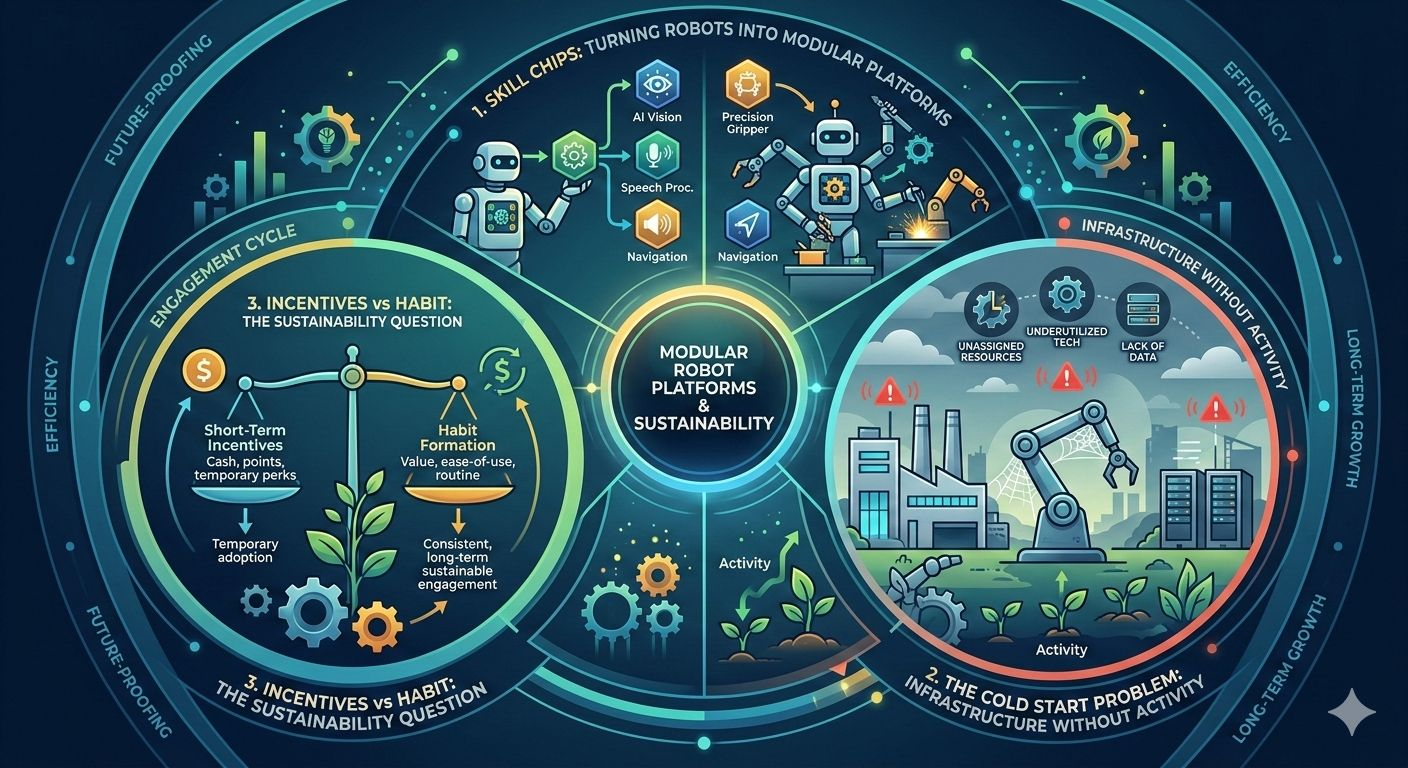
One of the more distinctive ideas within the system is the concept of skill chips.
Skill chips function somewhat like an app marketplace for robotic abilities.
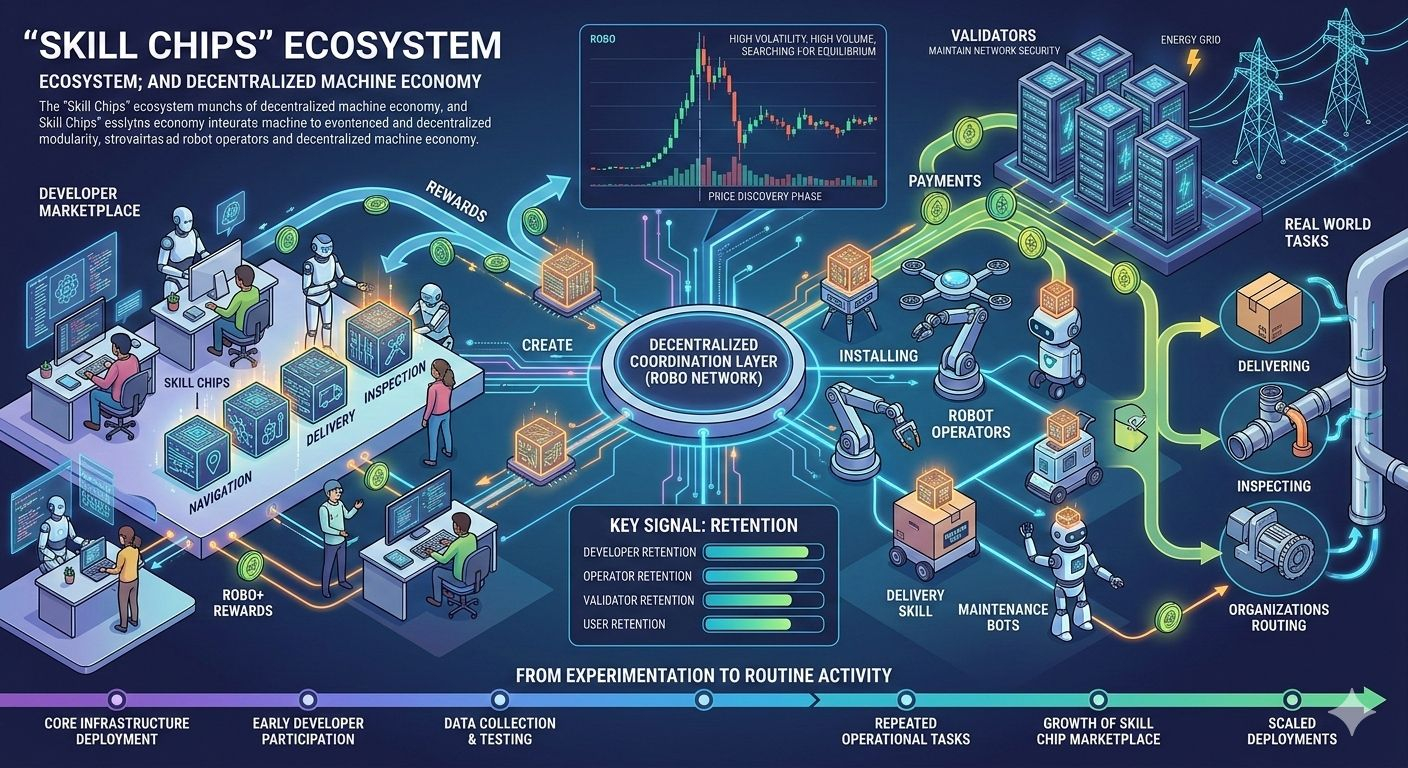
Instead of building every machine with fixed capabilities, the model allows developers to create modular software skills that robots can install depending on the tasks they need to perform.
For example, a robot might install a navigation skill for autonomous movement, a delivery skill for logistics operations, a repair skill for industrial maintenance, or an inspection skill for infrastructure monitoring.
This modular design creates a potential developer marketplace where engineers can build capabilities that machines adopt dynamically.
If such a system grows large enough, it could evolve into a marketplace for robotic intelligence where developers create capabilities, operators deploy machines, machines perform tasks, and payments circulate across the ecosystem.
In theory, this structure could allow the robotics industry to scale more flexibly by separating hardware production from software capability development.
However, the system still faces a major obstacle.
The Cold Start Problem: Infrastructure Without Activity
The biggest structural challenge facing the project is something common across many new networks: the cold start problem.
The protocol is essentially attempting to build economic infrastructure for an ecosystem that does not yet exist at scale.
This is similar to constructing a trading exchange before the underlying commodity market becomes active. Even if the exchange works perfectly, it cannot generate activity by itself.
For a decentralized machine economy to function, several groups must participate simultaneously. Robot operators must run machines, developers must build new skill chips, validators must maintain network security, and organizations must route real tasks through the system.
Without enough participants on each side, the network risks becoming technically functional but economically inactive.
The team behind the project appears aware of this challenge, as early documentation frequently mentions the need to bootstrap supply-side participation. This means developers, validators, operators, and contributors must begin using the system even before large-scale demand emerges.
Incentives vs Habit: The Sustainability Question
Early network activity in crypto ecosystems often depends heavily on incentives.
Participants may join because they receive token rewards, early allocation opportunities, liquidity incentives, or governance influence.
These incentives can attract initial participation, but they do not always create long-term behavioral patterns.
Once incentives decline, activity sometimes disappears unless the network provides real economic value.
For the ROBO ecosystem, long-term success depends on transforming incentive participation into habitual usage.
Developers must continue building skill chips after early reward programs fade. Operators must route real robotic tasks through the system rather than simply participating for token rewards. Validators must maintain infrastructure even when operations become routine instead of exciting.
This transition from speculative participation to operational habit is where many networks either mature or fade.
Market Behavior: ROBO in the Price Discovery Phase
Market activity surrounding the token illustrates how uncertain the valuation currently is.
Following its launch, ROBO experienced a rapid rise in price and briefly reached an early all-time high before declining sharply in the following days.
By early March the token was trading significantly below that initial peak. Despite the decline, trading volume remained extremely high relative to the market capitalization.
This pattern often appears during the price discovery phase of new crypto assets.
When traders are unsure how to value a token, liquidity increases as participants trade frequently and volatility rises as opinions about value diverge.
Some traders see long-term infrastructure potential while others see a narrative trade tied to robotics and AI. The result is constant turnover while the market searches for equilibrium.
At this stage speculation still dominates over measurable network usage.
Why the Concept Still Makes Strategic Sense
Despite the uncertainty, the underlying logic behind the system remains compelling.
If autonomous machines eventually operate in open environments such as cities, logistics networks, factories, and public infrastructure, they will require digital systems to manage economic interaction.
Machines may need wallets for payments, identity credentials, work histories, reputation records, permission systems, and automated settlement mechanisms.
A decentralized coordination layer could potentially provide these functions more efficiently than isolated corporate platforms.
Instead of each robotics company building separate infrastructure, a shared network could allow machines from different operators to interact within the same economic environment.
That is the long-term vision behind the architecture created by the Fabric Foundation.
The Roadmap: From Experiments to Routine Activity
The development roadmap suggests a gradual transition toward real operational usage.
Early stages emphasize deployment of core infrastructure, data collection, experimentation, and initial developer participation.
Later phases focus on repeated operational tasks, growth of the skill chip marketplace, increased validator participation, and expansion into larger deployments.
This shift from experimentation to repetition is critical.
Repeated usage rather than demonstrations is what ultimately signals that a network is becoming economically relevant.
The Key Signal: Retention
When analyzing long-term protocol success, one metric often matters more than price.
Retention.
Retention measures whether participants continue engaging with the system after the initial excitement fades.
For the ROBO ecosystem several retention signals will be particularly important.
Developer retention will show whether new skill chips continue appearing months after launch.
Operator retention will show whether robotic tasks are repeatedly routed through the network.
Validator retention will show whether infrastructure participants remain active.
User retention will show whether organizations return to use the system again and again.
These signals reveal whether the system is evolving into an operational platform rather than remaining a speculative asset.
Risks That Could Slow Adoption
Several risks remain visible.
Activity could become circular where participants interact mainly to collect incentives instead of solving real problems.
Incentive spending could outpace genuine demand, creating unsustainable economics.
Governance structures might remain centralized in early phases if validator participation stays limited.
Additionally, the robotics industry itself may take longer to integrate decentralized coordination systems than expected.
None of these outcomes necessarily invalidate the technology, but they could delay meaningful adoption.
Conclusion: Watching Behavior Instead of Hype
The most interesting aspect of the ROBO ecosystem is not the short-term price volatility.
It is the experiment unfolding behind it.
The project attempts to construct financial infrastructure for autonomous machines before that machine economy fully exists.
That approach carries risk, but it also positions the network ahead of potential technological shifts.
Ultimately the market will not decide the value of ROBO based solely on charts or narratives.
The real answer will come from behavior.
Who continues building when early incentives decline?
Who continues operating machines through the network when tasks become routine?
Who keeps returning to use the system when speculative hype disappears?
Because in this case retention is not just another metric.
For the emerging machine economy envisioned by the Fabric Foundation, retention may ultimately determine whether the infrastructure becomes a living ecosystem or simply an ambitious idea waiting for a market that never fully arrived.
