
The Problem Nobody Was Talking About
Robots are already working in warehouses, hospitals, and factories. But here's the dirty secret: they can't talk to each other.
A UBTech robot and an AgiBot unit, operating five feet apart on the same production floor, run on completely separate software stacks. No shared memory. No coordination. No way to transact.
That's not a minor inconvenience. That's the biggest bottleneck standing between where robotics is today and a fully autonomous machine economy.
Fabric Protocol (ROBO) was built to break that wall.
What Fabric Protocol Actually Does
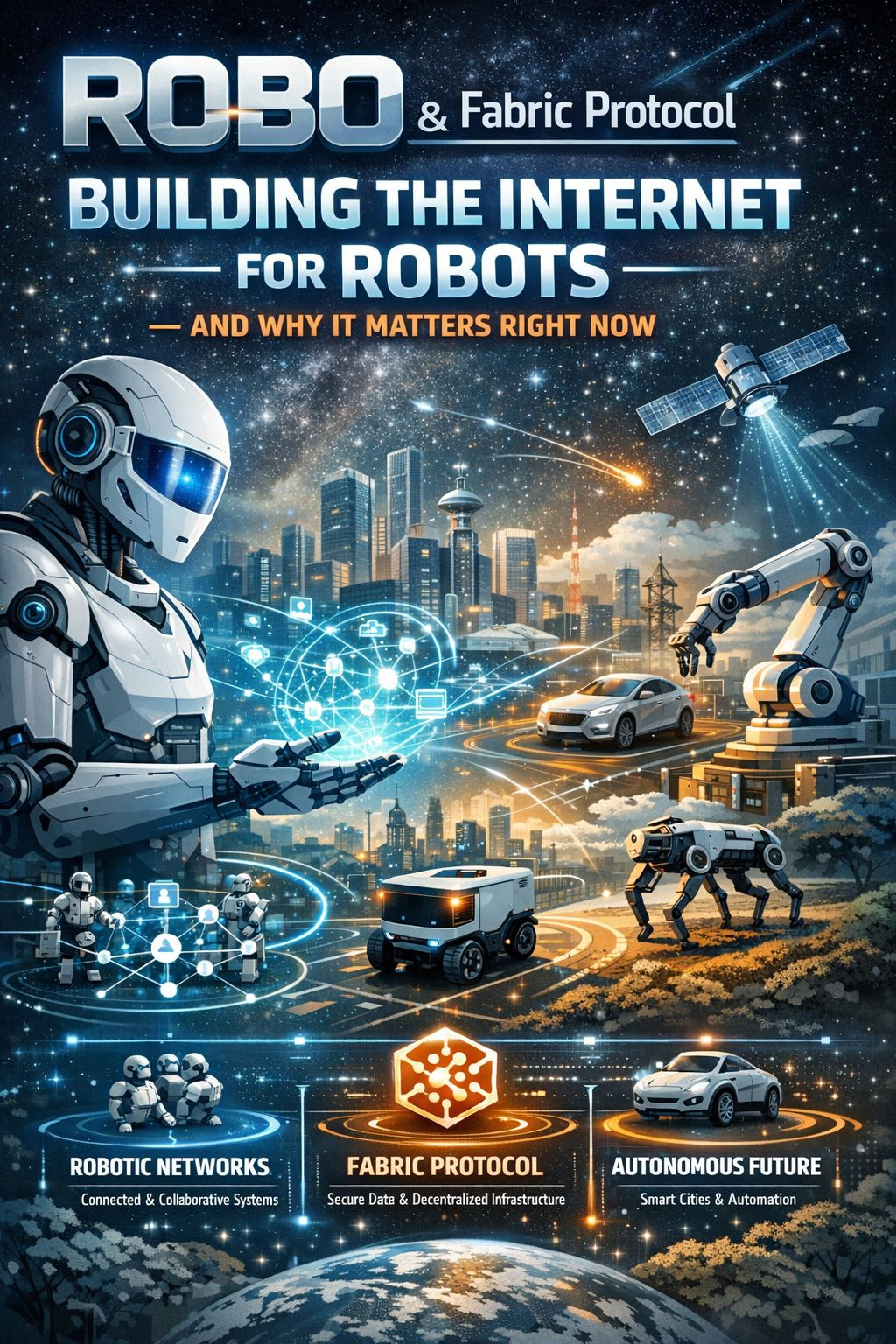
@Fabric Foundation is the coordination layer for robots — think TCP/IP, but for machines with arms and legs.
Built by the team behind OpenMind, Fabric integrates the OM1 universal operating system with a blockchain-native identity and payment framework. The result: robots from different manufacturers can share intelligence, execute on-chain transactions, and verify their actions in a transparent, public ledger.
Here's a concrete example of what this unlocks:
A delivery robot completes a route. It logs proof of work on-chain. It receives payment in $ROBO . It automatically contracts a charging robot using a smart agreement — no human in the loop.
That's not science fiction. That's the architecture Fabric is building right now.
The ROBO Token: More Than Just a Ticker
ROBO sn't a memecoin riding a robotics narrative. It's a utility token with four distinct functions baked into the protocol:
1. Network Payments — Robots pay transaction fees in ROBO for identity registration and coordination services.
2. Staking — Participants stake ROBO access infrastructure, support validation, and prioritize task allocation.
3. Governance — Token holders vote on protocol upgrades, fee structures, and ecosystem parameters. This is a community-run network.
4. Machine-to-Machine Coordination — Autonomous agents use #ROBO to access compute resources and data services without any centralized intermediary.
Fixed total supply: 10 billion tokens.
Largest allocation: 29.7% to Ecosystem & Community (Proof of Robotic Work rewards).
The Funding Behind the Vision
In August 2025, OpenMind — the technical backbone of Fabric — raised $20 million in a round led by Pantera Capital.
The co-investors read like a Web3 who's-who: Coinbase Ventures, Digital Currency Group, Ribbit Capital, Amber Group, Primitive Ventures. These are not retail speculators. These are institutional bets on the thesis that physical AI infrastructure needs its own financial rails.
The Fabric whitepaper dropped in December 2025 with a clear provocation: AI models are now scoring above 0.5 on Humanity's Last Exam — a benchmark that was supposed to be unsolvable. LLMs can already control robots through open-source code. The question isn't if robots will be autonomous economic actors. It's who builds the infrastructure when they are.
Exchange Launches: What Just Happened
The timeline here matters:
February 20–24, 2026 — Community airdrop window. GitHub devs, OpenMind contributors, and Kaito/Surf AI participants were eligible.
February 27, 2026 — ROBO begins spot trading on Binance Alpha, Bybit, Bitget, and MEXC simultaneously. First-day volume: $142M+.
March 4, 2026 — ROBO graduates to Binance Spot (ROBO/USDT, ROBO/USDC, ROBO/TRY). A Seed Tag is applied — users must pass a knowledge quiz every 90 days. This signals volatility awareness, not a red flag.
7-day price performance post-launch: +129.61%, far outpacing the broader crypto market's +5.32%.
Current market cap sits around $115 million — still small-cap, still high-risk, still high-upside territory.
The Honest Risk Assessment
Don't let the launch hype cloud the fundamentals. A few things to keep clear:
The bull case rests on genuine industrial adoption. If OM1-integrated robots from UBTech, AgiBot, and Fourier actually use ROBO rails for real-world coordination, the token has a demand engine that doesn't depend on speculation.
The bear case is simple: this is early-stage infrastructure. The planned migration to a dedicated Fabric L1 chain is still ahead. Without sustained industrial deployment and ecosystem growth, the $115M market cap could compress quickly in a risk-off environment.
The macro context: The Altcoin Season Index sits at a neutral 34. Crypto Fear & Greed is in "Extreme Fear" territory. Small caps like ROBO are vulnerable to capital rotation. The 130% weekly pump is exciting — it's also a volatility flag.
The Bigger Picture: DePIN Meets Robotics
ROBO operates in the same conceptual space as Bittensor (TAO) and Fetch.ai (FET) — decentralized AI compute coordination via token incentives. But there's a critical difference.
Those networks coordinate digital AI workloads. Fabric coordinates physical robots operating in the real world.
That distinction has massive implications. It means Proof of Robotic Work is verifiable through physical outputs — a package delivered, a shelf restocked, a sensor calibrated. You can't fake it on a ledger.
This is DePIN at its most literal. And it's a segment that's barely been touched.
The Roadmap: What's Coming
Near-term: Continued Proof of Robotic Work deployment, ecosystem developer incentives, and partner robot fleet integrations.
Mid-term: Migration from Base (EVM-compatible) to a dedicated Fabric L1 blockchain — purpose-built for machine-native transactions.
Long-term: A Robot Skill App Store — open to developers worldwide. Think Apple App Store, but skills are bought and sold by robots.
Each milestone is a catalytic event for the token. Watch the L1 timeline closely.
The Takeaway
The robotics industry has a coordination problem. The AI industry has an alignment problem. Fabric Protocol is positioning itself as the infrastructure layer that solves both — simultaneously.
ROBO launched into a cautious market and still posted 130% gains in its first week. The backers are credible. The use case is concrete. The timing — as humanoid robotics goes from lab demo to factory floor in real time — is arguably perfect.
This isn't a trade. It's a thesis.
The thesis: robots will become first-class economic actors. Someone has to build their internet. Fabric Protocol is trying to be that someone.
Whether they succeed will depend on execution, adoption, and the pace at which physical AI matures. But the architecture is sound, the team is funded, and the window — as always in #crypto — is open right now.
#AltcoinSeasonTalkTwoYearLow #SolvProtocolHacked #MarketPullback