
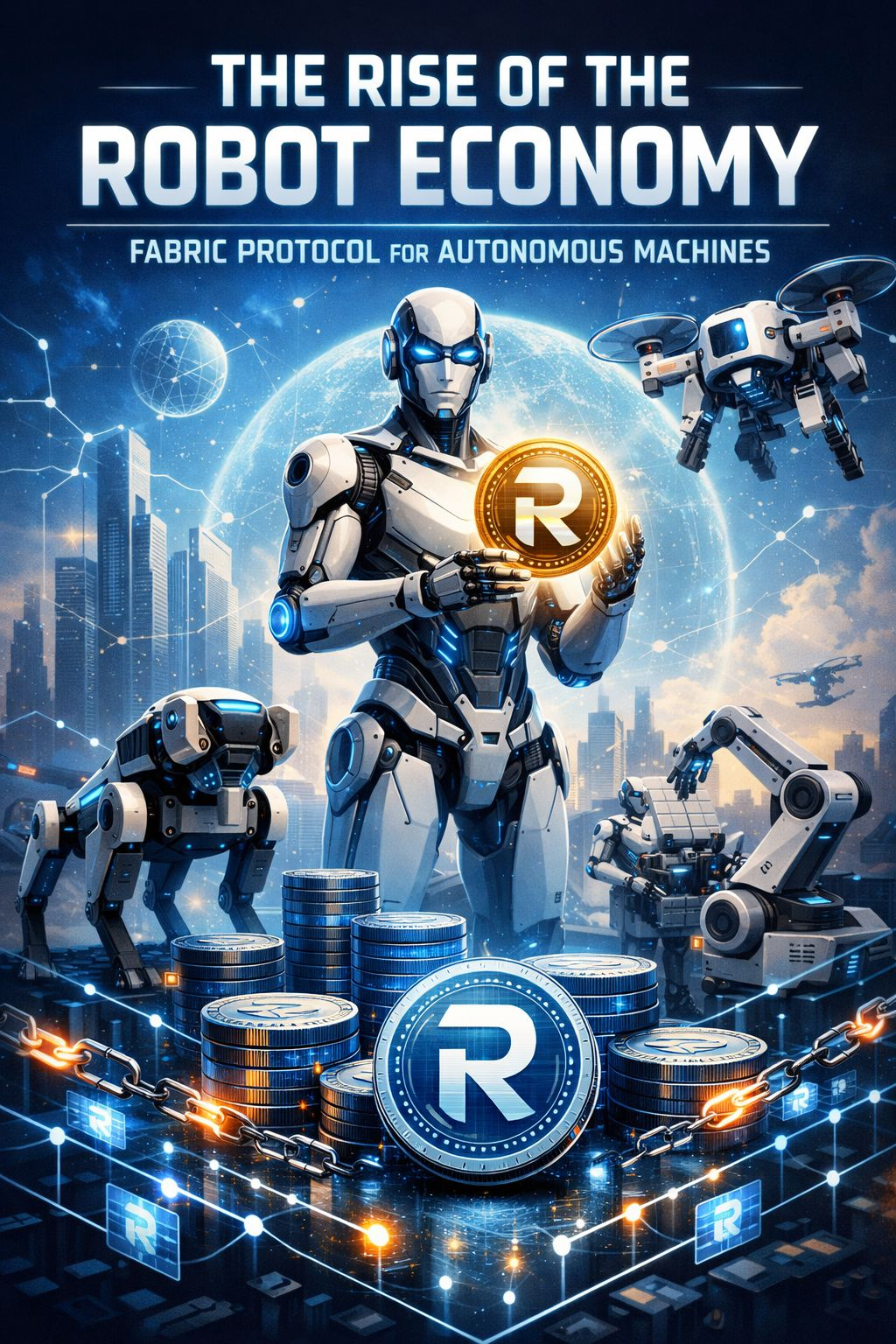
Artificial intelligence is advancing rapidly, but intelligence alone is not enough to transform the physical world. The next technological shift will happen when intelligent machines can coordinate, transact, and collaborate autonomously. This is the vision behind Fabric Protocol, an open network designed to power the emerging robot economy.
As robotics becomes more capable and widespread, industries such as logistics, manufacturing, healthcare, and infrastructure will increasingly rely on machines that operate independently. However, one critical problem remains unsolved: how do thousands or even millions of machines coordinate their work, verify their actions, and exchange value in a trustless environment?
Fabric Protocol aims to solve this challenge.
A Coordination Layer for Robots
Fabric Protocol is designed as a decentralized infrastructure layer that allows robots and AI agents to interact with each other and with humans through blockchain-based systems. Instead of robots operating in isolated fleets controlled by a single company, Fabric introduces an open network where machines can collaborate, perform tasks, and settle payments transparently.
CoinMarketCap +1
At its core, the protocol provides several essential components:
On-chain identity for robots
Task coordination and verification
Machine-to-machine payments
Governance and economic incentives
This infrastructure allows robots to become active participants in a global economic network, rather than simply tools controlled by centralized operators.
Why Robots Need an Economic System
In today's world, robots can perform physical tasks, but they lack an economic identity. They cannot hold bank accounts, sign contracts, or receive payments.
Fabric addresses this gap by enabling machines to operate with cryptographic identities and digital wallets, allowing them to receive payments and interact with decentralized applications.
Fabric Foundation
Through this system, robots could eventually:
Earn payments for completing tasks
Pay for resources such as energy or data
Coordinate work with other machines
Participate in decentralized service marketplaces
This model opens the door to a machine-driven labor market, where robotic services can be deployed globally and accessed by anyone.
The Role of the ROBO Token
At the center of the Fabric ecosystem is the ROBO token, which functions as the protocol’s native utility and governance asset.
The token enables several critical functions within the network:
Paying transaction and service fees
Staking to participate in coordination mechanisms
Governance voting on protocol decisions
Incentivizing verified robotic work
Fabric also introduces a concept known as Proof of Robotic Work, which ties token rewards to real-world robotic activity instead of passive speculation.
CoinMarketCap +1
This design connects digital incentives directly to physical productivity, aligning economic value with actual machine labor.
From Isolated Robots to a Global Machine Network
One of the biggest limitations in robotics today is fragmentation. Robots are typically built for specific tasks and controlled by individual companies.
Fabric Protocol attempts to change that by creating a shared coordination layer, allowing different machines, developers, and organizations to interact through the same infrastructure.
Fabric Foundation
In this system:
Developers can build robotic applications
Operators can deploy robot fleets
Businesses can request services
Machines can autonomously execute tasks
Over time, this could evolve into something similar to an “Internet of Robots”, where machines interact across industries and geographies.
The Future of Human–Machine Collaboration
The idea of robots participating in economic systems may sound futuristic, but the foundations are already being built.
As AI systems become capable of reasoning, planning, and executing tasks in the physical world, coordination and trust will become the most important challenges. Fabric Protocol is positioning itself as the infrastructure that enables safe, transparent collaboration between humans and intelligent machines.
If successful, the impact could be enormous.
Instead of isolated automation systems, we could see the emergence of a global network of autonomous machines working together to power logistics, services, manufacturing, and digital infrastructure.
The robot economy is still in its early stages, but protocols like Fabric suggest that the next evolution of technology may not just be smarter machines.
It may be machines that can participate in the economy itself.
