
Mira Network
Mira Network: When AI Needed Accountability, Not Applause
I remember the moment I began paying closer attention to the reliability problem in artificial intelligence. At the time, most conversations across the industry were centered on capability. Every few months a new model appeared, larger and more sophisticated than the last. Benchmarks improved, reasoning tasks became more complex, and the narrative repeated itself across conferences and research papers: AI is getting smarter.
But during my own research, I started to notice something slightly unsettling beneath that excitement. Intelligence was improving rapidly, yet reliability was not evolving at the same pace.
The deeper I looked into the ecosystem, the more obvious the gap became. Artificial intelligence had become incredibly good at generating information, but there was still no widely adopted system for proving that information was correct. Models could produce convincing answers with confidence, even when those answers were inaccurate.
This is where my research led me to Mira Network. At first glance it looked like another Web3 infrastructure project connected to the AI sector. But the more I examined the architecture and the philosophy behind it, the clearer its purpose became. Mira is not primarily trying to build smarter AI models. Instead, it focuses on something far more fundamental: making artificial intelligence accountable.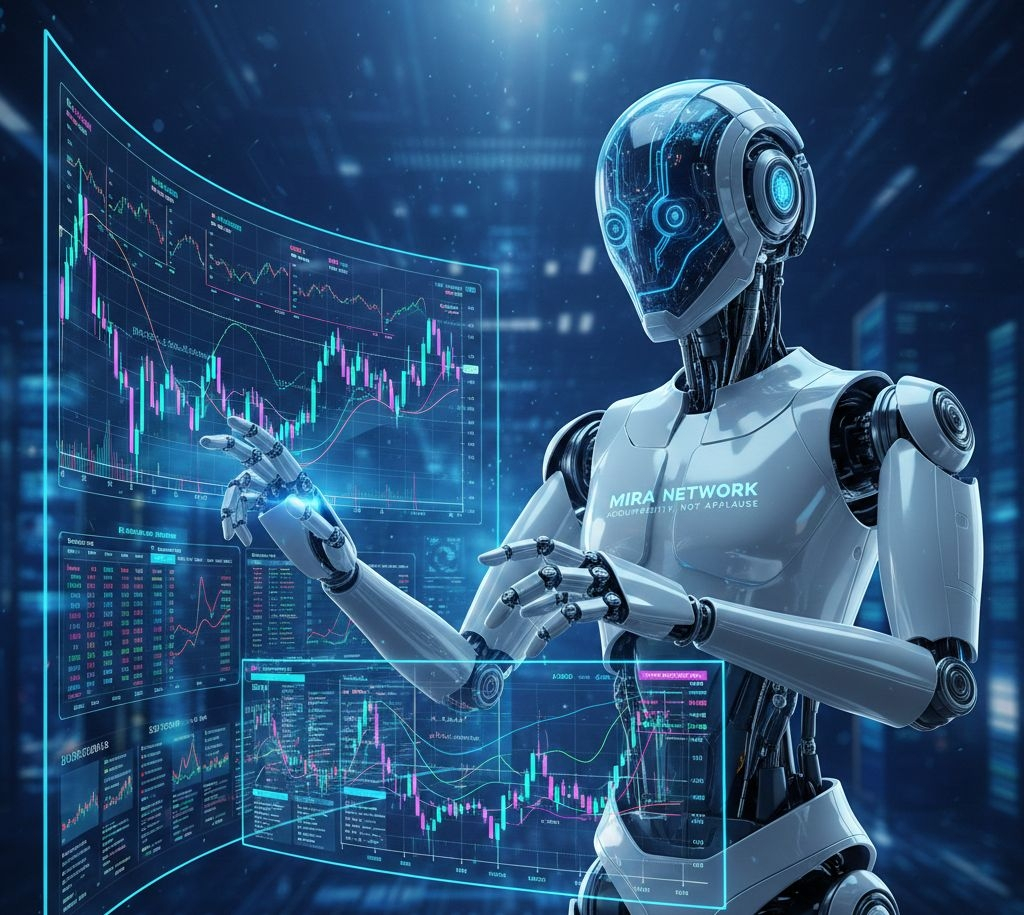
For many years AI systems functioned primarily as assistants. They helped draft documents, summarize articles, generate creative content, or answer questions in casual settings. In that environment, mistakes were tolerable. If an AI system misunderstood something or hallucinated a fact, a human user could usually recognize the error and correct it.
However, something important has been changing in the last few years. AI is gradually shifting from being a passive assistant to becoming an autonomous actor. Agents can now execute code, analyze financial data, manage workflows, and interact with digital infrastructure with limited human supervision.
Once artificial intelligence begins acting independently, the margin for silent errors becomes extremely small.
During my research into modern AI deployments, I encountered the same structural issue repeatedly: confident inaccuracies. Large language models often produce responses that appear precise and authoritative even when they contain incorrect information. These hallucinations are not simple random mistakes. They are coherent answers that look credible enough to pass casual inspection.
In low-stakes contexts this might only create confusion. But in environments like finance, healthcare, or public policy, the consequences of such errors become far more serious.
As I continued researching how AI systems operate in practice, another pattern became clear. The entire AI ecosystem currently depends heavily on centralized trust. When people use a model from a large technology company, they implicitly trust that the model has been trained responsibly, evaluated properly, and designed with appropriate safeguards.
Yet users typically have no transparent way to verify whether an answer is accurate or how the system reached its conclusion.
This centralized trust model becomes increasingly fragile as artificial intelligence starts influencing real-world decisions. When AI becomes part of financial analysis, clinical diagnostics, or governance processes, trust alone is no longer sufficient. Verification becomes necessary.
That realization is the foundation of Mira Network’s architecture.
Instead of assuming that AI outputs are correct, the network treats every piece of generated information as something that must be verified. When I studied the system more closely, I realized that its approach is structured around a simple but powerful idea: complex information can be broken down into smaller claims that can be independently evaluated.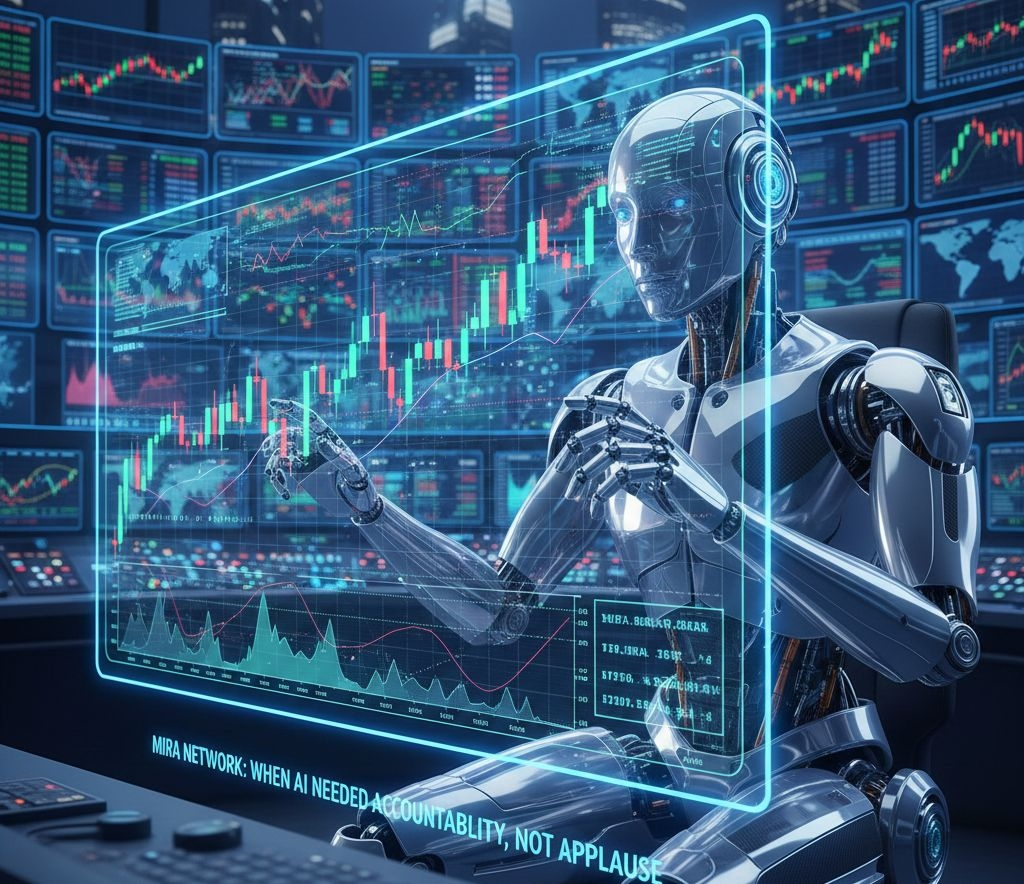
When an AI model produces an answer, Mira decomposes that output into individual factual statements. Each statement becomes a claim that can be analyzed by validators across the network. Rather than trusting a single model’s response, multiple independent models examine the claim and provide verification.
These validators operate within a decentralized environment. They run different AI systems and participate in evaluating claims submitted to the network. Their task is to determine whether each statement is accurate, misleading, or unsupported based on available data and reasoning.
What makes this mechanism particularly interesting is the economic structure surrounding it.
Validators are required to stake tokens in order to participate in the verification process. If their evaluations align with the network consensus, they receive rewards. If they behave dishonestly or consistently submit incorrect judgments, they risk losing part of their stake.
This creates an incentive structure where accuracy becomes economically valuable.
In many ways the system resembles blockchain consensus mechanisms, but applied to information rather than financial transactions. Traditional blockchains verify transfers of digital assets. Mira attempts to verify the truthfulness of AI-generated statements.
Once validators reach consensus about a claim, the verification result can be recorded on-chain. This process creates a transparent and auditable record of how information was evaluated and validated by the network.
While studying this architecture, it began to feel like a missing layer in the modern AI stack. The industry has spent enormous effort building systems that generate content and insights, yet far less effort has been directed toward systems that verify those outputs.
As artificial intelligence becomes more deeply embedded in critical sectors, this imbalance becomes increasingly problematic.
In finance, autonomous agents may soon analyze market data, manage portfolios, or execute trading strategies. In healthcare, AI systems may assist doctors in diagnosing diseases or interpreting complex medical records. In governance, AI tools might help analyze policy proposals, regulatory documents, or large datasets related to public administration.
In each of these contexts, reliability is not simply a convenience. It is a requirement.
An incorrect financial analysis could lead to massive capital misallocation. A flawed medical recommendation could affect patient outcomes. A biased policy summary could influence public decision-making.
In all these scenarios, the ability to verify AI outputs becomes essential.
While researching Mira Network, I also started reflecting on the broader philosophical shift this represents. For years the AI industry has measured progress primarily through capability. The question has always been how powerful models can become and what new tasks they can perform.
But capability alone does not guarantee reliability.
Intelligence without verification is ultimately just a probability distribution. Models generate answers based on patterns learned from data, but those answers are not inherently trustworthy unless they can be tested and confirmed.
Mira’s architecture suggests a different perspective. Instead of focusing only on what AI can do, it emphasizes whether AI outputs can be proven reliable.
The focus shifts from capability to accountability.
Of course, while studying this model I also became aware of several challenges it will inevitably face. Verification layers introduce latency. Breaking responses into claims, distributing them across validators, and reaching consensus requires time and computational resources.
For applications that require instant decision-making, this delay could become a limitation.
There is also the question of validator collusion. Like any decentralized consensus system, the network must assume that a majority of participants behave honestly. If a large group of validators coordinated maliciously, they could potentially manipulate verification outcomes.
Economic staking mechanisms are designed to discourage this behavior, but maintaining decentralization and incentive alignment will remain a constant challenge.
Scalability represents another major hurdle. Artificial intelligence systems generate enormous volumes of content every day. Verifying every claim across all outputs would require significant infrastructure and computational power.
The network must develop efficient methods for prioritizing verification tasks while maintaining accuracy and trustworthiness.
Despite these challenges, the underlying idea continues to feel increasingly relevant the more I analyze it. Artificial intelligence is rapidly evolving from a research tool into a foundational layer of global digital infrastructure.
As this transition occurs, reliability will become just as important as capability.
When I step back and look at the broader picture, Mira Network appears to represent an attempt to build a decentralized trust layer for artificial intelligence. A system where machine-generated information is not simply accepted but verified through transparent consensus and economic incentives.
It reflects a deeper shift in how the technology industry might begin thinking about intelligence itself.
For decades the goal was to build machines that could generate knowledge and insights. But as those machines begin influencing real-world systems and decisions, generating knowledge alone is no longer sufficient.
That knowledge must also be provable.
And perhaps that is the direction artificial intelligence must eventually move toward. As AI becomes more autonomous, the most important question will no longer be whether machines can produce answers.
The real question will be whether those answers can be trusted.
Because in a world increasingly shaped by artificial intelligence, intelligence alone will never be enough.
It must be paired with proof.
