This is where the concept often described as a “digital soul” becomes important—an idea closely related to the infrastructure being developed by the Fabric Foundation.
The Problem: Machines Without Identity
Today’s robots and AI systems are powerful but limited by a basic structural issue. Most machines operate inside closed corporate systems, controlled by centralized operators. They cannot:
Own a financial account
Sign contracts
Receive payments directly
Build a verifiable reputation
In other words, machines lack economic identity. Human systems—passports, bank accounts, signatures—were designed only for biological participants.
Fabric Foundation
Without identity and accountability, robots remain isolated tools rather than independent contributors to global systems.
The “Digital Soul” Idea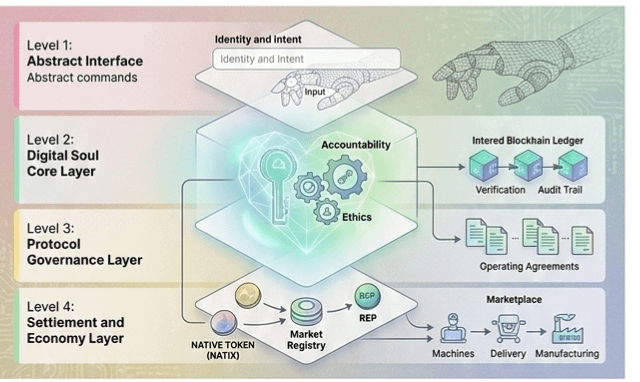
The “digital soul” metaphor refers to a persistent, verifiable identity and memory for machines. Instead of being anonymous hardware, a robot could have:
A cryptographic identity
A historical record of actions
A reputation based on past performance
The ability to hold and transfer digital assets
In the Fabric ecosystem, this identity is created through on-chain cryptographic credentials and blockchain wallets, enabling machines to interact economically and transparently.
This transforms a robot from a device into a network participant.
How Fabric Foundation Is Building This System
Fabric’s architecture introduces several layers that together form the “digital soul” of machines:
1. Identity Layer
Each robot generates a unique cryptographic identity recorded on a blockchain.
This allows the network to verify:
What machine it is
Who controls it
What permissions it has
Its past task performance
2. Economic Layer
Machines receive blockchain wallets so they can:
Receive payments
Pay for maintenance or compute resources
Participate in autonomous contracts.
Fabric Foundation
3. Coordination Layer
Tasks are distributed and verified through decentralized protocols.
Robots can collaborate, complete work, and receive rewards without a centralized operator.
Together these layers create an open operating system for the robot economy.
Why This Could Reshape the Global Economy
The world is entering a period where robots will increasingly handle tasks in:
Manufacturing
Healthcare
Logistics
Environmental cleanup
Infrastructure maintenance.
Fabric Foundation
However, scaling robotic labor globally requires trust and coordination systems similar to those humans use today.
Fabric’s approach enables:
Transparent machine behavior
Verifiable work records
Decentralized governance
Machine-to-machine payments.
In this model, robots can operate as autonomous economic participants, not just company-owned tools.
Aligning Humans and Machines
Another reason the “digital soul” concept matters is alignment.
If machines are making decisions and performing work in society, their actions must be:
Observable
Accountable
Governed by shared rules.
Fabric aims to build infrastructure that allows humans, developers, and machines to participate in a transparent coordination network, ensuring machines remain aligned with human values and oversight.
Fabric Foundation
The Road Ahead
The robot economy is still in its early stages. Real-world deployment will require partnerships, regulation, and operational maturity. Yet the foundations are already forming.
If robots are to become independent workers in a global economy, they will need something similar to what humans already possess:
identity
memory
reputation
financial capability.
The infrastructure being developed by the Fabric ecosystem attempts to give machines exactly that—a digital soul that makes trust possible in a world of autonomous systems.#ROBO $ROBO @Fabric Foundation