

@Fabric Foundation What keeps nagging at me about robotics is not whether machines are getting smarter. They are. The quieter question is harder, and honestly more practical: when a robot shows up in the world and does something that matters, who exactly is it in an operational sense? Not philosophically.
This is not about movie ideas. It means who is running the machine, what it is allowed to do, how it gets money, what proof it leaves behind, and who is responsible if it causes a problem.That is the kind of boring problem people tend to skip past when they talk about the future. Fabric Protocol is interesting because it seems to start there instead of treating identity as a detail to patch in later. In its recent public materials, Fabric describes itself less as a pure robotics company and more as a network for payment, identity, and capital allocation so robots can act as autonomous economic participants. Its white paper pushes that further, calling Fabric a global open network to build, govern, own, and evolve general-purpose robots through public ledgers.
I think that matters because most of the real friction around robots is not dramatic. It is administrative.A robot can carry a box, check a shelf, deliver an item, or charge itself. That part is easy enough. The real problem starts when it enters a workplace, a road, or a supply chain built for people and businesses.Contracts assume legal persons. Payment systems assume bank accounts. Insurance assumes identifiable operators. Compliance assumes somebody can be named, checked, restricted, and audited. Fabric’s own framing is blunt on this point: infrastructure built for humans excludes non-biological thinking machines, and robots lack what it calls financial identity. The project’s answer is to give robots an onchain registry and associated economic rails rather than leaving every deployment trapped inside a private fleet silo. 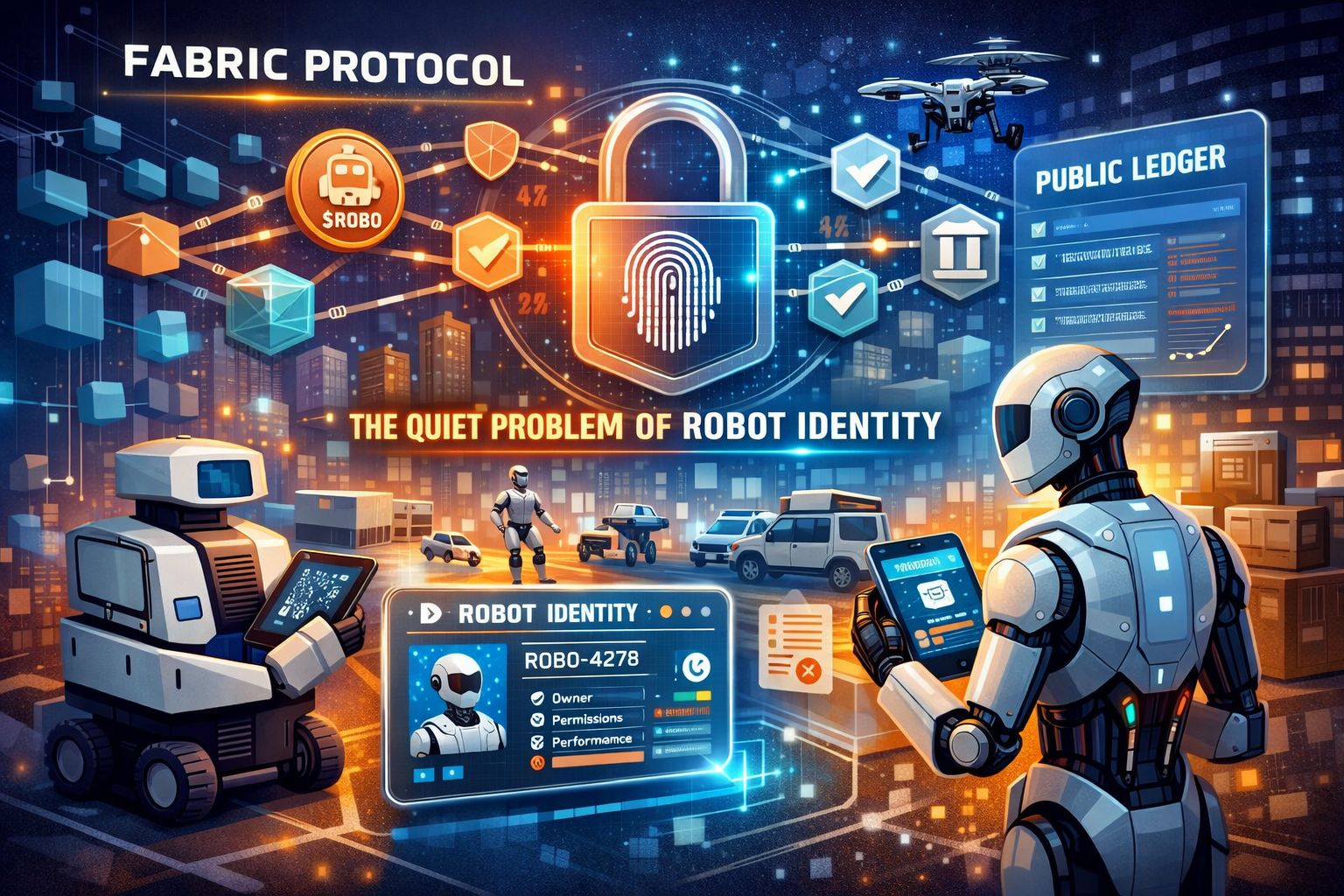
That may sound technical, but the underlying issue is simple. Identity is what turns an action into something legible. Without identity, there is activity but no durable memory around it. A robot completed a task. Says who? Under what authority? Using whose resources? With what history of reliability? Fabric explicitly says a persistent identity layer should let the world know what robot it is, who controls it, what permissions it has, and what its historical performance has been, with provenance recorded in an auditable and interoperable registry. That is not a cosmetic layer. It is the difference between a machine being a gadget and a machine becoming a participant in a system of work.
What I find especially revealing is that Fabric does not talk about identity in isolation. It keeps tying identity to settlement and verification. On the public blog, Fabric says it wants a marketplace-like infrastructure layer that coordinates participation and settles fees in $ROBO based on verified task completion. In the white paper roadmap, the first quarter of 2026 is described in very plain terms: deploy initial components for robot identity, task settlement, and structured data collection in early deployments, then begin gathering real-world operational data. That sequencing says a lot. The project is not presenting identity as branding for machines. It is treating identity as the base layer for payment, measurement, and later incentive design.
And that feels closer to reality than a lot of robotics rhetoric does. In practice, robots do not fail only because perception models are weak or hardware breaks. They also fail institutionally. They fail because nobody shares the same record of what happened. The operator has one log, the customer has another, a sensor says something else, and the financial trail sits somewhere off to the side. When that happens, trust gets expensive. Humans fill the gap with managers, paperwork, and private arbitration. Fabric’s design seems to be asking whether part of that coordination burden can be turned into common infrastructure. The white paper repeatedly frames public ledgers as the way to coordinate data, computation, ownership, and oversight, while the blog positions the network as a unified open system for robot labor rather than a stack of disconnected private deployments.
There is another layer here that people do not always say out loud. Identity is also about limits. We usually talk about digital identity as a gateway to access, but for robots it is also a way to define boundaries. A robot with no durable identity is hard to permission, hard to restrict, hard to rate, and hard to remove from sensitive environments in a standardized way. Fabric’s materials suggest a system where permissions, contribution tracking, validation, and historical performance all sit inside a broader governance framework. Even its roadmap and governance section admit that important choices are still open, including how validators are selected at the start and how the protocol defines sub-economies or measures meaningful success beyond revenue. I actually like that those uncertainties are written down. It makes the project feel earlier, but also more honest.
That “early” point is important. It would be easy to oversell this category, and Fabric’s own documents give reasons not to. The blog says robotic fleets at scale will still require deployment partnerships, operational maturity, insurance frameworks, and reliable service contracts. The white paper similarly places many pieces on a future roadmap, with larger-scale deployment preparation happening later in 2026 and a machine-native Layer 1 described as a goal beyond that. So the useful way to read Fabric today is not as a finished robot economy, but as a serious attempt to define the missing institutional plumbing before the industry is forced to improvise it badly. 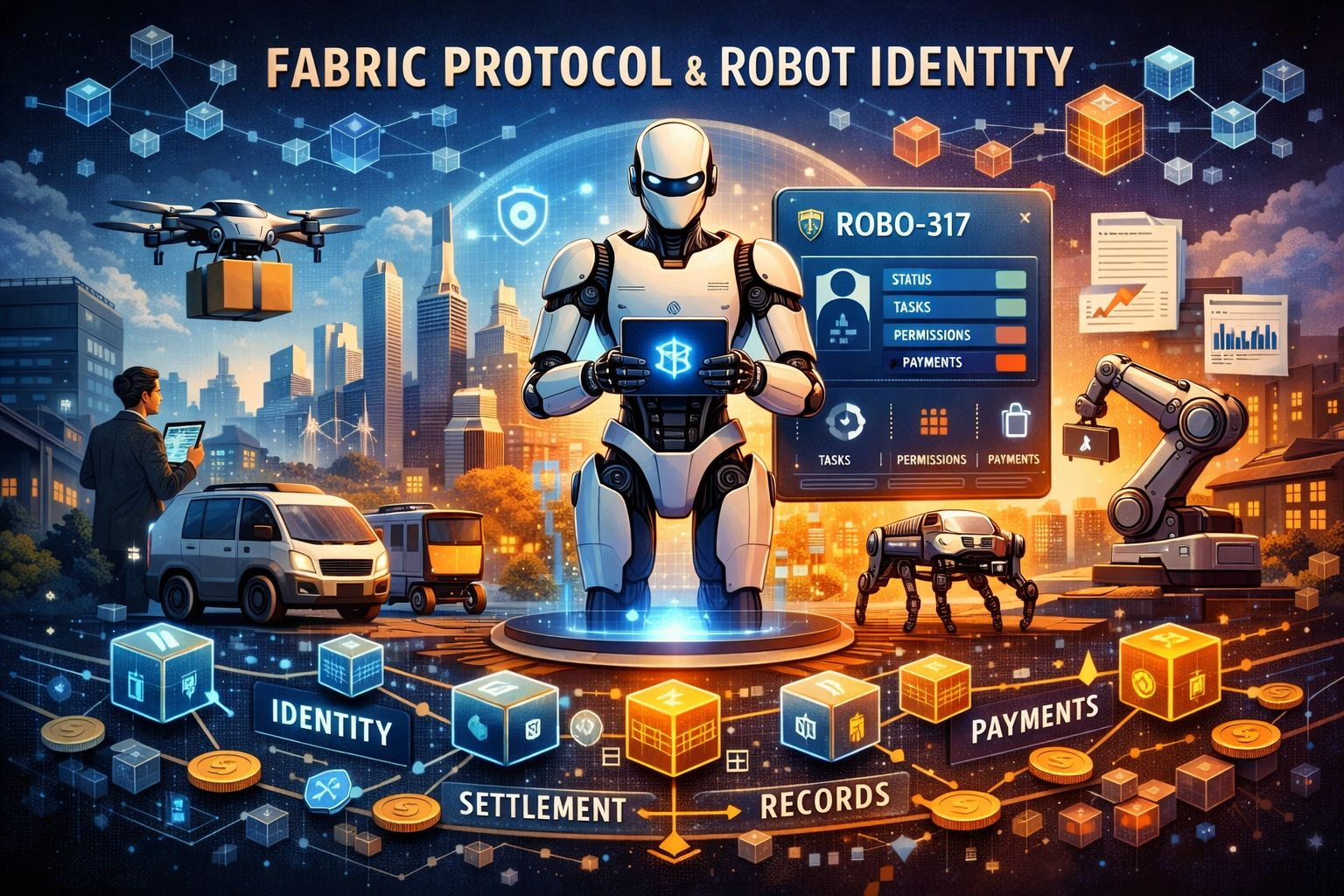
I also think the project is saying something bigger than “put robots onchain,” which is the sort of phrase that makes people tune out. The deeper claim is that automation is drifting toward economic agency, and once that happens, identity cannot remain informal. If a machine can receive work, trigger payments, consume compute, log performance, and participate in incentives, then identity becomes the thread holding all of those actions together. Fabric’s white paper even frames robotics as shared public infrastructure, where contributors can train, secure, and improve the system and be rewarded through the protocol. Whether that exact model succeeds is still open. But the instinct behind it is sharp: smart machines are not only a software problem, they are a coordination problem.
That is why the title question lands for me. Robot identity sounds quiet because it does not have the theater of humanoid demos or bold autonomy claims. Yet it may end up being one of the least avoidable design problems in the whole field. Before a robot can become trustworthy, useful, or economically independent, it has to become legible. Not lovable. Not mystical. Legible. Fabric Protocol seems to understand that the future of robotics may depend less on making machines feel human and more on making their presence accountable in systems humans already depend on. And maybe that is the mature direction for the industry. Not pretending the hard part is intelligence alone, but admitting that once a machine enters public life, identity is where the real work begins.