
As automation and AI continue to grow, one important question starts to appear:
What happens when machines begin creating value on their own?
Today when a machine completes a task — whether it processes data, performs a service, or powers a network — the financial side still depends on humans. Payments are routed through company accounts, developer wallets, or banking systems controlled by people.
The machine does the work, but the economic system around it still belongs entirely to humans.
This is the problem Fabric Foundation is trying to explore.
Machines Need Their Own Digital Identity
Instead of treating machines as tools controlled by humans, the idea is to give them verifiable identities on a blockchain.
These identities could store information such as:
• What tasks a machine has completed
• How reliable its performance has been
• What capabilities it has
• Its transaction history within the network
Rather than anonymous wallet addresses, machines could build reputation and history over time.
Why Blockchain Is Important Here
Traditional financial systems were designed around people and companies.
Opening accounts, signing contracts, verifying identity, and building credit all assume a human or organization is responsible for every action.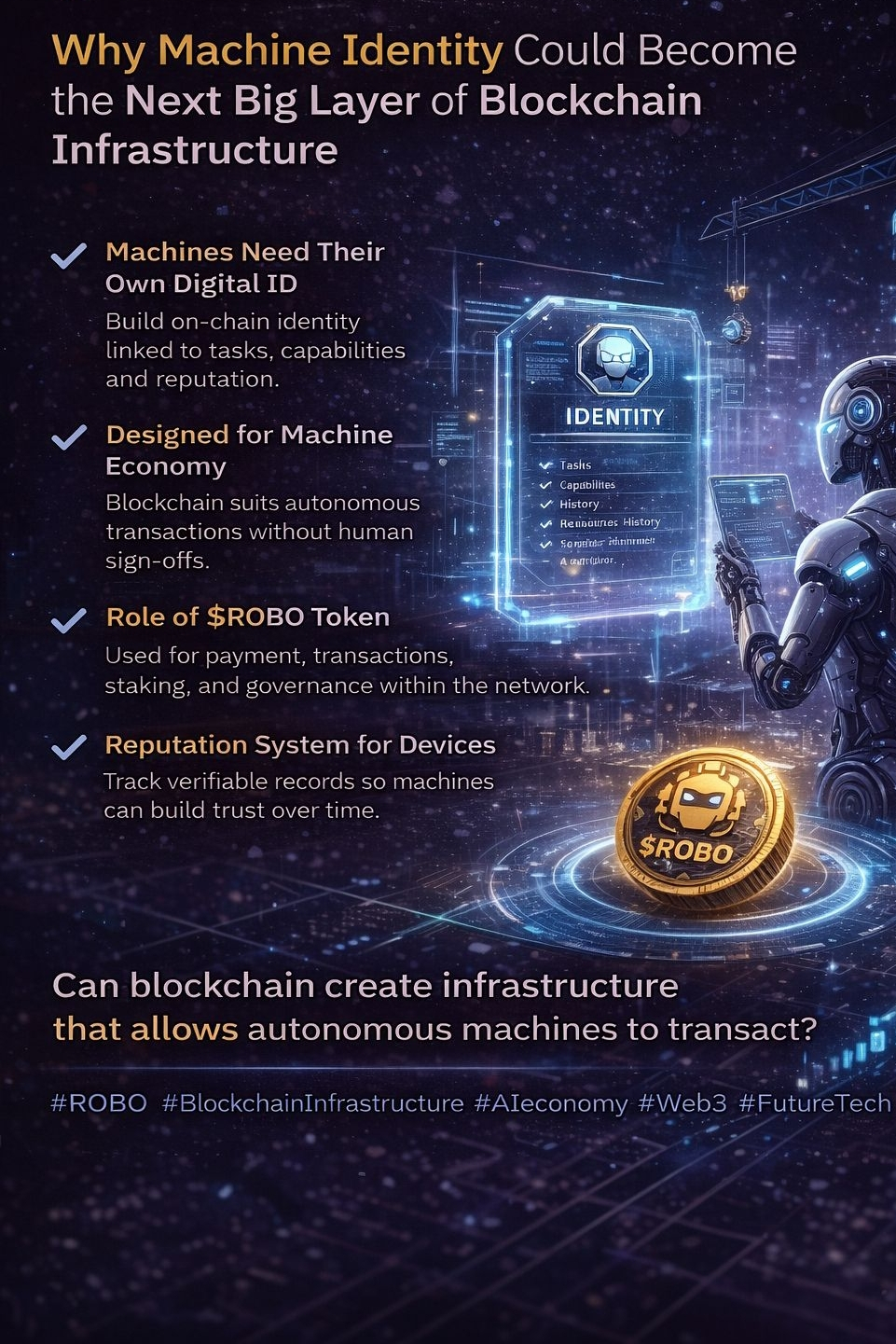
Autonomous machines do not fit easily into those structures.
Blockchain networks offer an alternative. A digital identity on-chain does not require a passport, a bank account, or a corporate registration. Smart contracts can settle payments automatically and record activity in a transparent ledger.
That makes decentralized infrastructure a natural environment for machine-to-machine interaction.
The Role of $ROBO
Inside the ecosystem being developed by Fabric, $ROBO acts as the economic layer.
It can be used for:
• Paying network fees
• Settling transactions between participants
• Staking for network roles
• Participating in governance decisions
Instead of existing purely as a speculative token, it becomes the unit that allows the system to function.
Reputation for Machines
One interesting part of the design is the focus on machine reputation.
Most blockchain systems only track transactions between wallet addresses. That information alone does not explain what the participant actually did.
Fabric’s concept suggests a richer identity layer. Machines could build verifiable records showing the work they performed and the quality of that work.
This kind of data could help:
• Companies choose reliable robots for tasks
• Developers select trustworthy infrastructure providers
• Insurance systems evaluate operational risk
Reputation becomes a key part of the machine economy.
A Long-Term Vision
It is also important to recognize that this type of infrastructure will not appear overnight.
The robotics industry evolves much more slowly than the crypto market. Real-world autonomous machines capable of large-scale economic activity are still developing.
Fabric itself acknowledges that the ecosystem is still in progress. Core infrastructure, validator participation, and application layers will take time to mature.
Building Before the Wave Arrives
If the future includes millions of machines interacting digitally, those systems will require ways to identify themselves, exchange value, and build trust.
Projects like Fabric are attempting to build that infrastructure before the demand becomes obvious.
Whether they succeed is something only time will answer.
But the broader idea is worth considering:
If machines eventually participate in global economies, they will need systems designed specifically for them.
And decentralized networks might be one of the few environments capable of supporting that world.
What is your opinion on the concept of machine identities powered by blockchain? 👀
#ROBO #BlockchainInfrastructure #AIEconomy #Web3 #futuretech
