In the crypto industry we often see the same structure repeated. Projects launch a token, talk about future utility, and eventually the token ends up being used mostly for governance. The real demand only appears if the platform becomes extremely successful.
The model behind $MIRA from Mira Network tries to approach this problem differently.
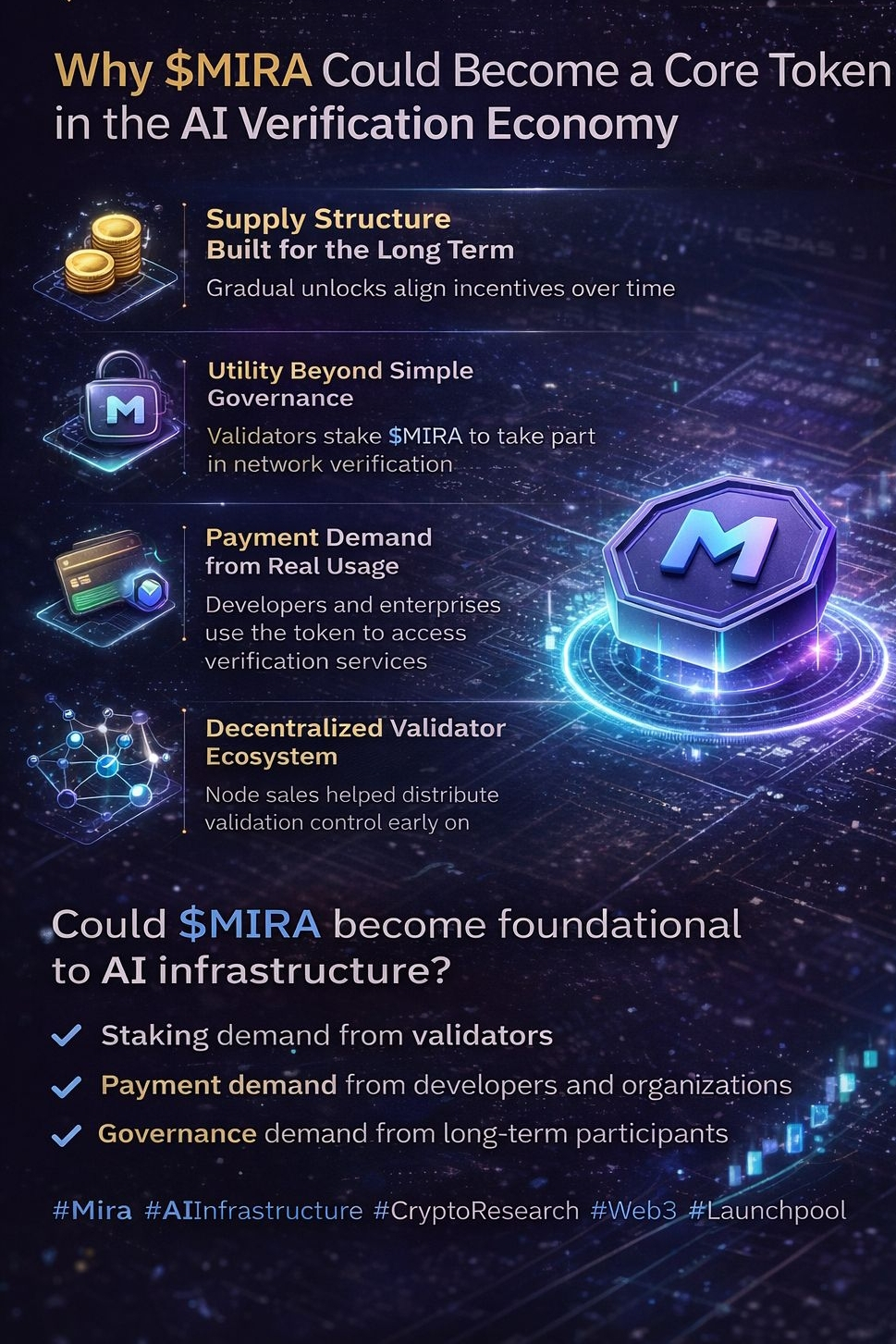
Supply Structure Built for the Long Term
At its Token Generation Event in 2025, the circulating supply started at roughly 19% of the total 1 billion token supply. Instead of releasing large amounts quickly, the project designed a gradual unlocking system.
• Core team allocations follow a long vesting period before becoming liquid
• Early backers receive tokens slowly over time
• Foundation allocations are also released gradually
• Ecosystem rewards depend on network growth milestones
This structure aligns the incentives of the people closest to the project with the long-term health of the network.
Utility Beyond Simple Governance
Where the token design becomes more interesting is on the demand side.
Participants who operate validators in the network must stake $MIRA in order to take part in the Dynamic Validator Network. Their stake is not symbolic. If a validator fails to perform correctly, part of the staked tokens can be lost.
This creates a system where operators are economically motivated to maintain accurate verification.
Staking as a Core Economic Layer
Validators with larger stakes are able to process more work and earn greater rewards. As network activity grows, the total amount of tokens locked for staking can increase as well.
This means demand for the token grows alongside network participation rather than relying purely on speculation.
Payment Demand from Real Usage
Another major demand driver comes from the service layer.
Developers and organizations using the network’s verification tools pay for that service using $MIRA . In other words, the token acts as the payment asset inside the ecosystem.
If adoption increases among developers or enterprises, the demand for MIRA increases naturally as part of the system’s operation.
Institutional Backing
The project has also attracted attention from major venture investors such as Framework Ventures and BITKRAFT Ventures, who supported the early funding round.
Both firms previously invested in infrastructure-level crypto projects, suggesting they see Mira as a potential foundational layer for AI-related verification.
Decentralized Validator Ecosystem
Before launching its full network, Mira distributed validator rights through node sales. This approach helped create a decentralized operator base from the beginning rather than concentrating control.
A distributed validator layer improves network reliability and credibility.
Governance for Long-Term Participants
Token holders who stake their assets also participate in governance decisions such as protocol upgrades or ecosystem funding.
Influence scales with long-term commitment, meaning those most invested in the network’s future help guide its development.
A Multi-Layer Token Economy
When looking at the overall structure, three main demand sources emerge:
• Staking demand from validators
• Payment demand from developers and enterprises
• Governance demand from long-term participants
Each layer reinforces the others. More validators improve verification quality, which attracts more users and generates more payment flow. Increased activity then strengthens the incentives for validators and stakeholders.
Instead of relying purely on hype or speculation, the design attempts to connect token demand directly to network usage.
The real question going forward is simple:
If AI systems increasingly require trusted verification layers, could Mira become part of that infrastructure?
What is your view on the long-term potential of $MIRA? 👀