

Let me start with a weird question.
What happens when a machine actually earns money?
Not in the sci-fi sense. I mean real value. Real work. Real output. A warehouse robot moving thousands of packages a day. A logistics AI saving companies ridiculous amounts of fuel by optimizing routes. Agricultural drones flying over farms collecting crop data for insurance companies.
These machines create value. A lot of it.
But here’s the awkward part nobody likes to talk about.
They can’t own the money they generate.
Seriously. They can’t.
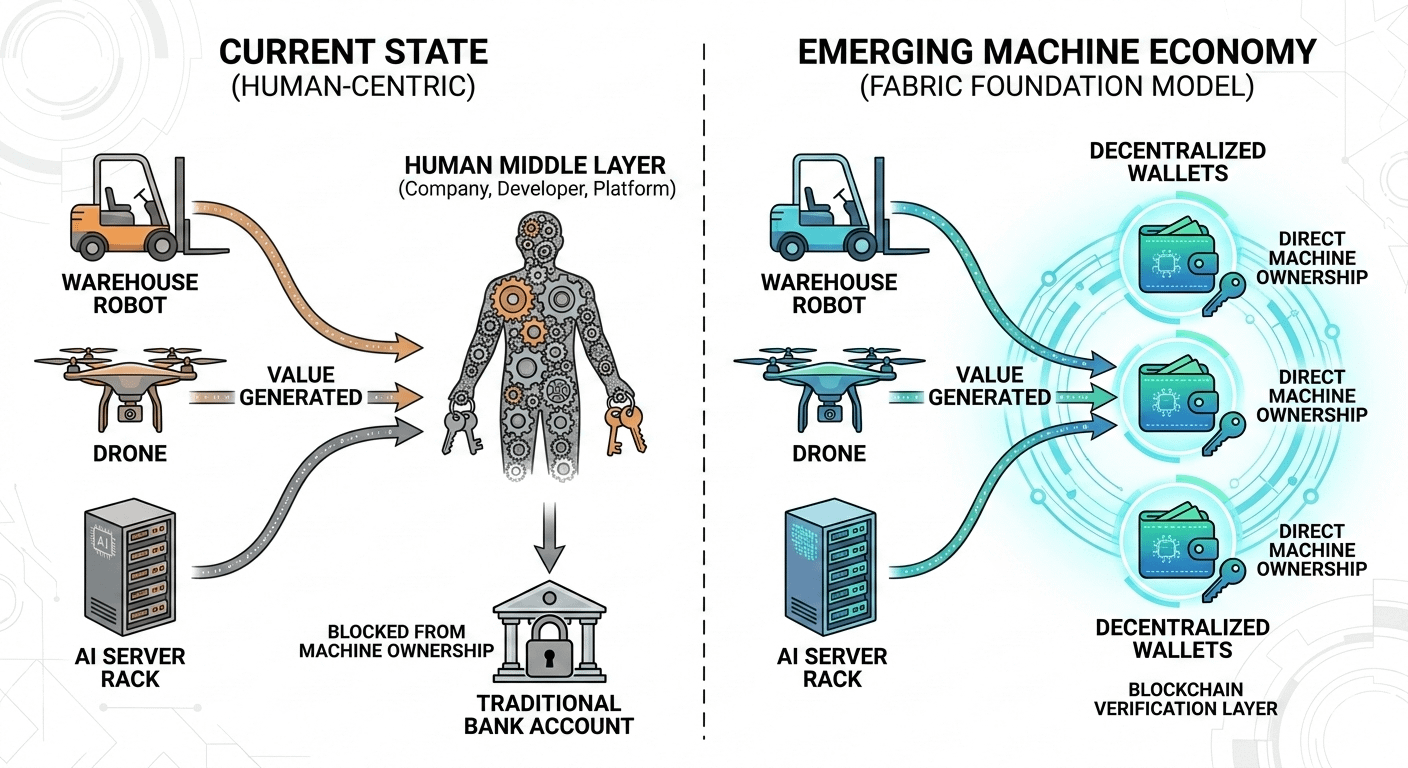
The payment always lands in a human account somewhere — a company wallet, a developer’s system, some cloud service account. The machine did the work. A human holds the keys.
Honestly, this is one of those quiet problems sitting right under the surface of the automation economy. People talk about AI replacing jobs. Robots doing more tasks. All that stuff.
But hardly anyone talks about the financial plumbing behind it.
And yeah… it’s messy.
Look, the current financial system was built for humans. Period.
Banks expect IDs. Legal accountability. Physical presence. Paper trails. Courts. Signatures. A robot can’t walk into a bank branch. An AI agent can’t sign a legal contract.
So the system improvises.
Every machine ends up operating through some human middle layer. A company account. A platform wallet. A developer’s infrastructure.
And that setup causes headaches. Real ones.
First problem — ownership gets blurry. Who actually owns the value the machine produced?
Second problem — payments slow down because humans still sit in the loop.
Third problem — trust assumptions creep in everywhere. Someone in the chain always holds control.
It worked fine when machines were just tools. Simple ones.
But modern robotics and AI agents? Different story. These things make decisions. They coordinate tasks. They operate independently for long stretches.
At some point you have to admit something slightly uncomfortable.
They behave less like tools… and more like economic actors.
Yeah, that sounds weird. But it’s happening.
Now here’s where blockchain starts looking less like a crypto experiment and more like a practical fix.
Traditional finance depends on institutions. Blockchain depends on verification.
That difference matters.
Instead of a bank approving payments, smart contracts execute them automatically. Instead of a company ledger, a public blockchain records transactions. Instead of identity verification through paperwork, you get cryptographic identity.
Machines actually fit into that system pretty well.
They can hold wallets.
They can execute transactions.
They can interact with smart contracts.
No human needed every five seconds.
This basic logic sits behind what teams around Fabric Protocol are trying to build. And yeah, I know — plenty of blockchain projects claim big ideas. I’ve seen this before.
But the angle here is slightly different.
They’re focusing on machine identity.
Not just wallets.
Actual identities.
Most blockchain networks stop at wallet addresses.
An address sends tokens. Receives tokens. That’s about it.
But an address tells you nothing useful about the thing behind it. Is it reliable? Does it finish tasks? Does it break constantly?
You have no idea.
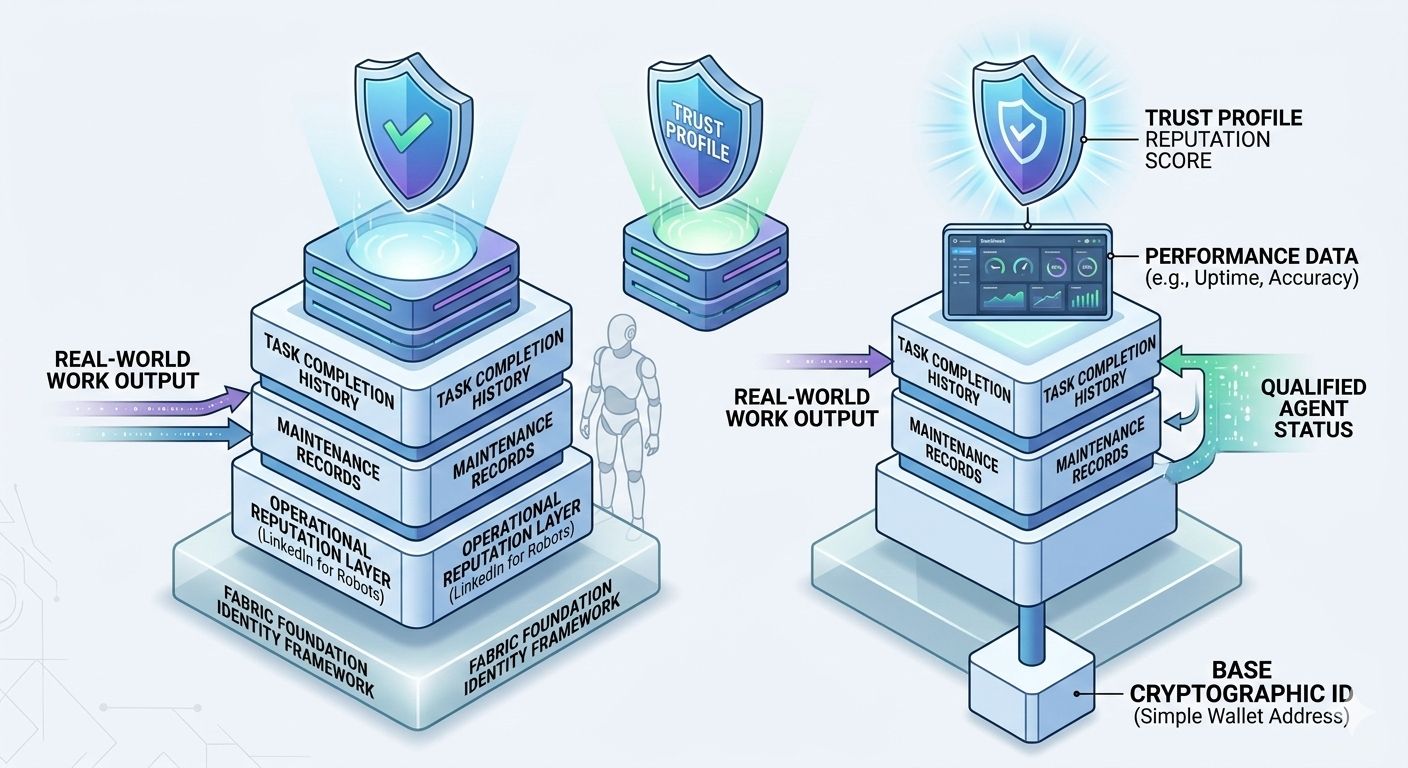
Fabric’s approach pushes identity way further. Instead of just assigning a wallet, the system tracks detailed machine profiles. We’re talking about performance history, task completion data, reliability scores, capability records — basically a work history for machines.
Think of it like LinkedIn… but for robots.
Okay, maybe that’s a slightly strange comparison. But you get the idea.
A machine builds reputation over time. Other participants in the network can see whether that robot or AI agent actually delivers results.
That changes how systems coordinate.
Suddenly you're not trusting a random wallet address. You're evaluating a track record.
And honestly, people don’t talk about this enough. Reputation systems matter way more than fancy tokenomics.
Speaking of tokens though, let’s talk about ROBO.
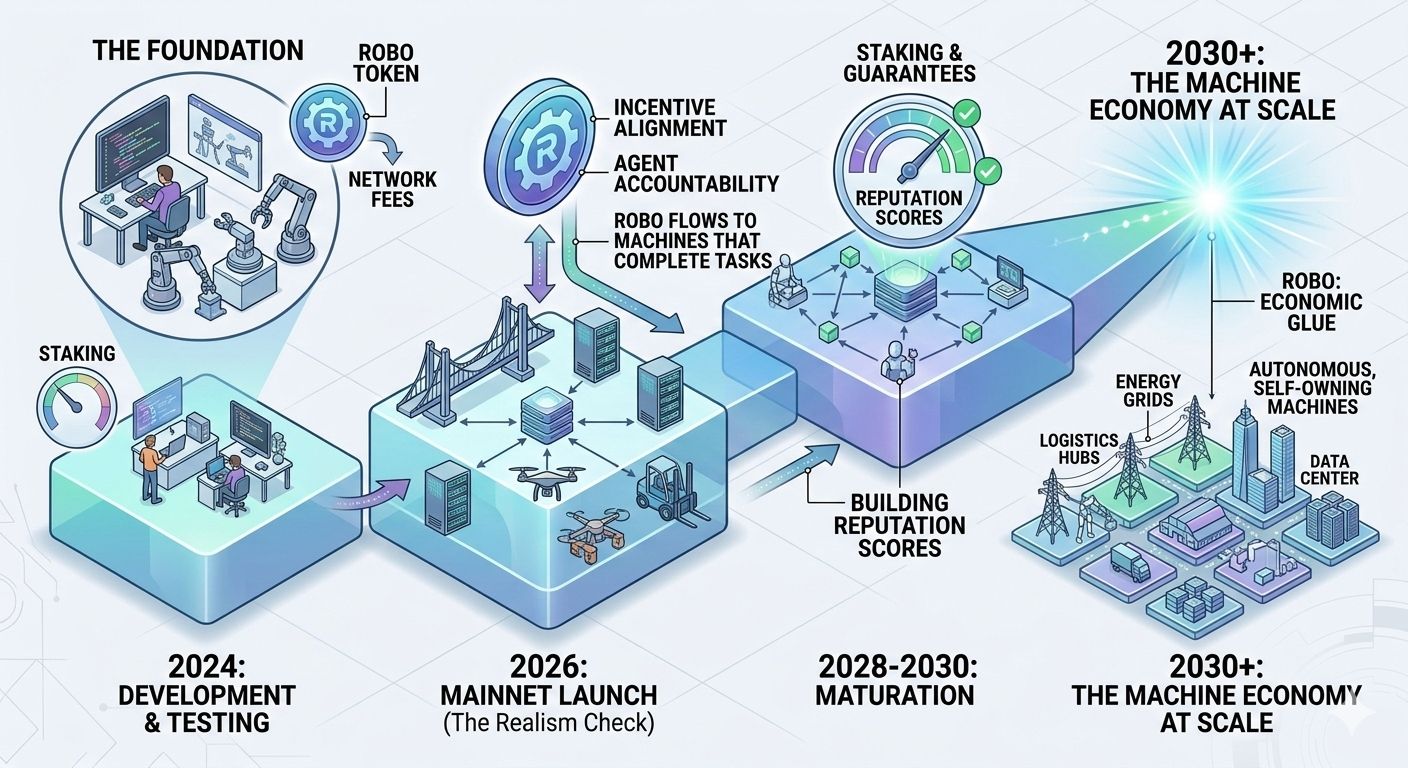
Inside the ecosystem built by Fabric Foundation, the ROBO token acts as the network’s economic glue.
Not hype fuel. Infrastructure currency.
Machines receive ROBO for completing tasks. Developers pay network fees using ROBO. Participants stake ROBO to signal reliability.
That last piece matters.
A lot.
When agents stake tokens, they put economic skin in the game. If something goes wrong — bad behavior, failed tasks, malicious activity — the system can penalize that stake.
It’s not perfect. Nothing is.
But it introduces accountability in an environment where machines operate autonomously. And that’s tricky territory.
Now let’s be realistic for a second.
Robotics moves slowly. Painfully slowly sometimes.
People used to fast-moving crypto cycles often underestimate this. Hardware takes years to develop. Testing takes forever. Safety regulations add another layer of friction.
You can’t just ship a robot network the same way you launch a DeFi app.
That’s why the ecosystem around Fabric points toward a 2026 mainnet timeline.
Some people hear that and complain. “Too far away.”
Honestly? It’s realistic.
Maybe even optimistic.
When you combine robotics, AI agents, and decentralized infrastructure… things take time. A lot of time.
There are still open questions everywhere.
How detailed should machine identities become?
How will regulators treat autonomous agents?
What standards will robotics companies adopt?
No one has perfect answers yet.
And that’s okay.
Zoom out for a second though.
Something bigger is happening here.
Machines are slowly shifting from tools to economic participants. Not overnight. Not dramatically. Just gradually, step by step.
They perform work.
They generate value.
Eventually they’ll need to receive payments directly.
Once that happens at scale, the financial infrastructure supporting them has to evolve.
Systems like the one explored by Fabric Foundation represent early attempts to solve that problem. Not finished products. More like foundational experiments.
Think of it as infrastructure scaffolding.
The kind people ignore early… and rely on later.
So what’s the takeaway here?
Honestly, patience.
That’s it.
People chasing overnight gains usually miss the boring stuff — infrastructure, standards, identity layers, coordination protocols. But those things quietly shape entire industries.
The machine economy isn’t arriving tomorrow. Anyone promising that probably sells tokens, not infrastructure.
But over the next decade?
Machines earning, spending, coordinating, and building reputations inside digital networks… yeah, that’s very possible.
And when that future finally shows up, the systems that allowed machines to participate economically will look obvious.
Right now though?
We’re still building the foundation.
Slowly. Carefully.
And if you ask me, that’s exactly how it should happen.
#ROBO @Fabric Foundation $ROBO
