
I was three weeks into building my AI agent project when I hit a wall.
The idea was simple. An autonomous agent that could handle repetitive research tasks without me being involved every step of the way. The logic was working. The outputs were decent. But the costs were not.
Every time the agent ran a full cycle it was pulling from paid APIs and cloud compute that I was not accounting for properly at the start. My budget was draining faster than I expected and I had no clean way to control it. The agent could not manage its own spending. I had to babysit every run manually which defeated the whole purpose of building it in the first place.
I started looking for solutions and that is when I came across Mira Network.
I shifted my agent to run through Mira and the cost difference was immediate. But what surprised me more was something I had never thought about before. I assumed verification was complete the moment the API returned 200 OK. Most developers do. I did too until I looked closer.
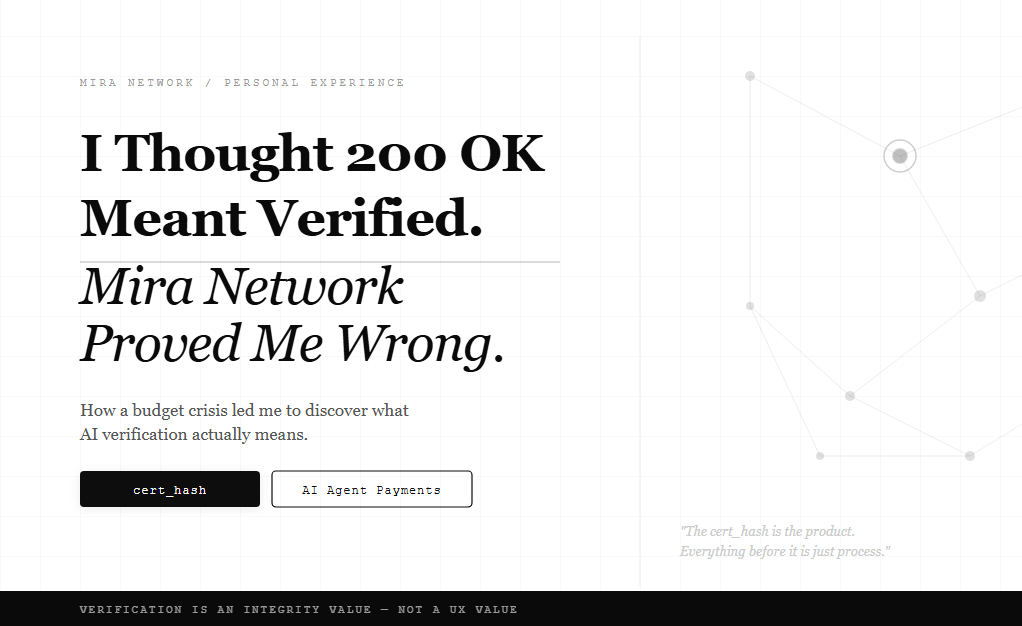
Real verification inside Mira ends when the cert_hash is returned. Not before.
Here is what I observed. An AI output gets broken into individual claims. Each claim receives a fragment ID and an evidence hash. Independent validator nodes running different models with different training data fan out across the mesh. A supermajority threshold must be crossed. Only then does a cryptographic certificate get issued.
That cert_hash is the only artifact that truly anchors a specific output to a specific consensus round. It is what auditors trace. It is what gives a verified badge any real operational weight.
Without it you do not have verification. You have a latency indicator dressed up as a trust signal.
The failure pattern I kept observing in my own workflow was the same pattern Mira is designed to solve. Stream the provisional response for speed. Let the certificate catch up in the background. Treat API success as verification success because the gap feels too small to matter.
But users do not wait for the certificate. They copy the output. They forward it. They build decisions on top of it. The reuse chain starts in seconds and provisional text does not come with a recall mechanism.
What I realized is that latency and assurance are not the same axis. Responsiveness is a UX value. Verification is an integrity value. Most infrastructure treats them as the same thing. Mira does not.
My project is no longer bleeding budget on every agent cycle. But more than the cost saving what actually changed is how I think about what a verified output even means. The cert_hash is the product. Everything before it is just process.
@Mira - Trust Layer of AI #Mira $MIRA