
Imagine looking out your window to see a delivery drone not just dropping off a package, but independently paying a local charging station for a battery top-up using its own digital wallet.
This isn't a pitch for a futuristic sci-fi movie; it is the real-world infrastructure currently being deployed by the Fabric Foundation. While most of the crypto market is chasing the next meme trend or speculative bubble, a quiet revolution is taking place at the intersection of AI, robotics, and Web3. Today, we are breaking down the smart mechanics behind this movement no hype, just a fundamental look at how smart contracts are giving machines economic autonomy.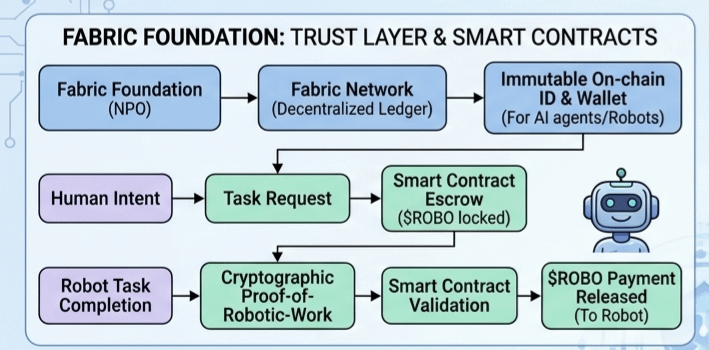
Community-Driven Robot Economy Mein Fabric Foundation Ka Yogdaan
To understand the ecosystem, we first need to look at the architects. The Fabric Foundation is operating as an independent non-profit entity with a very specific mission: to build the decentralized infrastructure that aligns intelligent machines with human intent.
They are not in the business of manufacturing the physical robots; instead, they are building the "trust layer." In a traditional setup, robots operate within closed, centralized corporate servers. The Fabric Foundation flips this model, championing a community-driven, public ledger approach. Through the Fabric Network, every autonomous machine is assigned an immutable on-chain ID and a decentralized wallet.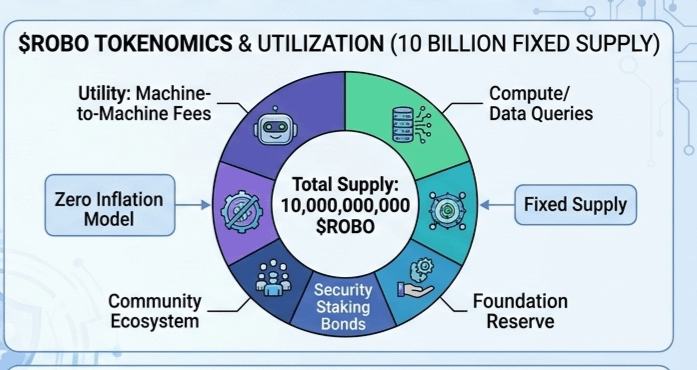
This means that instead of relying on a single corporate giant to oversee a robot's actions, the community oversees it via public blockchain ledgers. By integrating zero-knowledge proofs and advanced smart contracts, the foundation ensures that robots cannot be tampered with or impersonated, laying the groundwork for a secure, peer-to-peer robotic economy.
Robo Coin Introduction: Fabric Network Ka Native Token
At the very heart of this decentralized infrastructure is the Robo token. It is not designed to be a speculative store of value; rather, it is the fundamental "fuel" and settlement currency for the entire Fabric Network.
Whenever an AI agent or a physical robot performs a task, queries data, or requests a collaborative service from another machine, the transaction fees are settled in $ROBO.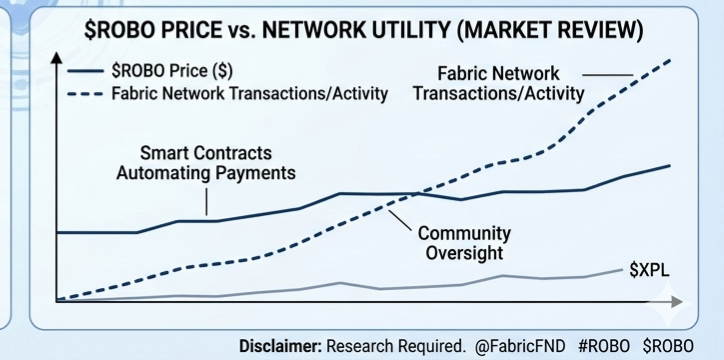
Here is where the smart contracts shine. When you hire an autonomous agent to perform a real-world task say, moving logistics inventory you lock the payment in a smart contract. The robot completes the work and submits a cryptographic "Proof-of-Robotic-Work" to the network. Once the smart contract verifies that the task was successfully completed, it automatically releases the $ROBO directly into the robot's wallet. There are no middlemen, no invoicing delays, and no centralized clearinghouses.
Real-Time Trading Experience & Review
Approaching this from a trader's perspective requires a shift in mindset. In my own real-time market analysis, when evaluating my Web3 portfolio tracking the development of utility-heavy tokens like Robo coin alongside other network-centric assets like Plasma ($XPL) I prioritize actual network demand over social media sentiment. Trading $ROBO is fundamentally different from trading standard DeFi governance tokens.
Its price action is deeply tied to network utilization. Because Robo is required for machine identity registration, compute tasks, and verifiable operations, the buy-side pressure is theoretically linked to actual robot deployments in the real world. In my experience, watching the order books and on-chain metrics for $ROBO reveals a market that is slowly pricing in the "Android of the physical world" narrative. It is a smart play for those who understand infrastructure, but it requires patience as the physical hardware deployments catch up to the software capabilities.
10 Billion Fixed Supply: Robo coin Ka Zero Inflation Model
One of the most critical aspects of any cryptocurrency is its economic design. The Fabric Foundation has implemented a highly structured tokenomics model for this ecosystem.
Unlike many projects that suffer from endless token emission to pay for network security, Robo coin features a hard-capped maximum supply of exactly 10 billion tokens. This fixed supply mechanism establishes a predictable, zero-inflation baseline for the long term.
But how do robots get paid if there is no inflation? The system relies on a purely meritocratic "Proof-of-Contribution" model. New Robo coin isn't blindly distributed to stakers every day; it is only generated or circulated when machines actually perform verifiable work. The network also employs structural demand sinks. For a robot to operate on the network, an operator must stake $ROBO as a security bond. Furthermore, a portion of the network's generated revenue is designed to acquire $ROBO from the open market, creating a sustainable loop that rewards actual utility rather than passive speculation.
Smart Breakdown: Key Takeaways
* On-Chain Identity: The Fabric Network gives robots an immutable digital ID and wallet, enabling true economic independence.
* Smart Contract Settlement: Payments are trustless and automated through Proof-of-Robotic-Work verification.
* Real Utility Over Hype:robo is required for network fees, machine-to-machine data queries, and verifiable compute.
* Deflationary Pressure: The 10 billion fixed supply, combined with staking bonds and open-market acquisition loops, prevents long-term inflation.
Conclusion
The transition from digital AI to physical, embodied robotics is happening faster than most anticipate. The Fabric Foundation and the $ROBO token represent a highly sophisticated, community-governed approach to ensuring this transition is secure, transparent, and economically viable. By utilizing smart contracts to govern machine behavior and a fixed-supply token to settle transactions, the Fabric Network is building the foundational rails for the machine economy. For investors and technologists alike, focusing on this kind of infrastructural utility is the smartest way to navigate the next evolution of Web3.
Join the conversation and let me know your thoughts on the future of autonomous machine economies!
@Fabric Foundation #ROBO $ROBO
Disclaimer: This article is for informational and educational purposes only and does not constitute financial, legal, or investment advice. Cryptocurrency markets are highly volatile. Always conduct your own thorough research and consult with a certified financial advisor before making any trading decisions.