
@Mira - Trust Layer of AI What has started to interest me about networks like Mira is not the old question of whether AI can generate something impressive. That part is already familiar. The more useful question now is who gets paid for making AI output dependable, and what exactly they are being paid to do. Mira’s answer is fairly clear: not just generate text, but verify it through a decentralized process that turns claims into something other systems can check, contest, and certify.
That is where the phrase “verification economy” begins to feel less like branding and more like a real design direction important because it gives verification a proper step-by-step structure. In Mira’s whitepaper, the network is described as a system that breaks complex output into independently verifiable claims, sends those claims through a distributed set of verifier models, and then returns a cryptographic certificate showing the verification outcome. Customers pay fees for that verified output, and those fees are meant to flow to the participants doing the verification work. In other words, reliability is being treated as a service with its own market, not as a side effect of model quality.
I think that distinction matters more than people first assume. Most AI products still sell speed, convenience, and fluency. Verification usually sits in the background as an internal quality process, or worse, as manual human cleanup after the model has already made a mistake. Mira is trying to shift that order. Its public materials frame verification as infrastructure: something externalized, auditable, and priced directly through the network rather than buried inside one provider’s black box. The product-facing side of that idea is visible in Mira Verify, which presents itself as a fact-checking API built around multi-model consensus and auditable certificates.
The technical mechanism is actually the most convincing part of the story. Mira does not assume a raw paragraph, legal note, or block of code can simply be handed to several models and judged cleanly.
The idea in the whitepaper is simple: if an answer is complex, you should not verify it all at once. It should be divided into smaller claims, so different verifier models are not checking random parts and creating mixed results. The network then sends those claims out, gathers the responses, applies a consensus rule, and returns the final outcome as a certificate. That is Where the economic layer enters is in the admission that verification is not automatically honest just because it is decentralized. Mira’s whitepaper is unusually direct about that problem. If a verification task has only a few possible answers, random guessing can become attractive, especially if participation is cheap. Mira’s proposed response is a hybrid economic security model that combines staking with inference-based work: nodes put value at risk, perform the verification task, and can be slashed if their behavior consistently looks like low-effort guessing or persistent deviation from honest consensus. The broader claim is that reliable AI will need crypto-economic pressure, not just better prompts and nicer dashboards. 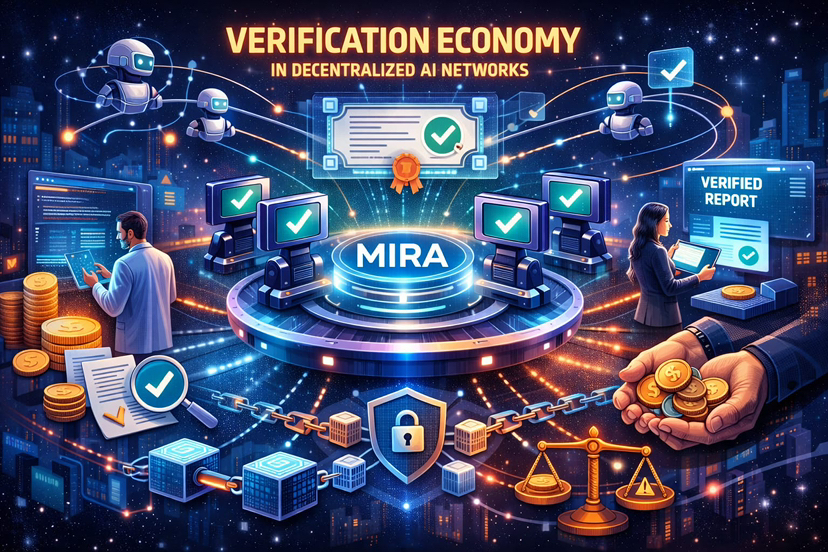
That is also why the word “economy” fits. The network is not only coordinating models; it is trying to create roles. There are customers paying for verified output, node operators supplying verification, and, in the whitepaper’s framing, data providers participating in the reward flow as well. What emerges is a market around trust production. This can sound like a big idea, but in practice it means something clear: AI matters less for just replying fast, and more for giving answers that can be examined and trusted later
Mira’s recent trajectory suggests the project understands that theory alone is not enough.
The project has moved forward step by step. Mira was publicly launched in November 2024 as a decentralized AI verification network. In December 2024, it added a node delegator program, and in February 2025 it introduced Klok as a product for everyday users. After that, the focus kept growing on developer tools like the Verify API and SDK. The docs also make it clear that the setup is live, with console-based API keys, the mira-network Python package, and a base API URL for app integration
That progression matters because it shows a move from research thesis to incentives to application layer to tooling.
There is also a quiet but important strategic choice here. Mira is not arguing that one superior model will solve reliability. The whitepaper explicitly says there is a lower bound on the error rate of any single model and argues for collective verification across diverse models instead. That is a different posture from the usual race for bigger training runs and more polished demos. It suggests the next phase of AI competition may be less about who generates first and more about who can coordinate disagreement well. I find that a more mature frame, because real-world trust often depends on how a system handles uncertainty, not on how confidently it speaks.
At the same time, this is still an early architecture, and some caution is healthy. Many of the strongest performance claims around Mira’s ecosystem are company-reported. For example, Mira has highlighted builder growth and says one partner improved question-answering accuracy to 96% using its verification infrastructure, but those claims should be read as project-provided evidence rather than independent benchmarking. The core concept may be sound without every reported metric being taken at face value.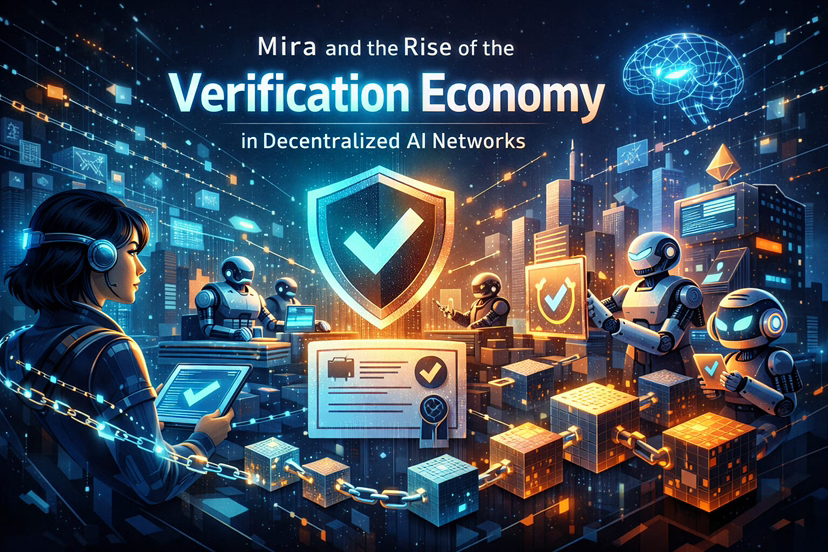
Even with that caution, the bigger trend still looks real to me. As AI gets used in work where mistakes can be expensive, just generating an answer is no longer enough value on its own.What starts to matter is proof, auditability, and incentive alignment around being right often enough to trust without constant human supervision. Mira’s materials repeatedly return to that point: verification should not be an afterthought, and decentralized participation is supposed to reduce the risk that one curator, one model family, or one platform quietly defines truth for everyone else. Whether Mira becomes the durable winner is still open. But the category it is pointing toward, where reliability is purchased, computed, and economically enforced, looks increasingly plausible.That is why I see the verification economy as something worth following. It makes decentralized AI feel less abstract and more practical. What matters then is who confirms the answer, who pays for that work, who bears the risk when the model is wrong, and how proof travels along with the response.Mira is one of the clearer attempts to build that stack in public. And whether or not its exact design becomes standard, the underlying idea is hard to dismiss now. AI is entering a stage where sounding right is no longer enough. Systems will increasingly need to show their work, and someone will have to be rewarded for making that possible.