
@Fabric Foundation What stands out to me is that Fabric is not mainly presenting itself as a better robot brain. It is trying to become the coordination layer that gives intelligent machines identity, payment rails, contribution accounting, and governance in one system, so humans and machines can work inside the same auditable framework.
I read Fabric less as a robotics product and more as an attempt to define the missing institutional layer around robotics. The Foundation describes itself as an independent non-profit focused on governance, economic, and coordination infrastructure for humans and intelligent machines, and that framing matters because it shifts the project away from pure hardware or model competition. The claim is that today’s economic rails were not designed for machine participation, especially not machines that act in physical environments and need to be observed, constrained, and paid.
In plain terms, the mechanism is fairly direct. A robot or operator in Fabric is supposed to have an onchain identity, a wallet, and a role inside a network that records tasks, payments, and accountability. The Foundation’s public materials keep returning to three basic functions: identity, settlement, and verification. That gives the project a cleaner center of gravity than a lot of robotics narratives, which often blur capability claims with governance claims.
Underneath that, the whitepaper makes a stronger move. It says Fabric coordinates data, computation, and oversight through public ledgers, and it describes ROBO1 as a modular general-purpose robot whose capabilities can be changed through interchangeable software modules called skill chips. I think that matters because modularity is doing two jobs at once here: it is a software design choice, but it is also a governance choice. If functions are separable, they are easier to inspect, replace, reward, or challenge. 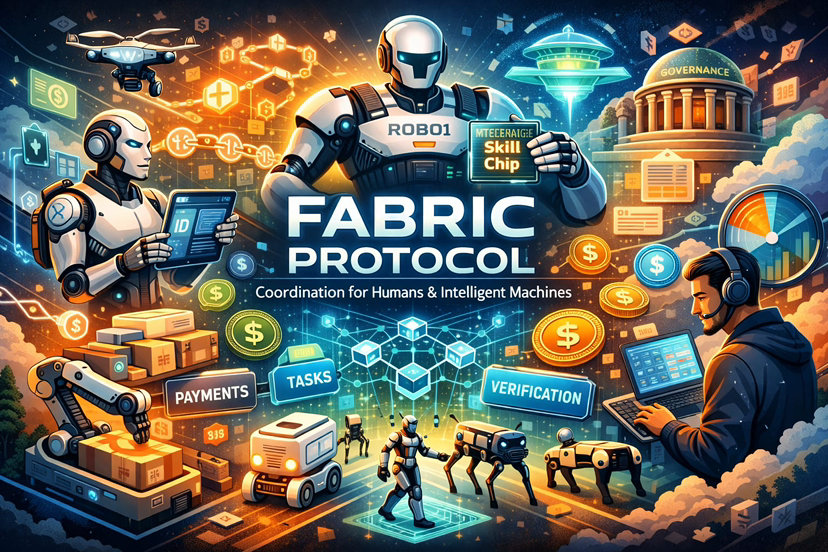
That is where Fabric’s view of verification becomes more important than its branding. The document does not assume token holding alone should produce rewards. It proposes contribution scores tied to measurable categories such as task completion, verified data provision, compute provision, validation work, and skill development, with rewards adjusted by quality outcomes and minimum activity requirements. I find that more serious than simple staking rhetoric, because it tries to tie payment to observable work rather than passive financial positioning. Whether that works in practice is another question, but the design intent is clear.
The token design follows the same logic. $ROBO is presented as the medium for network-native fees across data exchange, compute tasks, and API calls, even when pricing is quoted in stable terms for usability. The protocol model says off-chain or stable-value payments are converted into $ROBO for settlement, and it sketches a mechanism where a fraction of protocol revenue is used to acquire tokens on the open market. In theory, that links token demand to actual network usage rather than to attention alone. In practice, it also means the model depends heavily on real transaction flow arriving soon enough to justify the architecture.
Fabric’s evolution so far looks early but unusually compressed. The whitepaper is dated December 2025. The Foundation then opened the airdrop eligibility portal on February 20, 2026, and published its main public token and network framing on February 24, 2026. At the same time, it says the network will initially deploy on Base while longer-term plans point toward a dedicated machine-native Layer 1. That sequence tells me Fabric is still in the stage of converting a conceptual architecture into live operational rails.
The current data reinforces that reading.The project says $ROBO has a fixed supply of 10 billion tokens.
About 30% is set aside for the ecosystem and community, but a large share is still held by investors, the team, advisors, and the Foundation.So the design supports growth, but it does not remove concentration among core holders. The 2026 plan is fairly steady: first build identity and payment tools, then reward useful contributions, then support more advanced robot teamwork, and finally improve reliability by the end of the year.That is not a mature network schedule. It is a staged operational rollout.
I think the operational implication is straightforward. Fabric is trying to turn robotics coordination into something closer to a shared market infrastructure, where task allocation, settlement, accountability, and contribution tracking live in one visible system instead of being split across closed fleet software, internal ledgers, and bilateral contracts. If that works, smaller developers, validators, data contributors, and robot operators could plug into the same network rather than building isolated stacks. The Foundation says this directly when it argues that today’s fleets are siloed and that access to the robot economy is largely limited to institutions and well-capitalized operators. 
The broader pattern here is that Fabric is borrowing more from crypto market structure than from conventional robotics business models. It uses public identity, programmable incentives, auditable history, and slashing-style bonds to handle a problem robotics usually treats as internal operations. The whitepaper even frames bonds as risk-management deposits that can be reduced for fraud, spam, or downtime, not as passive yield instruments. That tells me the project sees machine coordination as an economic security problem first and a software integration problem second. I do not think that is a common position in robotics yet.
At the same time, I would not overstate what Fabric has already proven. The Foundation’s own materials admit the network is early and that scaled deployment still requires real-world partnerships, insurance frameworks, operational maturity, and reliable service contracts.Here are 3 simple versions:
The roadmap shows that the toughest work has not happened yet. Fabric still needs to collect real working data, check whether contributions are actually useful, and prove that its reward system can still work well in real-world conditions over time. So my view is cautious but not dismissive. Fabric makes the most sense when I read it as an attempt to build the rules and accounting system around intelligent machines, not as evidence that robot coordination has already been solved.
@Fabric Foundation #ROBO $ROBO
