
@Fabric Foundation #ROBO $ROBO
As artificial intelligence increasingly moves from software into the physical world, robots and autonomous systems are beginning to perform real-world tasks across industries such as manufacturing, logistics, healthcare, and services. This shift introduces new challenges around governance, safety, and economic coordination. Fabric is designed to address these challenges by creating an open, decentralized network where robots and humans can collaborate and participate in a shared robotic economy.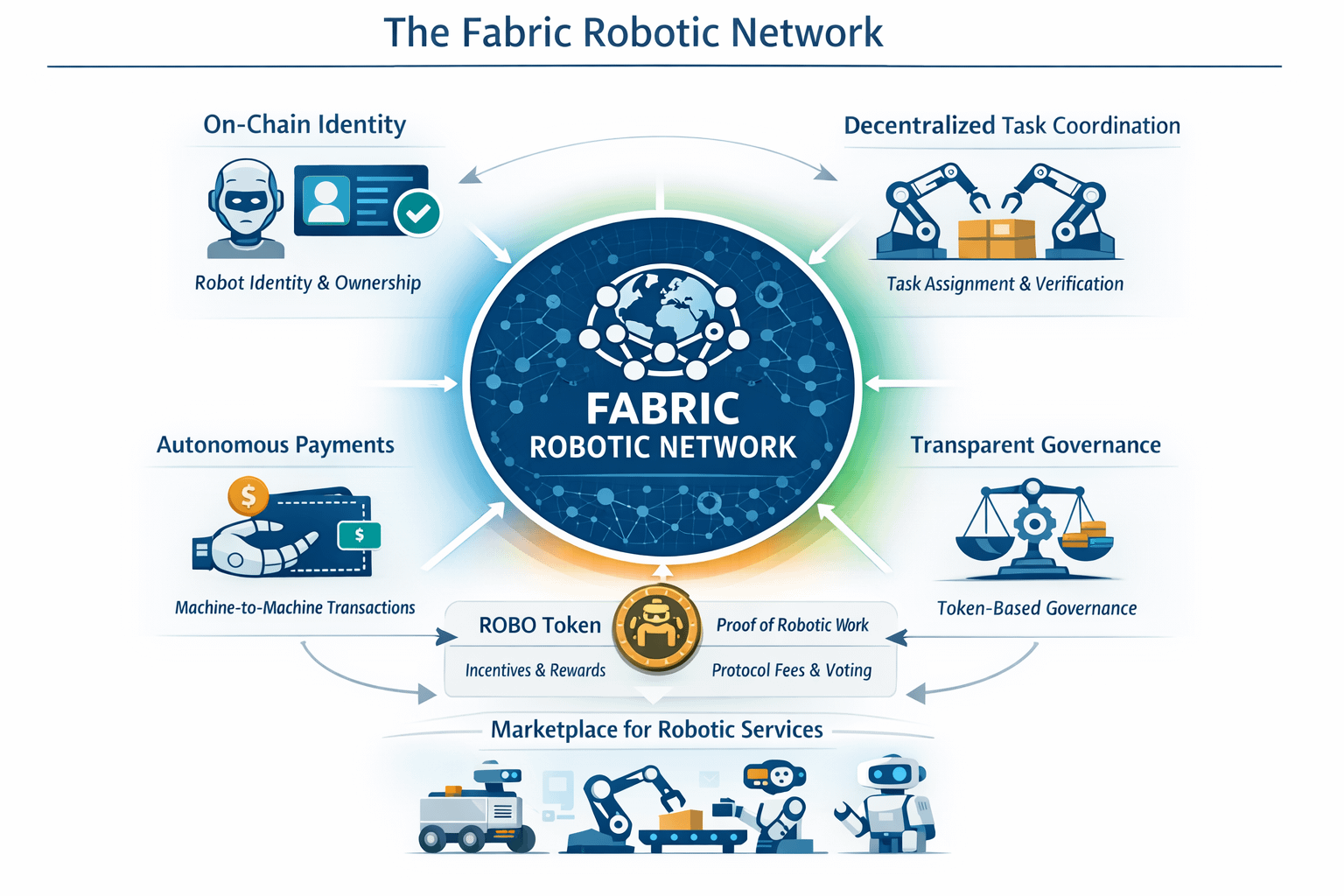
The Vision Behind Fabric
Fabric is a global protocol that enables people to build, govern, own, and evolve general-purpose robots through a decentralized infrastructure. Instead of relying on centralized robotics platforms controlled by corporations, Fabric uses blockchain technology to coordinate data, computation, and oversight across a public network. This approach allows anyone—developers, operators, or researchers—to contribute to the ecosystem and receive recognition or rewards for their participation.
The initiative is supported by the Fabric Foundation, a non-profit organization focused on developing governance frameworks and infrastructure that ensure intelligent machines remain aligned with human values while benefiting society globally.
How the Fabric Protocol Works
At its core, Fabric functions as a coordination layer for robotic systems. Through blockchain-based ledgers and smart contracts, the network provides key capabilities required for robots to operate as economic actors.
1. On-chain Identity
Each robot receives a verifiable cryptographic identity. This identity tracks ownership, permissions, and historical performance, enabling transparent monitoring and accountability.
2. Autonomous Payments and Wallets
Robots can hold digital wallets and perform machine-to-machine payments for services such as compute resources, maintenance, insurance, or task execution.
3. Decentralized Task Coordination
The protocol allows tasks to be assigned, verified, and completed across a distributed network of robots without relying on a central authority. Smart contracts automatically settle payments once tasks are verified.
4. Transparent Governance
Network participants help govern the ecosystem through protocol rules and token-based coordination, ensuring decisions about robot behavior, infrastructure, and upgrades remain decentralized.
The Role of the ROBO Token
The Fabric ecosystem uses ROBO as its core utility and governance token. The token facilitates several important functions within the network, including paying transaction fees, verifying robot identities, coordinating network participation, and governing protocol decisions.
Fabric also introduces a mechanism called Proof of Robotic Work, which ties rewards to verifiable real-world robotic activity rather than passive token holding. This model aims to link blockchain incentives directly to physical productivity.
A Marketplace for Robotic Labor
Fabric effectively acts as a marketplace infrastructure layer for robotic labor. Organizations can deploy robots through the network and pay for automated services using the protocol’s settlement system. Meanwhile, contributors—from developers to operators—can support deployment, maintenance, and optimization of robot fleets.
Over time, this structure could enable robots to perform tasks across multiple industries while being coordinated through a transparent, decentralized network. The goal is to create a global system where robotic labor can be deployed efficiently and governed responsibly.
Conclusion
Fabric represents a new approach to robotics infrastructure by combining blockchain coordination with autonomous machine systems. By enabling robots to have identities, wallets, and programmable economic interactions, the protocol aims to build an open network where humans and intelligent machines collaborate safely and productively.
As robotics and AI continue to evolve, Fabric’s model could become a foundational layer for the emerging machine economy, where robots operate as participants in decentralized markets while remaining aligned with human oversight and governance.