
That gap between generation and verification is becoming one of the most important infrastructure challenges in the AI era. As AI systems move deeper into finance, automation, research, and enterprise tools, the cost of incorrect information becomes much higher.
This is where Mira Network enters the picture.
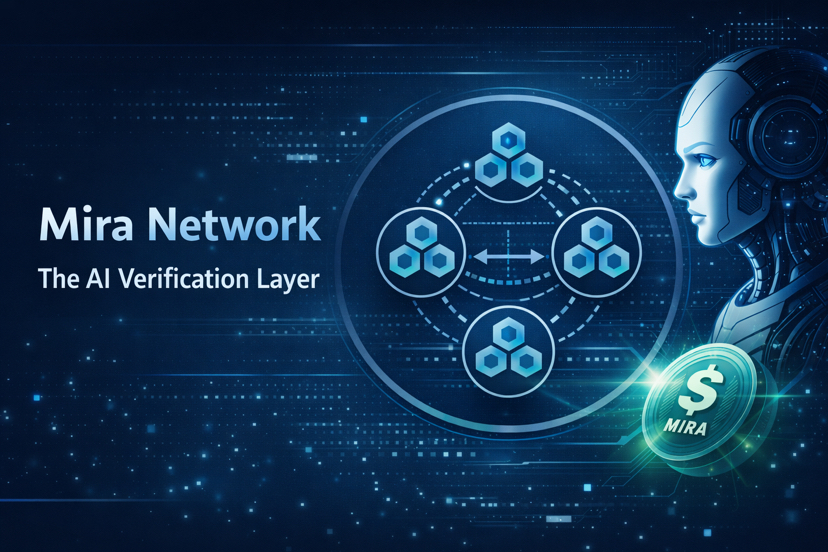
Mira is building a decentralized verification layer for AI generated knowledge. Instead of trusting a single model or company to determine what is correct, Mira creates a network where multiple AI models evaluate claims and score their reliability.
In simple terms, Mira focuses on one powerful idea.
AI should not only generate knowledge. It should also verify knowledge.
Understanding the Core Problem of AI
Today most AI applications follow the same structure. A model generates an answer and the user simply trusts it. But even the most advanced models sometimes hallucinate facts, misinterpret data, or provide outdated information.
For casual tasks this may not matter much. But when AI starts influencing financial decisions, automated systems, healthcare analysis, or enterprise operations, accuracy becomes critical.
A single incorrect output from an AI system can create serious consequences.
This is why the next stage of AI development is not just about building smarter models. It is about building systems that can verify and validate what those models produce.
Mira Network focuses entirely on solving this verification challenge.
How Mira Network Works
Mira operates as a verification marketplace where different AI models participate in evaluating claims. Instead of relying on a single model to decide what is true, multiple verifiers analyze the same piece of information.
Each verifier provides a confidence score based on its analysis.
These scores are then aggregated to determine the reliability of the original claim.
This system creates a decentralized validation process for AI generated knowledge.
If one model produces an incorrect answer, other models in the network can challenge it. Over time, this multi model evaluation creates a stronger layer of reliability around AI outputs.
For developers building AI applications, this verification layer can become a critical safety mechanism.
Instead of trusting a single model blindly, applications can rely on the Mira network to check the credibility of generated results.
Why Verification Infrastructure Matters
Many people assume that the future of AI will simply depend on larger models and more powerful GPUs. But infrastructure often becomes more important than raw intelligence.
Just like the internet required security protocols and financial systems required audit layers, AI systems will require verification layers.
Without verification, AI cannot safely scale into industries that demand accuracy.
Mira aims to become the protocol that sits between AI generation and real world usage.
When an AI model produces a claim, the Mira network can verify it before that claim is used in a decision making process.
This structure creates a more trustworthy environment for AI powered applications.
The Role of the $MIRA Token
At the center of the network is the $MIRA token. The token plays a role in coordinating incentives within the verification ecosystem.
Participants who operate verification models can earn rewards for contributing accurate analysis. At the same time, the token can be used to request verification services from the network.
This creates an economic system where verifying knowledge becomes a valuable service.
Instead of relying on centralized companies to audit AI outputs, the network distributes that responsibility across independent participants.
The token helps align incentives so that verifiers are rewarded for honest and reliable validation.
A Growing AI Infrastructure Narrative
In the broader technology landscape, a new category is beginning to form around AI infrastructure.
Some projects focus on compute power. Others focus on data availability. Some work on agent frameworks or decentralized model training.
Mira focuses on something equally important but often overlooked.
Verification.
As AI agents begin interacting with financial systems, autonomous services, and real world applications, the need for reliable information layers will grow significantly.
Verification networks could become as important to AI as oracles became to decentralized finance.
Mira positions itself directly within this emerging narrative.
Real World Use Cases
The potential applications of Mira extend across multiple industries.
In finance, AI trading systems could verify market insights before executing automated strategies.
In research environments, AI generated findings could be validated through multiple models before being published.
In enterprise automation, AI systems could check the reliability of operational data before triggering important actions.
Developers building AI products may integrate Mira as a reliability layer to ensure that their systems are not operating on flawed information.
As AI systems become more autonomous, this type of verification layer becomes even more valuable.
Why Mira Could Become Critical Infrastructure
Every major technological shift eventually creates a new layer of infrastructure.
The internet needed search engines, security protocols, and content delivery networks.
Blockchain required consensus systems, oracle networks, and scaling solutions.
Artificial intelligence is now reaching the stage where verification infrastructure becomes necessary.
Mira is attempting to build that layer.
If AI continues expanding across industries, systems that can validate and confirm machine generated knowledge may become essential components of the digital economy.
This is why Mira is not simply another AI project.
It is trying to solve a structural problem that will become more visible as AI adoption accelerates.
Final Thoughts
The AI revolution is often framed around bigger models and faster computation. But trust may become the real bottleneck.
If people cannot trust the outputs produced by AI systems, adoption will slow down in critical sectors.
Mira Network introduces a different approach by focusing on verification instead of generation.
By creating a decentralized network where AI models evaluate each other’s claims, Mira aims to make machine generated knowledge more reliable.
As the AI ecosystem continues to grow, infrastructure projects that focus on trust and validation may quietly become some of the most important technologies in the industry.
Mira is positioning itself exactly at that intersection between AI innovation and AI reliability.
And in a world increasingly powered by machines, the ability to verify knowledge might become just as valuable as the ability to generate it.
@Mira - Trust Layer of AI #Mira $MIRA
