
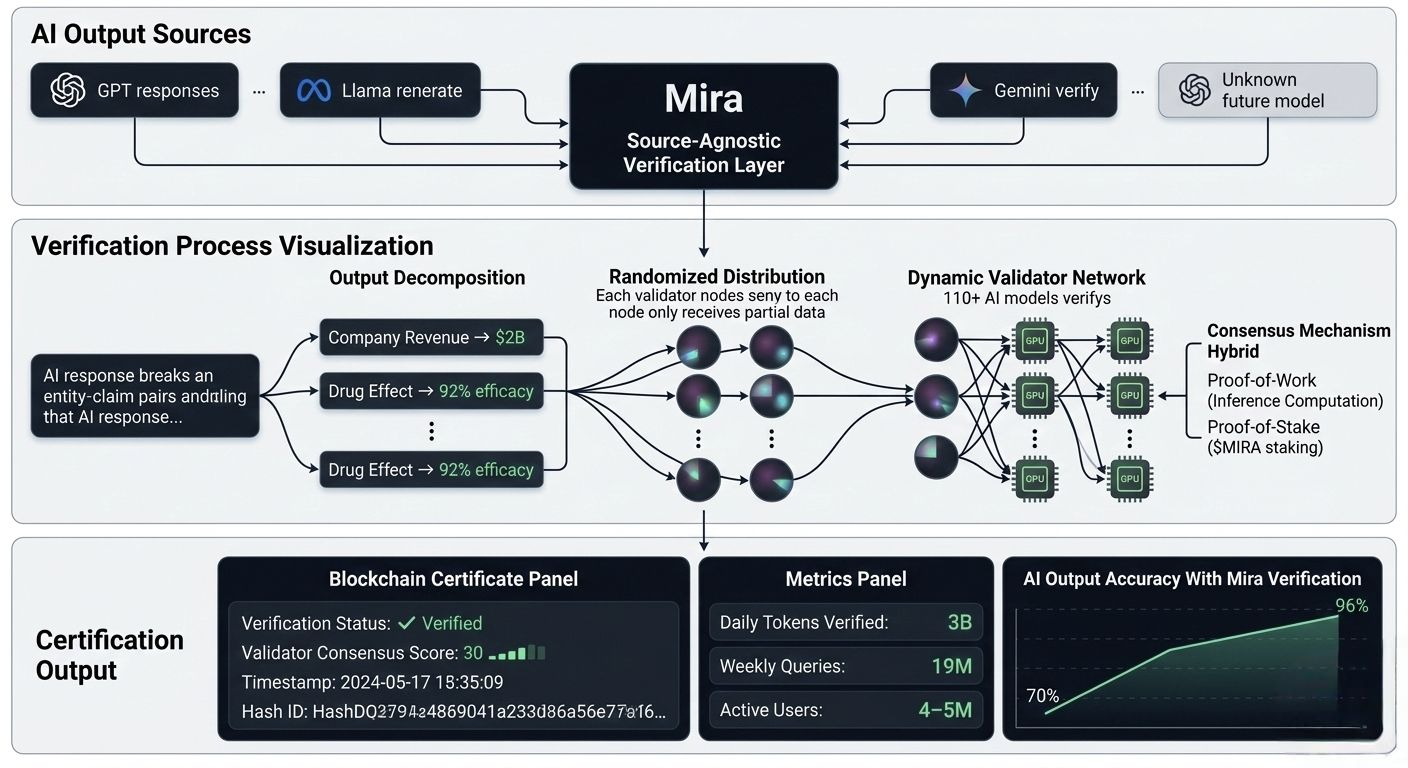
There is a detail buried in Mira Network's whitepaper that most coverage completely skips over — and it is, in my view, the single most important sentence in the entire document. It reads: the verification system is source-agnostic. Meaning Mira's protocol does not care which AI model produced the output. It does not matter if the content came from GPT, Llama, Gemini, or a model nobody has heard of yet. The verification layer sits above all of them. That architectural decision tells you everything about what Mira is actually building: not a competitor to AI models, not a replacement for them, but the independent truth layer that every AI model — regardless of who built it — will eventually need to pass through before its outputs can be trusted in the real world.
The AI capability race is producing increasingly powerful models. That part is working. What is not working is accountability. Every model still hallucinates. Every model carries embedded bias. Every model can produce a confident, fluent, completely wrong answer — and there is currently no standardized, decentralized, verifiable mechanism to catch it before it causes harm. That is the gap Mira Network exists to fill. And the more powerful AI models become, the more consequential that gap gets. This is not a niche problem. It is the central unsolved problem of the entire AI deployment era.
How the Verification Actually Works — and Why the Design Is Clever
Most explanations of Mira's protocol describe what it does. I want to explain why the specific design choices matter. When an AI output enters the Mira system, it gets decomposed into individual entity-claim pairs. These pairs are then randomly distributed across validator nodes — and that word randomly is doing a lot of work. Random distribution means no single node operator ever sees the complete candidate content. They only ever see fragments. This makes coordinated manipulation computationally impractical and economically irrational at the same time. Validators run diverse AI models — over 110 different ones across the Dynamic Validator Network — ensuring that verification does not simply inherit the same biases as the original output. Consensus is reached through a hybrid Proof-of-Work and Proof-of-Stake mechanism: validators must perform genuine inference computations, and they must stake MIRA to participate. The result is a cryptographic certificate stored permanently on Base, Ethereum's Layer 2. That certificate is immutable, auditable, and owned by nobody.
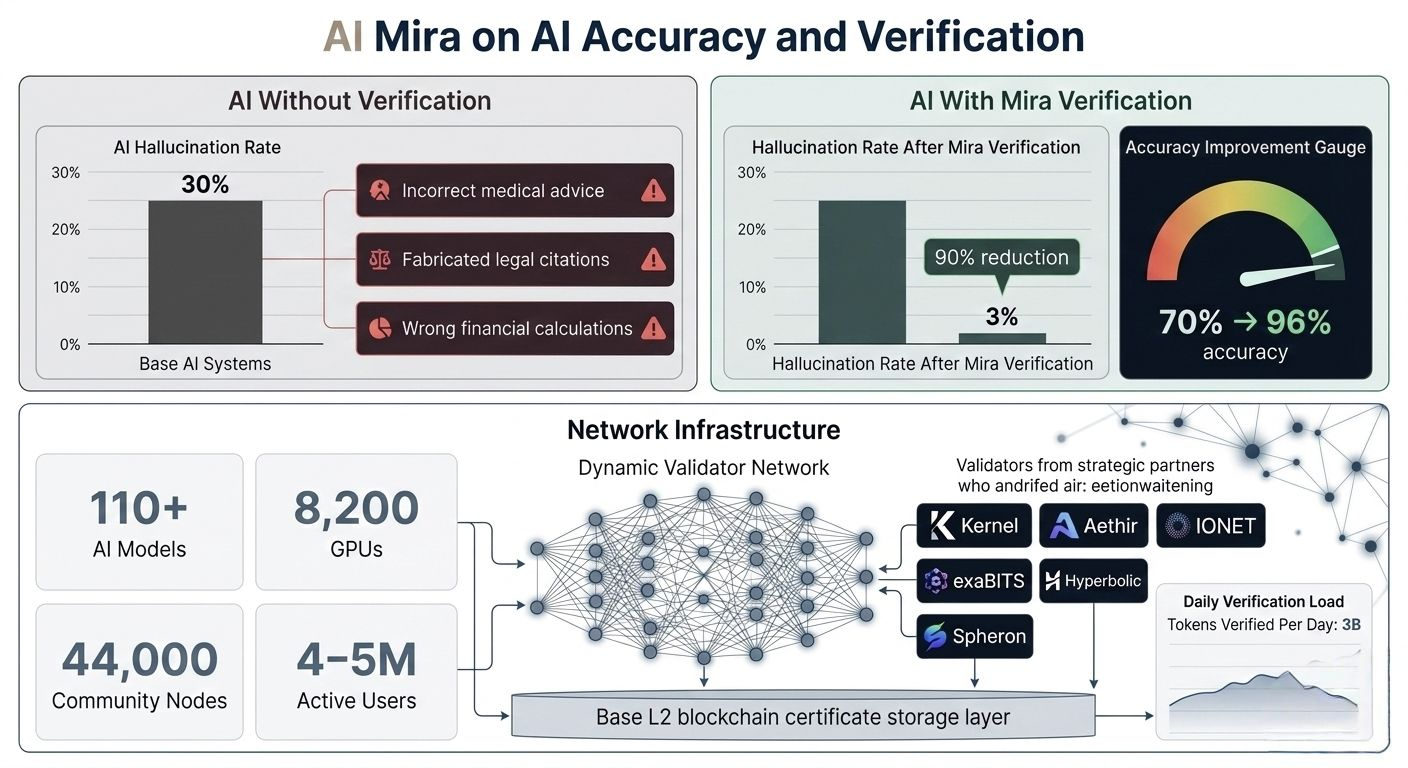
Here is what I think most people miss about this architecture: the randomized fragmentation is not just a security feature. It is a business moat. Any competitor trying to replicate Mira's verification guarantees cannot simply copy the consensus mechanism. They need an equally large, equally diverse, equally incentivized validator network running independently across many node operators. That takes years and capital to build. Mira already has it. Kernel, Aethir, IONET, exaBITS, Hyperbolic, and Spheron — which contributed over 8,200 GPUs and 44,000 community nodes — are staking real capital to operate inside this network. That is not a partnership list. That is a network effect already in motion.
The Numbers — What the Data Actually Says
Before MIRA had a listing date, the Mira network was already processing 3 billion tokens daily, handling 19 million queries per week, and serving 4 to 5 million active users. AI output accuracy in specialized domains — finance, education, healthcare — climbed from roughly 70% to 96% under Mira's verification layer. Hallucination rates were cut by 90%, from approximately 30% down to 3%. The Klok multi-model AI assistant built directly on Mira surpassed 500,000 users independently. Two node sale events in late 2024 and early 2025 raised a combined $850,000 — not enormous figures, but meaningful as proof of grassroots validator participation before institutional capital arrived. These are not launch-day projections. They are production metrics from a live network under real load.
Why MIRA Demand Is Structural — Not Speculative
The token utility question is where most infrastructure projects get vague. Mira is unusually specific. Validators stake MIRA to operate nodes — dishonest verification triggers automatic slashing, making accuracy economically rational. Every developer accessing the Verified Generate API or the Mira Flows marketplace pays in MIRA. Token holders receive priority access and preferential pricing on platform usage. Governance over emission rates, protocol upgrades, and network design runs through MIRA. And MIRA serves as the base pair for every token launched within the ecosystem. What this creates is compounding demand: every new developer integration, every new application, every new validator node requires more MIRA to function. The token does not sit alongside the network. It sits inside every transaction the network processes. Strip it out and the economic security model collapses entirely. That is a fundamentally different position than a governance token bolted onto an existing product.
The Risks — Because Honest Analysis Requires Them
I want to be direct about what could go wrong with Mira Network because nobody should make decisions based on one-sided analysis. The token launched at a $1.4 billion fully diluted valuation on Binance in September 2025 — a number the market has since judged as dramatically overpriced for an early-stage infrastructure project. MIRA has fallen approximately 94% from its all-time high of $2.35, sitting around $0.09 as of early 2026. The community on-chain is divided: long-term believers champion the AI verification thesis while frustrated holders watch Bitcoin rally while MIRA stays down. That tension is real and it matters.
The structural risk is unlock pressure. The 12-month team and investor cliff means significant supply becomes liquid in late 2026. The ecosystem reserve of 26% and foundation allocation of 15% carry staggered emissions over 35 months. Whether organic $MIRA demand from developer API usage grows fast enough to absorb those unlocks is the central unanswered question. The adoption risk is equally honest: enterprise AI verification as a paid service has not yet been proven at commercial scale. The thesis is credible. The execution is credible. But credible is not the same as proven. Mira still needs to show that organizations outside the crypto ecosystem will pay to route their AI outputs through a decentralized verification network. That proof does not exist yet.
What I Am Actually Watching in 2026
The Mira Foundation's $10 million Builder Fund is still actively deploying. The Kaito Season 2 campaign with a $600,000 prize pool is running now, designed to deepen developer and creator engagement around the verification narrative. The Irys partnership for permanent Layer 1 storage of verification certificates is arguably the most strategically important 2026 move — because enterprise and regulatory buyers don't just need a certificate today, they need a certificate that is still auditable in ten years. Educational hubs launching in Nigeria and other emerging markets signal genuine thinking about global developer pipelines rather than short-term community theater.
The whitepaper describes a long-term vision of a synthetic foundation model that delivers error-free output by design — AI that does not need external verification because verification is baked into its generation. That is years away if it arrives at all. What Mira Network is building right now — the source-agnostic trust layer that sits above any AI model and certifies its outputs on-chain — is the practical stepping stone that the entire AI industry needs before autonomous AI becomes deployable in environments where being wrong has real consequences. Every hallucination that causes a wrong medical decision, every fabricated legal citation, every AI-generated financial error that escapes without a verification trail — each one is an argument for what Mira is building. The market has not priced that in yet. Whether it ever does depends entirely on whether enterprise adoption arrives before patience runs out. That is the honest bet.
@Mira - Trust Layer of AI #Mira $MIRA
