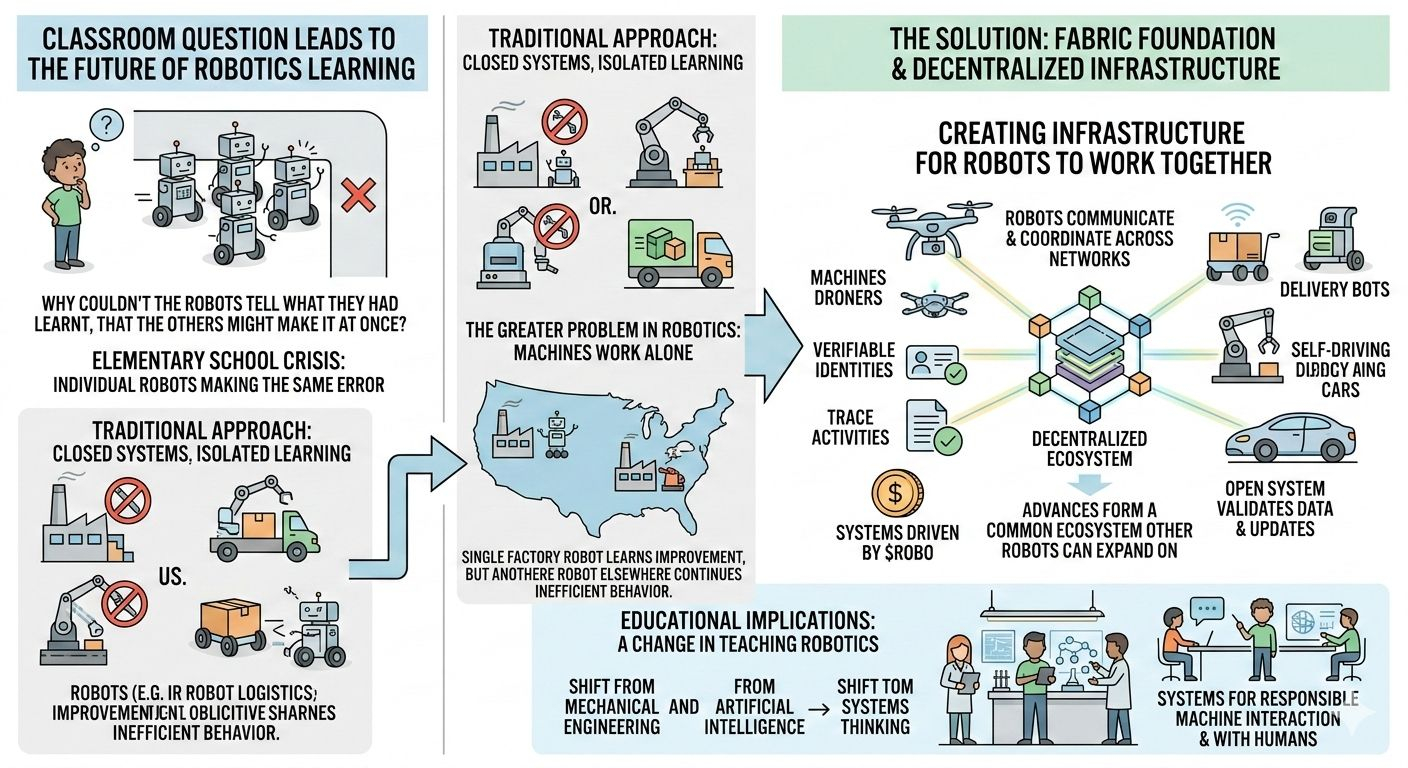
I was in a small engineering classroom the other day and elementary robots were being tested by the students. Nothing advanced. Only small programmable machines that were taught how to move along lines on the floor and to pick up objects. cloisters were all inquisitive. Wires, laptops, sensors, and the type of enthusiasm that is created when individuals find out that they are creating something that moves by itself.
One of the students had an interesting observation in the exercise. All of the robots in the classroom were committing the same error when turning a corner. The groups had programmed their machine individually but the error continued reoccurring. The code was eventually corrected by somebody, but the incident raised a greater question within the room. Why could not the robots tell what they had learnt, that the others might make it at once?
That elementary school crisis is an indication of a much greater problem in robotics. Machines are becoming more intelligent and more competent though they tend to work alone. One robot at a single factory can learn a useful improvement, but a different robot in a separate part of the country continues with the same inefficient behavior since there is no system of knowledge sharing, verification, and updates.
This is the type of problem that had made me focus on the work that is being conducted by Fabric Foundation. The project does not concentrate on the construction of robots, rather it pays attention to the creation of the infrastructure which might enable robots to work together, test their behavior and act in the framework of transparent economic systems. To put it simply, it poses the question of how machines can eventually coordinate with one another across networks and not within closed systems.
This notion creates a valuable insight to teachers and learners. Robotics is not mechanical engineering or artificial intelligence only. It is also concerning systems thinking. As soon as the thousands or even millions of machines start to work in the logistics networks, hospitals, farms, and cities, coordination becomes as significant as the robots themselves.
Fabric discusses how that coordination problem could be overcome through the use of decentralized infrastructure. Using the systems driven by ROBO, machines may even be seen as possessing verifiable identities, be able to trace the activities they are involved in, and conduct themselves in an open system which can be seen as validating of data and updates. Rather than individual robots learning, advances might make up a common ecosystem which other robots can expand on.
Educationally, this promotes the change in the method of teaching robotics. Students are also not just learning to make machines move, or even think. They are also learning to come up with systems on which machines are able to interact with each other and man responsibly. Such a mentality is probably what will characterize the next wave of robotics development.
The robots finally were able to figure out how to get around the corner in that classroom. It had to make some changes and we had to collaborate as students. However, the moment remained with me since it defined something significant about technology and education. The most important advancement is usually done in little errors and trivial questions.
And at other times such questions give rise to larger conceptions how the systems of the future could be.
@Fabric Foundation #ROBO $ROBO