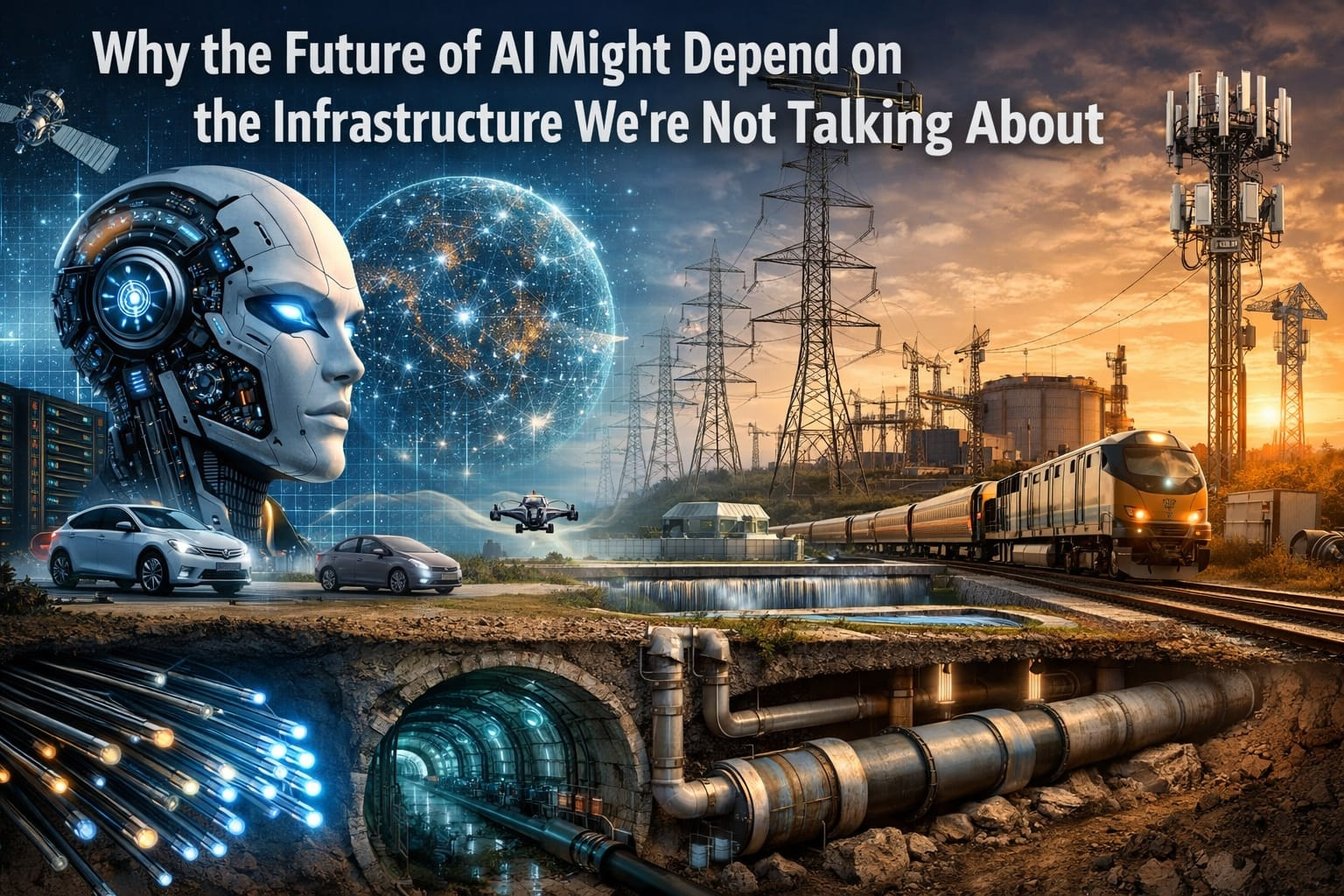
I’ll be honest, I’ve looked at a lot of crypto projects over time, and after a while many of them start to feel the same. Big vision, big claims, big narrative — but when you slow down and ask what is actually being built, the answer often feels much thinner than the story around it.
That feeling has become even stronger with AI. Almost every project now wants to connect itself to the AI theme in some way. Some add AI to the pitch, some build a whole identity around it, and some make it sound like they are building the future overnight. But when I look closer, I usually end up asking the same question: what problem is this really solving?
That is why Fabric stood out to me.
Not because it felt loud or over-marketed. Actually, it was the opposite. What caught my attention was that it seems to be focused on something deeper than the usual crypto or AI narrative. It looks like it is trying to build the missing layer between intelligence and real-world action, and I think that missing layer matters far more than most people realize.
AI is getting better very quickly, but most of what we see today still lives inside controlled environments. It can answer questions, write content, summarize information, generate code, and understand text, voice, and images better than ever before. But the moment AI has to interact with the real world, things get much more complicated.
At that point, it is no longer just about whether the model is smart enough. It becomes about trust. About coordination. About safety. About responsibility when something goes wrong. About whether humans remain part of the system. About whether the infrastructure is open or locked inside a few private companies.
That is where Fabric started to feel different to me.
Instead of only asking how AI can become more powerful, it seems to be asking a much better question: how do you actually connect intelligence to the real world in a way that is structured, usable, and accountable? To me, that is a far more meaningful problem than simply building another AI-branded product or another token attached to a trend.
The more I thought about it, the more I felt that Fabric is less about chasing a narrative and more about building infrastructure. And that distinction matters. A lot of projects want attention first and clarity later. Fabric feels like one of the few trying to work on the underlying system first — the part that is not always exciting at first glance, but the part that actually matters if this space is going to mature into something useful.
The simplest way I can put it is this: Fabric looks like it is trying to build a kind of real-world API for AI.
I do not mean that in a narrow technical sense. I mean it in the broader sense of creating a system that helps intelligence connect with machines, tasks, contributors, payments, verification, and human oversight in the real world. That idea feels much more grounded to me than most of what I usually see in this market, because intelligence alone is not enough. Even if AI keeps improving, it still needs structure around it. It needs systems that can support real-world use, where actions have consequences and mistakes affect actual people.
One of the things that pulled me in is that Fabric does not seem to treat intelligence like one magical black box. It feels more modular than that. And I think that matters, because real-world intelligence is never just one thing. If a system is going to operate in the world, it needs different layers of ability. It needs to interpret information, make decisions, handle specific tasks, adapt over time, and often allow humans to step in when autonomy is not enough.
That kind of system should not be rigid. It should be flexible. It should be upgradeable. It should be improvable over time. And ideally, it should not depend entirely on one closed operator controlling everything.
Fabric seems to understand that, and that is one reason I take it more seriously than many projects built around AI buzzwords. It feels like it is thinking about how intelligent systems actually evolve, not just how they can be packaged in a pitch deck.
This is also why the project stayed in my mind. Crypto has become very good at storytelling — maybe too good. A lot of teams know how to package a narrative people want to hear: AI, agents, automation, decentralization, ownership, the future of work, the future of finance. But once the excitement fades, I usually come back to one question: are they building something people will actually need underneath all of this?
That is where Fabric feels different to me. It seems less focused on selling the future and more focused on building the rails that future would need to stand on. And honestly, that is rare.
Real infrastructure is harder to explain. It is less flashy. It usually takes longer. It does not always create instant excitement. But when it works, it matters much more than the narrative layer built on top of it. That is why I keep paying attention to projects like this, even when they are still early.
I am also usually careful when I see a token attached to a complex idea. In this market, too many tokens are introduced as if they are the product itself. And when that happens, the actual system quickly becomes secondary. That is not how I read Fabric.
Here, the token feels more like part of the network’s internal machinery than the center of the story. It seems to sit inside the system as a way to support participation, incentives, coordination, and validation. That is a much healthier place for a token to exist — not as the main reason to care, but as one piece of a larger structure.
To me, that changes the tone completely. When a token is naturally tied to what the system is doing, it feels functional. When it becomes the whole point, it usually starts feeling hollow. In Fabric’s case, I think the project becomes more interesting when you stop looking at the token first and start looking at the infrastructure problem it is trying to solve.
What really kept me thinking about Fabric is that this does not feel like just an AI conversation. It feels more like a systems conversation. And I think that is where the industry is going, whether people fully realize it yet or not.
Sooner or later, AI will stop being only about generating answers on a screen. It will connect more deeply with logistics, robotics, services, operations, and many other real-world environments. And when that happens, the stakes change. A mistake is no longer just a bad output. It becomes a real-world failure, a coordination problem, a safety issue, a trust issue.
That means the system around the intelligence becomes just as important as the intelligence itself. You need accountability. You need verification. You need records. You need incentive design. You need clear roles. You need ways for people to contribute and also intervene when needed.
That is why Fabric feels more meaningful to me than a lot of projects in this category. It seems to understand that AI in the real world is not just a model problem. It is an infrastructure problem. And in the long run, infrastructure usually matters more than narrative.
I think the deeper issue here is not just what Fabric is building, but what kind of future projects like this are responding to. Because if AI becomes deeply embedded in the real economy, then somebody is going to control the systems behind it. That much is obvious. The question is whether those systems will be open enough for people to inspect, contribute to, and benefit from, or whether they will all end up locked inside a handful of private platforms.
That is the part I keep thinking about.
If the future of intelligent machines becomes fully closed, then people may use those systems, but they will not really have a role in shaping them. Ownership will stay concentrated. Oversight will stay limited. And the economics of those systems will mostly benefit the same small group of actors.
That is why I take open infrastructure ideas seriously, even when they are difficult to execute. Not because they are easy. Not because they are guaranteed to work. But because they are trying to solve the right problem.
From the way I see it, Fabric understands that coordination, ownership, governance, and accountability cannot be treated as side issues if intelligent systems are going to move into the real world in a serious way. Those things have to be part of the design from the beginning.
Of course, none of that means Fabric is a finished answer. Far from it. The idea is difficult. The execution challenge is huge. Building open systems is hard. Building useful machine-based systems is hard. Trying to connect AI, robotics, incentives, and real-world coordination is even harder.
So I am not looking at Fabric as something that has already solved the future. I am looking at it as one of the few projects that seems willing to work on the layer beneath it. That alone already makes it more interesting than most of what I see, because too many projects are still building for attention, while too few are building for long-term usefulness.
The more time I spend in this market, the less interested I become in polished stories and the more interested I become in projects trying to build foundational systems. That is where Fabric caught my attention.
It does not feel like just another AI label wrapped around a token. It does not feel like a short-term narrative trade. And it does not feel like the project only wants to sound futuristic. It feels more like an attempt to build a real coordination layer for intelligent systems that may eventually operate in the real world.
That is why the idea stays with me.
When I say Fabric might be building the missing real-world API for AI, I do not mean that in a dramatic way. I mean it more simply than that. AI is improving fast, but it still needs structure around it if it is ever going to interact with the real world in a reliable, open, and accountable way. It needs systems for coordination, verification, incentives, payments, contribution, and oversight.
Most projects are still talking about what AI could become. Fabric seems more interested in what that future would actually need underneath. And right now, I think that is one of the more important things to pay attention to.
#ROBO @Fabric Foundation $ROBO