

The decentralized finance sector faced another security scare after Solv Protocol, a platform focused on bringing Bitcoin liquidity into DeFi, confirmed that one of its vault contracts had been exploited. The attack resulted in the loss of roughly 38 SolvBTC, valued at around $2.7 million at the time of the incident.
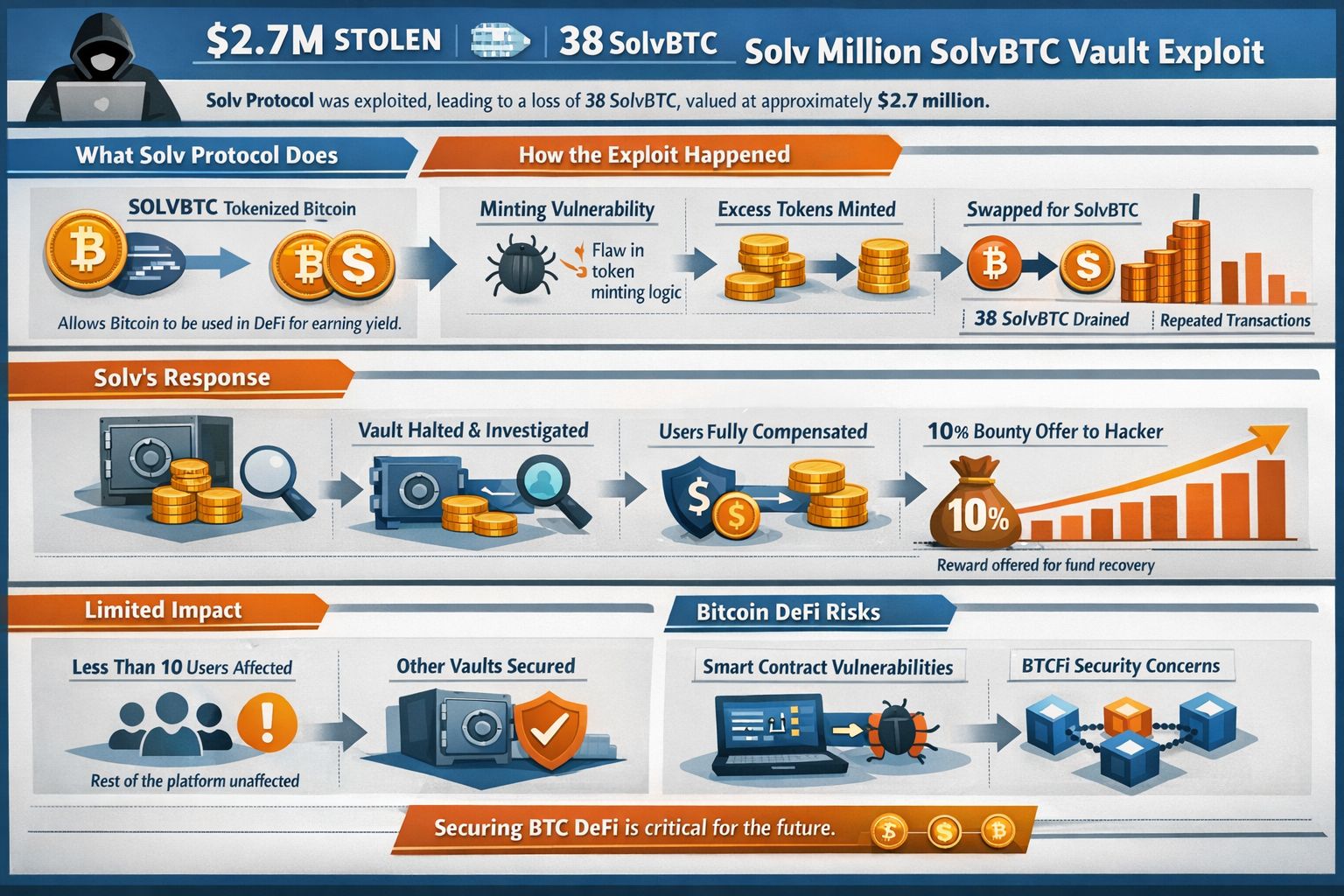
Although the scale of the exploit was smaller compared to some historical DeFi breaches, the event quickly attracted attention across the crypto community because Solv Protocol plays an important role in the emerging Bitcoin-based DeFi ecosystem, often referred to as BTCFi.
What Solv Protocol Does
Solv Protocol is designed to unlock financial utility for Bitcoin holders. Traditionally, Bitcoin is seen as a store of value, but it does not easily integrate into DeFi systems that rely on smart contracts.
To solve this, Solv created SolvBTC, a tokenized representation of Bitcoin that allows BTC to participate in decentralized finance strategies such as yield generation, liquidity provision, and structured investment vaults.
Users deposit assets into vaults that execute specific strategies, allowing them to earn returns while maintaining exposure to Bitcoin. These vaults rely heavily on smart contracts to automate deposits, withdrawals, and yield distribution.
How the Exploit Happened
The attack targeted a specific BRO vault, one of the protocol’s yield-generating structures.
According to early investigations and security researchers, the vulnerability allowed the attacker to manipulate the minting logic within the vault contract. By exploiting this flaw, the attacker could mint more tokens than intended by the system.
Once these tokens were created, the attacker converted them into SolvBTC, effectively extracting real value from the vault.
Blockchain analysts reported that the exploit transaction was executed multiple times in rapid succession. Through a sequence of transactions, the attacker drained approximately 38 SolvBTC before the abnormal activity was detected.
Importantly, the vulnerability was isolated to a single vault contract rather than the entire protocol.
Immediate Response From the Solv Team
After detecting the suspicious activity, Solv Protocol acted quickly to contain the situation.
The team halted the affected vault and began investigating the exploit with several blockchain security firms. Industry security specialists were brought in to analyze the vulnerability and trace the attacker’s wallet activity on-chain.
At the same time, the protocol issued a public statement assuring users that the exploit did not compromise the broader Solv infrastructure. Other vaults and platform components remained secure.
The team also announced that all users affected by the incident would be fully compensated, meaning losses would be covered by the protocol rather than individual depositors.
White-Hat Bounty Offer
In an attempt to recover the funds, Solv Protocol issued an open message to the attacker offering a 10% bounty if the stolen assets were returned.
This type of offer is increasingly common in the DeFi sector. Protocols often give attackers the opportunity to return funds in exchange for a reward and legal protection, transforming a malicious exploit into a so-called white-hat recovery.
Whether the attacker will accept the offer remains uncertain.
Limited Damage but Important Warning
One reason the situation did not escalate further is that the exploit impacted only a small number of users. Reports suggest fewer than ten accounts were affected because the compromised vault had limited participation.
However, the incident still highlights the ongoing security challenges within decentralized finance.
Smart contracts are powerful tools, but even small coding mistakes can create vulnerabilities that attackers can exploit. As DeFi protocols become more complex and begin integrating major assets like Bitcoin, the attack surface grows larger.
What This Means for Bitcoin DeFi
The Solv Protocol exploit also shines a spotlight on the rapidly developing Bitcoin DeFi sector.
BTCFi platforms aim to transform Bitcoin from a passive asset into a productive one by integrating it with DeFi infrastructure. But this also introduces new risks, since Bitcoin must interact with smart contracts, bridges, and tokenization systems.
When vulnerabilities appear in these systems, the security of funds depends not only on Bitcoin itself but also on the code managing those assets.
As a result, security audits, monitoring tools, and bug bounty programs are becoming essential parts of any protocol attempting to build financial services around Bitcoin.
The Investigation Continues
At the time of writing, investigators are still tracking the attacker’s wallet activity while security teams analyze the exact mechanics of the exploit.
Solv Protocol is also reviewing its vault architecture and implementing additional safeguards to prevent similar vulnerabilities from appearing in the future.
While the financial damage from this exploit was limited compared to some past DeFi hacks, the incident serves as another reminder that in decentralized finance, code security is just as important as liquidity