

The first thing I noticed watching ROBO this week was how fast traders skipped past the boring part. Price was ripping on fresh listings, volume was huge, and the market did what it always does with a new AI-adjacent token: it treated access as the story. But once I got past the exchange noise and into the Fabric paper, the part that stuck with me was much less flashy. Governance in this system is not just about who holds tokens. It is about who gets to decide upgrades, quality thresholds, validator rules, and which operating parameters spread across the network. That sounds technical until you realize those choices decide how the machine behaves in the real world. In a network built to “build, govern, own, and evolve” general-purpose robots, version control is political power wearing a lab coat.
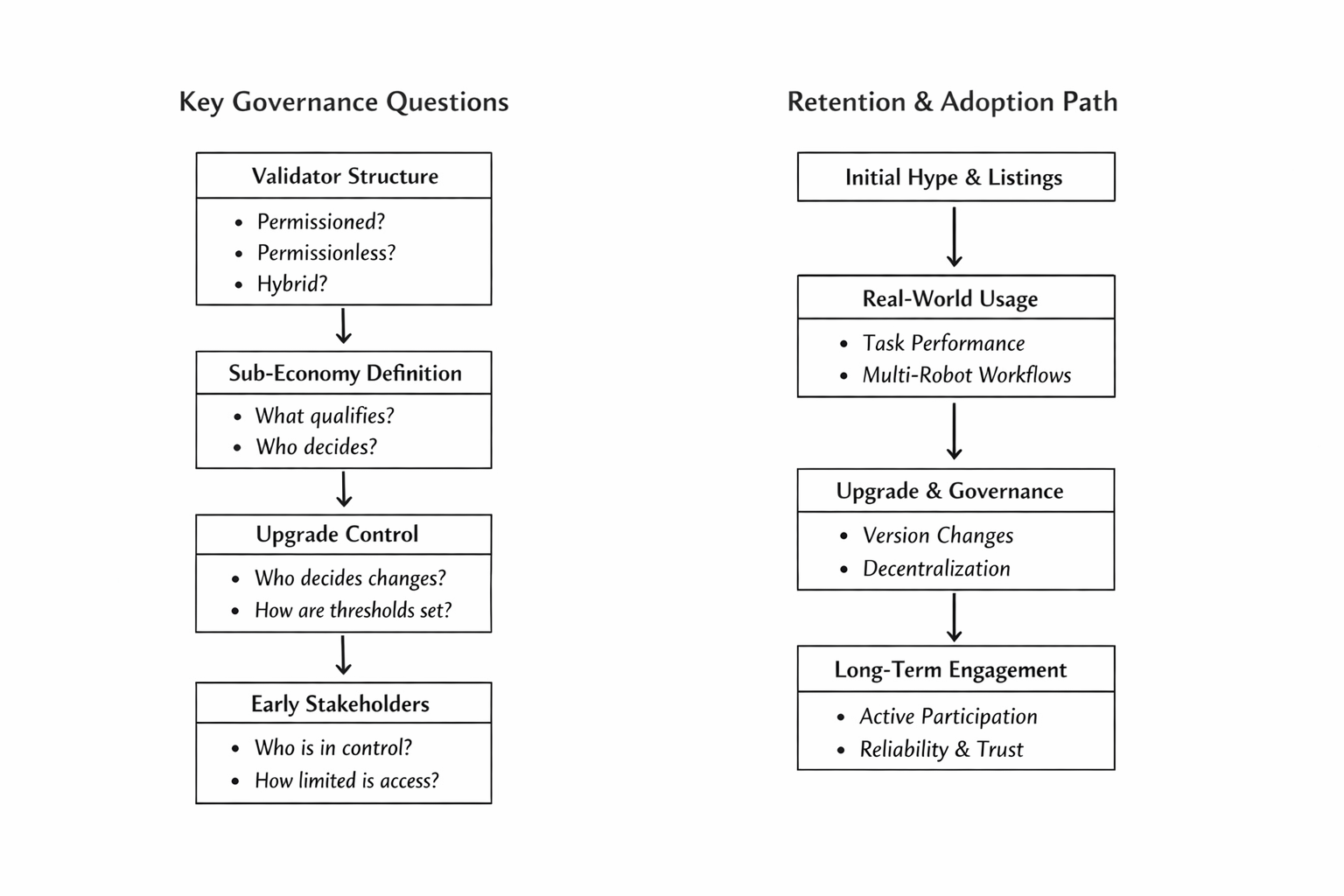
That matters because Fabric is explicitly framing ROBO as a modular system. The whitepaper describes a cognition stack made of many function-specific modules, with skills added and removed like app-store style components. It also says successful sub-economies can have their pricing models, quality thresholds, and other operating parameters propagated across the broader network. Think of it like this: the token may be the share ticker traders watch, but the real control surface is the update path. Whoever determines which model version, which reward parameter, which validation rule, or which skill configuration becomes standard is shaping the actual economy that ROBO lives in. And here’s the risk traders should put first, not last. The whitepaper is pretty open that several key questions are unresolved before finalization, including how sub-economies are defined and whether the initial validator set starts permissioned, permissionless, or hybrid. It also says governance structures may evolve over time and that early-stage decision making may involve a limited set of stakeholders. That is the quiet power grab I’m watching. Not a malicious one necessarily. Just the normal reality that in early systems, the people deciding version changes and validator standards often matter more than the people posting slogans about decentralization. If you’re trading ROBO like pure beta on “robot economy” headlines, you can miss that the governance bottleneck is still very real. The market side has already shown how easy it is to get distracted. Binance listed ROBO with a Seed Tag on March 4. At the same time, live market trackers showed daily volume pushing well above $100 million while market cap stayed under the kind of level that usually attracts a second wave of momentum traders. That setup creates velocity, but velocity is not retention. It tells you people will show up for a listing. It does not tell you they’ll stay around long enough to care which validator policy wins, which quality threshold gets tightened, or whether a new version actually improves throughput and trust. That retention problem is the part I think matters most for longer-horizon traders. Fabric’s own roadmap for 2026 moves from identity, settlement, and early data collection toward more complex tasks, repeated usage, multi-robot workflows, then reliability and throughput refinement. The paper also hard-codes the idea that rewards should favor active, repeated participation rather than passive holding, with contribution decay and minimum activity thresholds designed to keep emissions flowing to contributors who keep showing up. So the real question is not whether ROBO can trend for a week. It is whether operators, developers, validators, and users remain engaged long enough for governance over upgrades to become economically meaningful. No retention, no durable governance premium. Just a liquid token attached to an unfinished coordination experiment. I’ll be honest about the tradeoff here, because this is where I still have some friction with the story. A network like this probably does need tighter control early on. Robots are not meme coins. If validator rules are too loose, or if quality thresholds are politically softened to chase growth, trust disappears. But if the foundation or a narrow early coalition ends up being the de facto release manager for everything that matters, then token governance starts looking cosmetic. That tension is right there in the document: token holders can signal on network upgrades and protocol parameters, but governance rights do not extend broadly beyond protocol operations, and some core questions remain open ahead of mainnet. So what would change my mind either way? I want to see repeated usage rise with reliability, not just listings stacking on listings. I want evidence that governance decisions become legible onchain through parameter changes, validator decentralization, and successful sub-economies earning the right to propagate better operating models. I want version changes to show up as retention, not just narrative. That is the trade here. If you’re eyeing ROBO, stop treating version numbers like release notes and start treating them like votes on who gets to govern the machine economy. Track the upgrades, track the validator path, track whether users keep coming back after the excitement fades. Don’t just buy the chart. Audit the control surface, because in systems like this, the next version is where power hides.
@Fabric Foundation #ROBO $ROBO
