
In the aftermath of multiple crises in the crypto industry, one principle has become more important than ever: verifiable transparency. Users no longer want to simply trust exchanges-they want the ability to verify that their funds are truly backed.
This is where Proof of Reserves (PoR) enters the picture.
Through a combination of Merkle Trees and zk-SNARK cryptographic proofs, Binance provides a system that allows users to independently confirm that their assets are fully backed 1:1 on-chain. Rather than relying solely on traditional audits, this system leverages cryptography to create an open and verifiable reserve structure.
The latest audit snapshot demonstrates that Binance maintains reserve ratios above 100% for major assets such as Bitcoin, Ethereum, and stablecoins, reinforcing the exchange’s claim that all user funds are fully backed.
But what exactly does this mean in practice? And how can users verify it themselves?
What is Proof of Reserves?
Proof of Reserves refers to a verification system that demonstrates an exchange holds enough assets to cover all user balances on a 1:1 basis.
In simple terms:
If a user deposits 1 BTC, the exchange must hold at least 1 BTC in reserve.
The purpose of this system is to eliminate the risk of hidden liabilities and ensure that user deposits are not secretly being used elsewhere without sufficient collateral.
In the latest reserve report snapshot taken at:
Audit Time:
1 March 2026 – 00:00:00 UTC
Bitcoin Block Height: 938,780
Binance reported the following reserve ratios:
Asset Reserve Ratio
$BTC 100.05%
$ETH 100.00%
$BNB 101.14%
SOL 100.00%
USDT 105.09%
USDC 107.35%
FDUSD 107.60%
XRP 101.01%
TUSD 102.53%
A reserve ratio above 100% means that the exchange holds more assets than the total user balances, providing an additional margin of safety.
For example:
Bitcoin (BTC)
User Net Balances: 631,145 BTC
On-chain Wallet Holdings: 631,480 BTC
This indicates a reserve ratio of 100.05%, meaning Binance holds slightly more BTC than required to cover all customer balances.
Why Proof of Reserves Matters
The crypto industry has learned difficult lessons about transparency.
Historically, centralized exchanges operated similarly to banks-users deposited assets, but they had limited visibility into how those funds were managed.
Proof of Reserves changes this dynamic by enabling cryptographic verification rather than requiring blind trust.
The system provides three key guarantees:
1. Transparency
Users can verify that their balances are included in the total liability calculation.
2. Asset Backing
The exchange proves that it holds sufficient on-chain assets to cover all user balances.
3. Cryptographic Integrity
Verification mechanisms prevent the exchange from altering the dataset without detection.
Together, these mechanisms create a system where users can independently confirm the solvency of the platform.
The Technology Behind Binance’s Proof System
Binance combines two cryptographic technologies:
Merkle Trees
zk-SNARK proofs
These systems allow verification while preserving user privacy.
Merkle Trees: Compressing Millions of Accounts Into One Hash
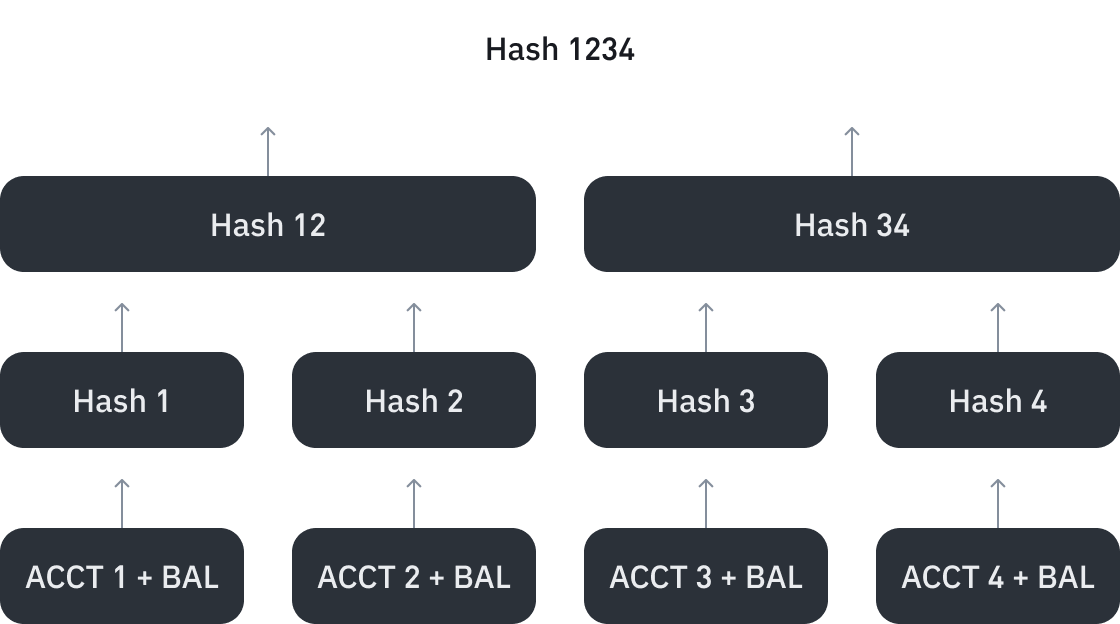
A Merkle Tree is a cryptographic structure used to organize and verify large datasets.
Instead of publishing millions of account balances individually, all user data is hashed and combined into a single value called the Merkle Root.
For this reserve report, the Merkle Root Hash is:
2557b307f9f061450b80573384d8300932974f5e3f55a44bbfb7725b5caa44e1
This root acts like a cryptographic fingerprint of the entire dataset.
If even a single account balance changes, the Merkle Root will also change-making tampering immediately detectable.
Each user receives a Merkle Leaf (Record ID) which represents their own position in the dataset.
Using this ID, users can verify that their account balance was included in the liability report without revealing other users’ data.
zk-SNARKs: Zero-Knowledge Proofs for Financial Transparency
While Merkle Trees prove that balances are included, zk-SNARKs provide an additional layer of validation.
A zk-SNARK (Zero-Knowledge Succinct Non-Interactive Argument of Knowledge) allows a party to prove a statement is true without revealing the underlying data.
In the context of Proof of Reserves, zk-SNARKs ensure that:
Each user balance is included in the total reserve calculation
The total balance of each account is non-negative
The Merkle Tree data has not been falsified
This means Binance can prove that the sum of all account balances equals the reported liabilities without exposing individual account details.
How New Users Can Verify Their Own Assets
One of the most powerful aspects of the system is that any user can verify their inclusion in the reserve report.
Here is the process:
Step 1: Log in to your Binance account
Go to the Binance website and sign into your account.
Step 2: Navigate to your wallet
Click on:
Wallet => Verification
Step 3: Locate your Record ID
The page will display your Merkle Leaf / Record ID, which corresponds to your encrypted account balance in the Merkle Tree.
Step 4: Select a verification snapshot
You can choose the audit date you want to verify.
The page will show:
verification type
assets included in the audit
your balance at the time of the snapshot
your Merkle Record ID
Step 5: Verify inclusion
Using the Record ID and the Merkle proof, users can independently confirm that their account was included in the liability dataset used to generate the Merkle Root.
This process ensures that every user can verify that their assets were counted in the system.
How the Verification System Works Internally
The reserve verification process follows four main stages:
1. Wallet Ownership Verification
Binance first proves ownership of the wallets holding reserve assets, including both hot wallets and cold storage.
2. Snapshot of User Balances
A snapshot of all user account balances is taken at a specific time.
This snapshot forms the basis of the liabilities dataset.
3. zk-SNARK Proof Generation
A cryptographic proof is generated showing that the dataset is internally consistent and correctly summed.
4. Merkle Tree Construction
All user balances are hashed and organized into a Merkle Tree, producing the final Merkle Root.
This root becomes the public reference for the audit.
The Role of SAFU and Risk Protection
Beyond Proof of Reserves, Binance maintains an emergency insurance fund known as SAFU (Secure Asset Fund for Users).
This reserve is designed to cover losses in extreme events such as:
security breaches
system exploits
unexpected incidents
Combined with the Proof of Reserves system, this provides multiple layers of protection for users.
What These Numbers Actually Tell Us
The latest reserve report shows that Binance holds excess collateral across all major assets.
For example:
USDT
User balances: 36.49B USDT
On-chain reserves: 38.35B USDT
Reserve ratio: 105.09%
Similarly:
USDC
User balances: 8.17B
On-chain reserves: 8.77B
Reserve ratio: 107.35%
These excess reserves provide an additional buffer above the 1:1 requirement.
However, Binance also clarifies that excess assets in the reserve wallets do not represent the full amount of Binance’s corporate assets, only those used to back user balances.
The Bigger Picture: Verifiable Trust in Crypto
Proof of Reserves represents an important shift in how financial platforms build trust.
Instead of relying entirely on traditional audits or corporate statements, crypto exchanges can use mathematics and cryptography to create verifiable transparency.
This approach aligns closely with the foundational philosophy of blockchain itself:
Don’t trust. Verify.
By allowing users to independently confirm the backing of their funds, Proof of Reserves transforms transparency from a promise into something users can verify themselves.
And in a system designed around decentralization and trust minimization, that distinction matters.
@Binance Vietnam #CreatorpadVN