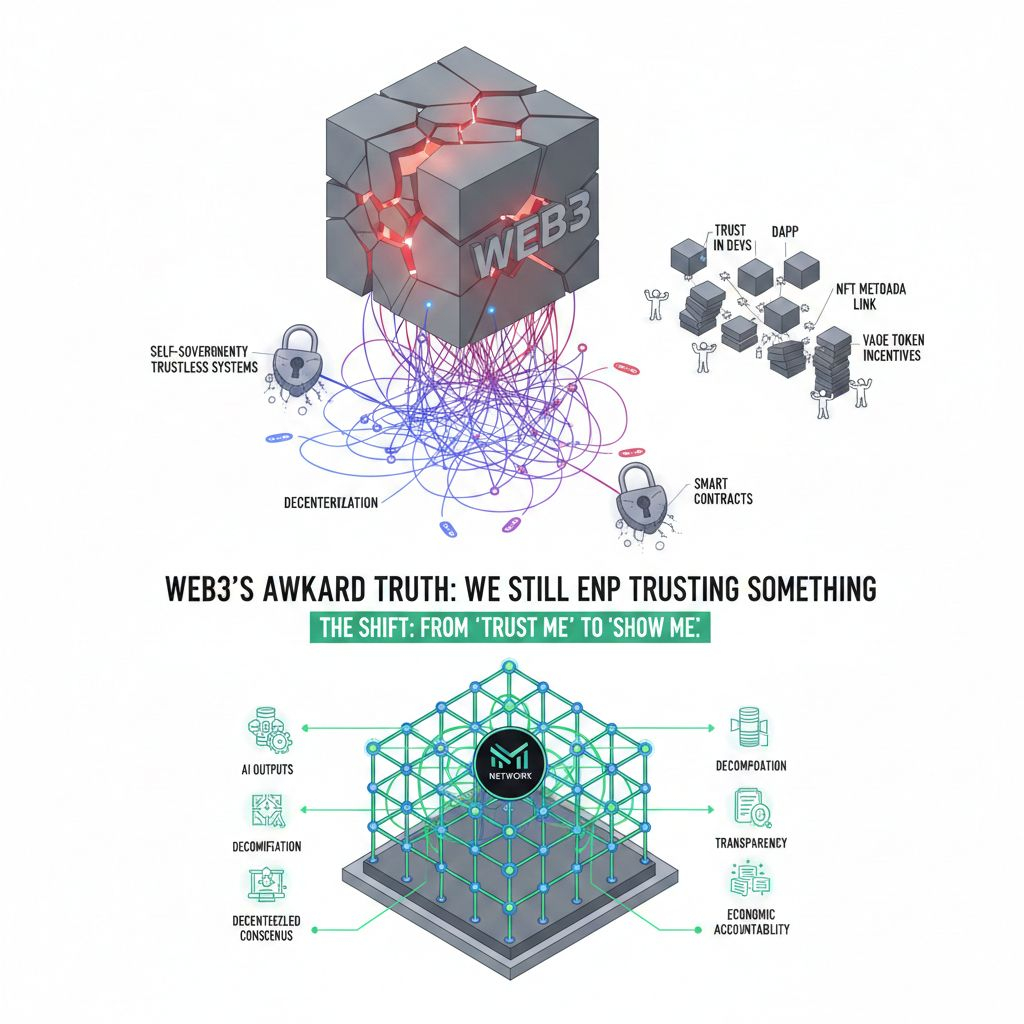
People in Web3 love talking about decentralization. You hear it everywhere—self-sovereignty, trustless systems, ownership of the future. On paper it all sounds amazing.
But if we’re being honest for a minute, the reality feels a lot messier.
A lot of what we call “trustless” still quietly depends on trust. Maybe it’s trust in the developers, trust that a smart contract won’t break, or trust that a DAO’s governance won’t suddenly fall apart when something important needs to be decided.
So the system is technically decentralized… but in practice we’re still hoping everything holds together.
You see it in small ways all the time. An NFT project where the metadata link stops working. A “decentralized” app that suddenly goes offline because one backend server had a problem. When things like that happen, everyone just shrugs and calls it growing pains.
Maybe it is. But sometimes it also feels like we’re building new systems on top of foundations that aren’t fully solved yet.
And when new “solutions” appear, a lot of them feel rushed. Some rely on vague token incentives that don’t really line up with real behavior. Others simply move control from one group to another and call that decentralization.
None of that really fixes the core problem.
That’s why projects focusing on verification instead of hype are starting to get attention.
One example is Mira Network. What caught my attention is that it’s trying to deal with a very practical issue: how to verify AI outputs instead of just trusting them.
Rather than assuming an AI answer is correct, Mira breaks the response into smaller claims and checks them across multiple independent models. If those models don’t agree, the claim doesn’t pass verification. Participants also have economic incentives tied to accuracy, so being wrong has consequences.
It’s not the flashiest idea in the world, but it’s a practical one.
And honestly, that might be what Web3 needs more of right now.
Less hype about the “next revolution,” and more focus on the basic infrastructure that actually makes these systems reliable. Verification, accountability, and transparency may not make for viral marketing posts, but they’re the kind of things that help technology last.
Because if Web3 is going to move beyond speculation and experiments, the systems behind it need to work in ways people can actually rely on.
And that probably starts with building tools that prove things are working—rather than asking everyone to simply trust that they are.
$MIRA @Mira - Trust Layer of AI #MIRA