

I looked at the promise of “autonomous robots” the same way I look at any Silicon Valley fever dream. I looked for the point where the marketing slides would hit the friction of a factory floor and shatter.
Because here is the truth: A robot isn't a computer. If a computer fails, you lose a packet of data. If a robot fails, you lose a limb, a shipment, or a patient’s life. The stakes of AI are high, but the stakes of embodied AI—robotics—are absolute.
We’ve spent a decade treating robots like isolated toys. We buy them as CAPEX, lock them in proprietary silos, and pray the vendor stays in business. It’s a broken model. It’s inefficient, it’s expensive, and it lacks the one thing a global economy requires to scale: verifiable accountability.
This is where Fabric Foundation and the $ROBO token move from "crypto narrative" into "industrial necessity."
The Settlement of Motion
When I strip it down, Fabric isn’t trying to build a "better robot." They are building the infrastructure for the Robot Economy.
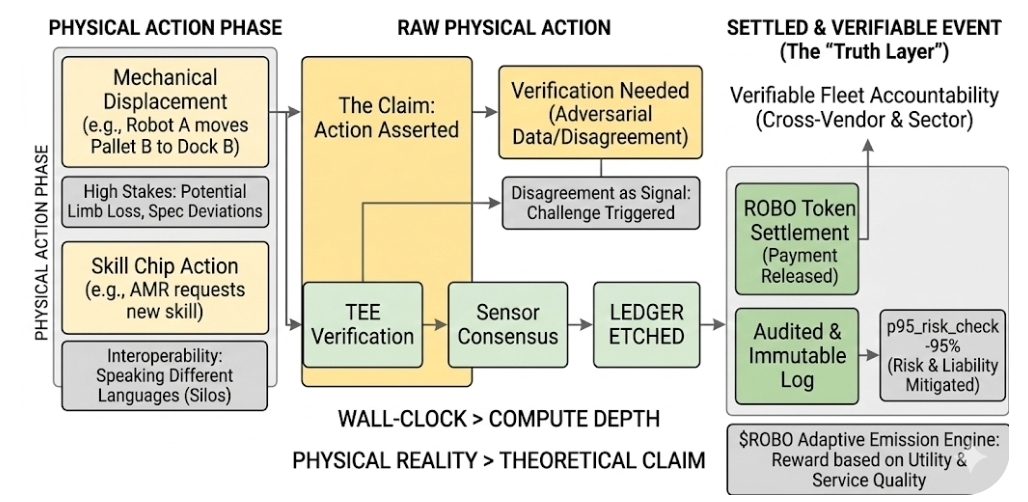
In the current world, if a robot in a Mercedes plant needs to talk to a robot from a different supplier, it can't. They speak different languages, live on different servers, and have no way to trust one another’s intent. Fabric treats a robotic action the same way a blockchain treats a transaction.
It pushes the physical world toward a claim-like structure. * The Claim: "I moved Pallet A to Dock B at 14:00."
The Verification: Sensors, TEEs (Trusted Execution Environments), and peer-validators confirm the displacement happened.
The Settlement: The action is etched into a ledger. Payment in ROBO is released.
This isn't just about paying for work; it’s about creating a "Truth Layer" for atoms. It turns a mechanical movement into a settled, audited event.
In the Trenches: Manufacturing & Healthcare
The vision "clicks" when you look at the two sectors where failure is most expensive.
1. Manufacturing: De-siloing the Floor
Today’s factories are accidental museums of incompatible tech. You have a robotic arm from one decade and an AMR (Autonomous Mobile Robot) from another. Fabric introduces Skill Chips—modular software that allows these machines to download capabilities like apps.
But the real shift is economic. Through the ROBO token, Fabric enables decentralized fleet coordination. Instead of one massive corporation owning every bolt, the network allows for a "Stake-to-Contribute" model. It turns manufacturing from a heavy, static asset into a liquid, verifiable service. When a robot completes a task on the assembly line, the $ROBO settlement proves the work was done to spec, preventing the "drift" between what was ordered and what was actually built.
2. Healthcare: The Zero-Trust Clinic
Healthcare is a high-adversity environment. You have strict compliance (GMP, Annex 1), sterile requirements, and a chronic labor shortage.
In a Fabric-powered hospital, a service robot isn't just "wandering the halls." It’s an economic actor with a cryptographic identity. When it delivers medication or monitors a patient’s vitals, it generates a traceable data log that is essential for digital compliance.
If a robot fails to maintain a sterile boundary, the network knows instantly. The "authority" isn't the robot’s manufacturer—it's the verification layer. By using ROBO to incentivize accurate reporting, Fabric ensures that "Trust me, I disinfected the room" becomes "Here is the cryptographic proof that I did."
Disagreement is the Signal
Most people want a robot that just works. Fabric is built for when they don't.
In a decentralized network, you will have "collisions." One sensor says the arm moved; another says it stayed still. Most systems would crash or hide this. Fabric treats this disagreement as the fragile point. It demands more evidence. It triggers a challenge.
That is closer to how a real foreman or a head nurse works. You don’t trust one report blindly; you look for where the stories diverge. Fabric forces the machine economy to be as disciplined as a human audit trail.
The ROBO Incentive: Physics Meets Finance
The hard part of any "Machine Economy" isn't the physics; it’s the incentives.
If the verification is performed by actors with economic motives, the system is only as strong as its rewards. Fabric uses an Adaptive Emission Engine. It rewards ROBO based on utility and service quality.
If a validator is lazy or a robot produces low-quality work, the rewards dry up.
If the network is under-capacity, incentives increase to attract more hardware.
This isn't just "printing tokens." It’s a feedback loop designed to prevent the system from collapsing into theater. It punishes "fake work" and rewards "meaningful convergence."
The End of the "Trust Me" Era
We are moving toward a world of total autonomy. Autonomy demands accountability. And accountability at scale looks like what Fabric is building: a coordination layer for adversarial participants.
Fabric isn’t selling a shiny new toy. It’s selling discipline for the physical world. If it works, you won't notice it when a robot delivers your package or assists in your surgery. You’ll only notice it when the cost of being wrong stops being theoretical—and the system demands a truth that can survive the collision of reality.
That is the Robot Economy. And it settles in